Viz

Vizsla

Quick Facts

🐕 Breed Group
Sporting Group
📏 Size Category
Medium
📏 Height
Males: 22-24 inches, Females: 21-23 inches
⚖️ Weight
Males: 55-60 pounds, Females: 44-55 pounds
⏱️ Life Expectancy
12-14 years
🧣 Coat Type
Short, smooth, dense
🎨 Coat Colors
Golden rust
😀 Temperament
Affectionate, energetic, loyal, sensitive
🏃 Exercise Needs
High
🎓 Training Difficulty
Easy
👶 Good with Children
Yes
🐾 Good with Other Pets
Good with dogs; manage prey drive with small animals

Other Names & Breed Recognition

Viz is the affectionate shorthand that devoted Vizsla owners have used for generations, a nickname born from the same warmth and familiarity that the breed itself inspires. The name is simple and direct, perfectly suited to a dog that is itself uncomplicated in its affections. Among hunters, field trialers, and companion owners across North America and Europe, "the Viz" is understood immediately - a shorthand carrying a whole world of association: rust-golden coats, amber eyes, and a dog pressed against your leg at the end of a long day afield.

The full name, Vizsla, is Hungarian in origin and generally understood to mean "pointer" or "searcher," reflecting the breed's ancient role as a hunting dog of the Magyar nobility. When Hungarian emigrants brought their beloved breed to other countries in the mid-twentieth century, the name came with them, but shortened forms followed naturally as the breed settled into new cultures. Viz emerged as the most enduring of these, widely used in casual conversation, on breed forums, in hunting camps, and in households where the dog is simply too beloved to be addressed formally every time.

Other alternate names exist for the Vizsla, though none have achieved the recognition of Viz. The breed is sometimes called the Hungarian Vizsla to distinguish it from the Wirehaired Vizsla, a related but separately recognized breed. Hungarian Pointer appears in some European contexts. In the show ring and on field trial entry forms, the full name Vizsla is always used, but outside those formal contexts the nickname is everywhere.

The Vizsla is recognized by every major kennel club under its full name. The American Kennel Club placed the breed in its Sporting Group in 1960. The United Kennel Club, the Canadian Kennel Club, and the Federation Cynologique Internationale all recognize the breed as Vizsla, with the FCI classifying it under Group 7 as a continental pointing dog. The Kennel Club in the United Kingdom recognizes the Vizsla in its Gundog Group. None of these organizations use Viz in official documentation, but the informal name is widely understood by breed enthusiasts affiliated with all of them.

Viz Organizations & Standards

The Vizsla is represented in the United States primarily through the Vizsla Club of America, the AKC parent club for the breed, which has been active since 1954 and played a central role in achieving formal AKC recognition in 1960. The VCA sets the breed standard against which all American Vizslas are evaluated, oversees health initiatives, and sanctions field trials and hunt tests where working ability is formally assessed. Membership connects owners and breeders to a community that takes seriously both the conformation and field qualities of the Viz. The club has always insisted that the breed remain a dual dog, capable of winning in the show ring and functioning in the field on the same weekend.

The breed standard describes a medium-sized, short-coated pointing dog of distinguished appearance and athletic build. The coat is solid golden rust, with the standard permitting small white markings on the chest and feet while penalizing extensive white or color that departs from the characteristic golden rust. The head is lean and muscular, the muzzle tapering cleanly to a moderately wide nose. Eyes are medium in size and should harmonize with the coat in color, producing the characteristic amber-eyed expression that owners describe as intelligent and searching. Ears are thin and silky, hanging close to the cheeks. The tail is traditionally docked in countries where the practice is permitted; where docking is prohibited the natural tail is accepted by the standard.

The Kennel Club in the United Kingdom places the Vizsla in its Gundog Group and maintains a breed standard broadly consistent with the AKC version, with minor differences in terminology. The FCI standard, maintained by Hungary as the breed's country of origin, is considered the foundational document for the breed worldwide. The FCI classifies the Vizsla under Group 7, Section 1.1, Continental Pointing Dogs. Health testing recommendations for the breed include hip evaluation through OFA or a comparable scheme, annual ophthalmologist examination, and thyroid function testing. The Vizsla Club of America's health committee has published guidance on responsible breeding practices intended to maintain the breed's historically robust constitution.

Field trial and hunt test programs offered through AKC, UKC, and regional hunting dog organizations give the Viz regular opportunities to demonstrate working ability in formal competition. The breed is eligible for AKC Master Hunter titles and competes actively in pointing breed field trials. Canine Good Citizen certification and AKC obedience and agility titles are popular pursuits among owners who want structured outlets for the breed's energy and trainability. The range of competitive options available to the Viz reflects its genuine versatility across working and companion roles.

Kennel Club Recognition

  • American Kennel Club (AKC): Recognized in 1960, Sporting Group
  • United Kennel Club (UKC): Recognized, Gun Dog Group
  • Canadian Kennel Club (CKC): Recognized, Sporting Group
  • FCI: Recognized, Group 7 - Pointing Dogs
  • The Kennel Club (UK): Recognized, Gundog Group

Viz Physical Description

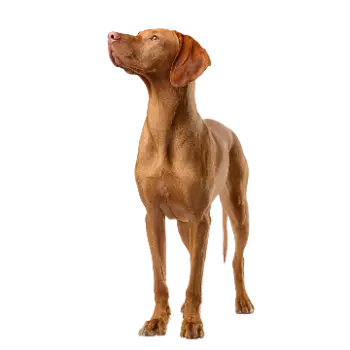
The Viz cuts a striking figure in the field or the living room, a dog whose physical presence immediately communicates both elegance and capability. The overall impression is of a lean, muscular athlete with nothing wasted and nothing missing - every line of the body serves a purpose, and the whole package is wrapped in a coat the color of dried autumn leaves, a warm golden rust that is unlike any other breed's color and instantly recognizable to anyone who has seen one up close.

The head is distinguished and aristocratic without being coarse. The skull is moderately wide, slightly domed between the ears, with a median line running down the center. The stop is moderate - not as pronounced as in some sporting breeds, giving the Viz a clean profile that flows naturally from the top of the skull to the tip of the muzzle. The muzzle is long and square, tapering slightly toward the nose, with the bridge of the nose slightly convex. Nostrils are wide and brown, matching the overall coat color. Lips are tight and close-fitting, giving the face a clean, dry expression. The jaw is strong, meeting in a scissors bite. The overall head conveys intelligence and alertness, an impression fully reinforced by the eyes.

Those eyes are among the breed's most distinctive features. Medium in size and slightly oval, they range from medium amber to a darker brown-gold, always harmonizing with the coat. A Vizsla with dark brown or black eyes is a fault, because the characteristic amber eye is part of what gives the breed its signature expression - alert, questioning, deeply warm. The ears are proportionally large, thin, silky, and set just below the level of the top of the skull. They hang close to the cheeks with rounded tips and contribute significantly to the gentle, aristocratic expression that distinguishes the Viz from harder-headed sporting breeds.

The neck is strong, smooth, and muscular, arching moderately and blending cleanly into well-laid-back shoulders. The topline is level and firm. The chest is moderately broad and deep, with well-sprung ribs that allow for good lung capacity without barrel-chested bulk. The loin is short, well-muscled, and slightly tucked. The croup falls gently. The tail, whether docked or natural, should be carried level or slightly elevated during movement, never curled over the back or carried low between the legs.

The legs are straight and strong, with good bone that is substantial without being heavy. Feet are cat-footed and compact, with thick pads suited for work over varied terrain. The hindquarters are well-muscled with broad thighs and moderate angulation, providing the drive that fuels the breed's characteristic ground-covering trot. Movement is light-footed, effortless, and far-reaching - the Viz moves as if it costs nothing, covering ground with a fluidity that reflects centuries of selection for all-day field endurance.

The coat is perhaps the breed's most admired feature. It is short, dense, and smooth, lying flat against the body with a natural sheen. There is no undercoat, which means the Viz does not shed heavily by sporting breed standards and the coat requires minimal grooming to stay presentable. The color is always some shade of golden rust, ranging from a lighter golden yellow to a rich, deep rust. White markings are permitted only on the chest as a small spot and on the toes; any other white is a fault in the show ring. The nose, eye rims, and nails should blend with the coat color rather than being black, which is one of the hallmarks that distinguishes the Viz from other pointing breeds at a glance.

Affectionate With Family
The Viz bonds with total commitment to its family and wants physical closeness at all times. Expect a dog that will follow you from room to room and consider your lap its rightful territory.
Good With Young Children
The Viz is playful and tolerant with children and has the energy to match even the most active kids. Supervision around toddlers is wise given the breed's enthusiasm.
Good With Other Dogs
The Viz is generally sociable with other dogs, particularly those with similar energy levels. Early socialization produces the most reliably friendly adults.
Shedding Level
The Viz sheds consistently throughout the year, though the short coat means individual hairs are less noticeable than those of longer-coated breeds. Weekly brushing keeps it manageable.
Coat Grooming Frequency
The short, smooth coat needs only weekly brushing and occasional bathing. This is one of the easier sporting breeds to keep clean and presentable.
Drooling Level
The Viz has tight, dry lips and produces minimal drool under normal circumstances. This is not a breed that leaves wet spots on furniture or clothing.
Coat Type
The coat is short, dense, and smooth with no undercoat, lying flat against the body with a natural sheen. It is functional for field work across moderate climates.
Openness To Strangers
The Viz tends to be reserved with people it does not know, warming up once it has assessed a stranger as safe. Early socialization reduces excessive wariness.
Playfulness Level
The Viz retains a playful, puppyish quality well into adulthood and actively invites play with family members. Games and interactive activity are central to the breed's daily happiness.
Watchdog/Protective Nature
The Viz is alert and attentive to its environment and will reliably announce strangers. The breed's devotion to family underpins a strong protective instinct.
Adaptability Level
The Viz can adapt to various living situations provided its exercise needs are consistently met. The exercise requirement is the non-negotiable variable; the square footage is secondary.
Trainability Level
The Viz is among the most naturally trainable sporting breeds, combining genuine desire to please with quick uptake of new concepts. Positive reinforcement methods work exceptionally well.

Viz History & Development

The nickname Viz belongs to a breed with one of the oldest and most dramatic histories in the sporting dog world. The Vizsla's ancestors hunted alongside the Magyar tribes who swept into the Carpathian Basin around 895 AD, and images resembling the breed appear in stone etchings and illuminated manuscripts dating back nearly a thousand years. These dogs were bred by Hungarian nobility who understood that a versatile hunting companion - one that could point, retrieve, and work at close range across varied terrain - was worth more than any narrow specialist. The Vizsla that emerged from centuries of careful noble breeding was refined to a very specific purpose and a very specific appearance, and the breed has changed remarkably little in its essential character since those early medieval centuries.

The name Vizsla, meaning pointer or searcher in Hungarian, was the dog's formal designation throughout the centuries of its development. The nickname Viz emerged not from any formal process but from the organic shortening that happens when a breed becomes beloved enough that formality feels unnecessary. Hunters who call for their dog a hundred times a day in the field don't say "Vizsla" every time - they say "Viz," and the abbreviation carries all the affection and working partnership that the full name implies. This casual shortening appears consistently in breed club communications, online forums, and hunting camp conversation throughout the twentieth and twenty-first centuries, marking the word as something that genuinely belongs to the community of people who live and work with the breed every day.

The post-war history of the Viz is itself remarkable and directly shapes how the nickname spread so widely. The breed had been nearly destroyed by two world wars, Soviet occupation, and the disruption of the noble estates where it had long been maintained. Hungarian breeders working under genuinely difficult conditions preserved what they could. When Hungary opened to the wider world, the Viz survived through the dedication of committed breeders who simply refused to let it disappear. In the United States, the first Vizslas arrived in the early 1950s, brought by Hungarian immigrants who could not imagine leaving their dogs behind. The Vizsla Club of America formed in 1954, and AKC recognition followed in 1960. The nickname traveled with the dogs, embedded in the informal language of the immigrant community that carried the breed into American life.

The name Viz took on additional meaning in North America because it bound together a community of immigrants and enthusiasts building something new from a very old foundation. Breed clubs used it informally in newsletters and correspondence. Field trialers recorded their dogs as Vizs in competition diaries. The word became a marker of insider knowledge and shared affection. Today the Viz ranks consistently in the AKC's top forty breeds by registration, and its popularity continues to grow as more hunters and active families discover what Hungarian nobles understood centuries ago: this is a dog of exceptional ability and equally exceptional companionship.

Viz Temperament & Personality

The Viz is what happens when a dog is bred for a thousand years to work in close partnership with a single person - the result is an animal so thoroughly oriented toward human connection that "velcro dog" has become the breed's unofficial second nickname. This is not a dog that is content to be in the same house as its person; it wants to be in the same room, on the same furniture, pressed against the same leg. Vizsla owners learn quickly that privacy is a concept their dog finds baffling. The Viz does not understand why any door should ever be closed, and will communicate this confusion with patience and persistence until the situation is corrected.

This intensity of connection is one of the breed's greatest qualities and one of its greatest challenges simultaneously. The Viz bonds completely and gives its full emotional investment to its family. The flip side is that separation is genuinely difficult for this breed. A Viz left alone for long hours without preparation and training is likely to develop separation anxiety, express it destructively, and be miserable in the process. Potential owners who work long hours away from home and cannot arrange for dog company during the day need to think carefully about whether the Viz is the right fit for their circumstances. This is not a criticism of the breed - it is a description of what unconditional attachment actually means in practice.

With family, the Viz is warm, playful, and almost comedically affectionate. The breed is known for what owners call "Vizsla hugs" - the dog's tendency to press its entire body against a person's legs or climb into a lap regardless of its size. This physical affectiveness is paired with a lively, curious intelligence that makes the Viz an entertaining household companion. They notice everything, learn quickly, and have a well-developed sense of humor about the world. The breed tends to be sensitive to household moods and will often position itself as emotional support for a family member who is having a difficult day, with no instruction required.

With children, the Viz is generally excellent when raised with them and properly introduced. The breed's energy level is high enough to keep up with active children, and its tolerance for the unpredictable behavior of young people is good. As with all breeds, supervision around very young children is wise, not because the Viz is aggressive but because its enthusiasm can overwhelm a toddler. With other dogs, the Viz is typically friendly, particularly with breeds of similar energy. With cats and small animals, early socialization helps but instinct is present - this is a hunting dog with a strong prey drive, and that needs to be respected and managed thoughtfully.

The Viz is not a dog that tolerates harsh handling. Sensitive by nature and deeply attuned to the emotional state of the people around it, the breed responds poorly to punishment-based training and can shut down or become anxious if corrections are frequent or sharp. The best Viz owners understand that the breed's sensitivity is not weakness - it is a feature of what makes the dog so responsive and so deeply connected. That same sensitivity, properly channeled, produces a dog that reads its person's signals with extraordinary accuracy and genuinely tries to do the right thing.

Viz Family Life & Living Requirements

The Viz is not a dog for sedentary households, and potential owners who are honest with themselves about their activity levels will find either that this breed is a perfect match or an obvious mismatch. There is no ambiguity. The Viz requires significant daily exercise - most experienced owners and breeders recommend a minimum of one to two hours of genuine physical activity per day, not a leisurely stroll but actual running, hiking, swimming, or field work. A Viz that does not get adequate exercise will find its own outlets for energy, and those outlets will not involve any activity the owner considers acceptable.

Inside the home, a well-exercised Viz is a remarkably calm and adaptable companion. The breed can live comfortably in a house or a large apartment provided its exercise needs are genuinely met. A Viz in an apartment that gets a thirty-minute walk and is otherwise confined will be a problem. A Viz in an apartment whose owner runs it hard for ninety minutes morning and evening will often be calmer than a sporting breed in a house with a yard but minimal engagement. The exercise is the variable that matters most, not the square footage.

The Viz does best with access to a securely fenced outdoor space where it can run freely. The breed has a strong prey drive and will pursue anything that moves, so an unfenced yard is an invitation for the dog to follow a squirrel into traffic. The fence should be solid and tall - the Viz is an athletic animal quite capable of clearing modest barriers when motivated. Underground invisible fences are generally not recommended for this breed, which can push through a correction in pursuit of something interesting.

Apartment and urban living is possible with the Viz, but it requires genuine commitment to the exercise program described above. Dog sports are an excellent supplement to physical exercise for this breed. Agility, nose work, hunt tests, obedience, and dock diving are all pursuits where the Viz excels and through which the breed's need for mental and physical stimulation can be well met. The Viz that has a job - whether that job is hunting, competing in dog sports, or simply accompanying an active owner on daily runs - is a happier, calmer, and better-behaved dog than one that is simply housed and fed.

Viz Training & Exercise Needs

The Viz is one of the most naturally trainable breeds in the sporting group, and experienced trainers often describe working with one as a pleasure. The breed wants to please, picks up new concepts quickly, and has the intelligence to generalize learned behaviors across different contexts. This combination of desire and aptitude means that a well-trained Viz is a remarkably capable animal - the breed competes successfully in obedience, agility, hunt tests, tracking, and therapy work, often with owners who are not professional trainers. The learning curve for the dog is rarely the limiting factor.

The training approach matters enormously with this breed. The Viz is sensitive and responds to positive reinforcement with exceptional enthusiasm, making reward-based training both effective and enjoyable. Harsh corrections or heavy-handed methods produce anxiety and avoidance in a breed that is hardwired to seek approval. The best training philosophy for the Viz involves clear communication, consistent expectations, and generous reinforcement of correct behavior. Punishment should be rare and mild; a verbal correction delivered with the right tone is usually sufficient for a dog that is as attuned to human emotional signals as the Viz.

Early socialization is essential. The Viz that is exposed broadly to different people, environments, sounds, and situations during the first few months of life develops into a confident, adaptable adult. The breed can be somewhat reserved with strangers, and without good early socialization this reserve can become excessive timidity or defensive behavior. Well-socialized Vizs are typically friendly and curious with new people, not indiscriminately so but appropriately confident.

Exercise and training are deeply interconnected for this breed. A Viz that has not had sufficient physical exercise before a training session is likely to struggle with focus and impulse control. Owners who schedule training after a good run or field session will find the dog more receptive and more successful. The breed's physical exercise needs and mental engagement needs both need to be addressed, and doing both together - as in hunt test training or agility practice - is more efficient and effective than treating them separately. The Viz that has enough physical and mental challenge in its daily life is easy to live with; the one that doesn't is not.

Viz Health Concerns

The Viz is generally a healthy breed with a robust constitution, but like all purebred dogs it carries predispositions to certain conditions that owners and breeders monitor carefully. Hip dysplasia is the most commonly screened-for orthopedic condition, and responsible breeders evaluate breeding stock through OFA certification or a comparable hip evaluation scheme before producing a litter. The breed's athleticism and demanding activity level make joint health a legitimate long-term consideration, particularly as dogs age into their senior years and the cumulative effects of field work or sport activity begin to be felt.

The Viz benefits from a veterinary relationship that includes proactive screening rather than waiting for symptoms to appear. Establishing a baseline of hip scores, thyroid levels, and eye examination results in the first two years of life gives owners and veterinarians a reference point from which to monitor changes over time. A good quality diet, weight management throughout life to protect joints, regular dental care, and annual wellness examinations are the foundation of keeping a Viz healthy into its senior years. The breed's typical lifespan of twelve to fourteen years reflects its generally sound constitution, and many Vizs remain active and vigorous well into their later years with attentive, proactive care.

Common Health Issues

Preventive Care & Health Monitoring

  • OFA hip evaluation of breeding stock - OFA hip evaluation of breeding stock
  • Annual ophthalmologist examination - Annual ophthalmologist examination
  • Annual thyroid testing - Annual thyroid testing
  • Regular dental care - Regular dental care
  • Weight management throughout life - Weight management throughout life
  • Annual wellness veterinary examinations - Annual wellness veterinary examinations

Viz Grooming & Maintenance

The Viz is one of the lower-maintenance breeds from a grooming standpoint, a fact that comes as a welcome surprise to new owners who might expect more from an active sporting dog. The short, dense, smooth coat requires very little formal grooming to stay clean and presentable. A weekly once-over with a rubber curry comb or a soft-bristled brush removes loose hair and distributes skin oils, keeping the coat shiny without any product. The Viz does shed, but the short hairs are considerably less obtrusive than the longer shedding of many other breeds, and regular brushing keeps it manageable throughout the year.

Bathing is needed only occasionally - typically when the dog has rolled in something memorable or accumulated field grime that brushing alone cannot address. The Viz is naturally quite clean, and many owners bathe their dogs only a few times per year under normal circumstances. When bathing is needed, a mild dog shampoo and thorough rinsing are all that is required. The short coat dries quickly, which is a practical advantage for a breed that frequently seeks out water in the field and at home.

Ears require regular attention, particularly in dogs that swim. The drop ears of the Viz can trap moisture and debris, and without periodic cleaning this creates conditions favorable to infection. Weekly ear checks with a cotton ball and a veterinarian-recommended cleaning solution are sufficient for most dogs. Any redness, unusual odor, or persistent head shaking warrants a veterinary visit rather than continued home treatment.

Nails should be trimmed every three to four weeks in dogs that do not naturally wear them down through activity on hard surfaces. Long nails affect gait and can cause discomfort, so keeping them short is not merely cosmetic. Dental hygiene is important for the Viz as for any breed - regular tooth brushing or a consistent program of dental chews helps prevent periodontal disease, which is the most common preventable health condition in dogs overall. With its minimal coat care demands and generally clean habits, the Viz is genuinely one of the easier sporting breeds to keep looking and feeling its best.