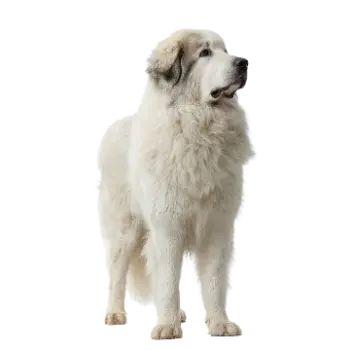
The South Russian Sheepdog's appearance is defined by contrast. Beneath a long, shaggy, soft-looking white coat lies a lean, powerful, massively boned frame built for speed, endurance, and physical confrontation with large predators. First-time observers often mistake the breed for an oversized, friendly sheepdog. This is a dangerous misunderstanding. The coat conceals an athlete and a guardian, and the gentle appearance is entirely unrelated to the dog's temperament.
Males stand a minimum of 26 inches at the withers, with many individuals reaching 28 inches or taller. Weight ranges broadly from about 100 to 150 pounds or more, though the breed standard emphasizes lean musculature over bulk. Females are approximately two inches shorter and somewhat lighter but maintain the same massive bone structure and well-developed muscle mass that the standard demands. The overall silhouette is slightly longer than tall, with a straight, strong back and a deep, broad chest that provides substantial lung capacity for sustained physical effort. The breed's proportions convey both power and endurance, reflecting its dual heritage as a guardian that could also cover enormous distances alongside migrating flocks.
The head is elongated and wedge-shaped, similar in basic proportions to the wolf, with a moderately broad forehead and strongly pronounced occipital crest and zygomatic arches. The stop is barely visible, creating a continuous line from forehead to the tip of the large, black nose. The muzzle is approximately equal in length to the skull. The jaws are strong and carry a complete set of large, white teeth meeting in a scissors bite. The eyes are dark, oval, and set horizontally, typically hidden or partially obscured by the long hair that falls across the face. This curtain of hair served a practical function on the steppe, shielding the eyes from wind-driven grit and snow glare. The ears are small, triangular, and pendant, lying close to the head and nearly invisible beneath the coat.
The neck is moderately long, muscular, and set high, carrying the head with an alert, watchful bearing. The chest is deep and broad, with well-sprung ribs providing ample room for heart and lungs. The loin is short and slightly arched, leading into a moderately sloping croup. The overall body structure combines the skeletal mass of a guardian breed with the ranginess of a dog that was historically required to chase and physically engage wolves.
The breed's defining physical feature is its coat. Long, coarse, thick, and dense, it reaches lengths of up to six inches and covers the entire body with equal length on the head, legs, chest, and tail. A well-developed undercoat provides insulation against both the freezing winters and hot summers of the steppe. The coat texture is slightly wavy or crimped, never corded or tightly curled. Accepted colors are white, white with yellow or straw-colored tones, ashen grey, and various shades of grey mixed with white. The predominantly light coloring served a practical purpose in the breed's working environment, allowing shepherds to distinguish their dogs from the wolves they were meant to repel.
The legs are long, straight, and heavy-boned, providing the agility and ground-covering stride that reflects the sighthound ancestry in the breed's background. The feet are oval, large, and well-arched with thick pads designed for the rugged terrain of the steppe. Movement at the trot is heavy but free and extended, and the gallop reveals the surprising speed that allowed these dogs to run down predators on the open steppe. The tail is long, reaching at least to the hock, carried low in repose and raised no higher than the level of the back when the dog is active. When the South Russian Sheepdog is in full coat and moving at speed, the overall impression is of a large, white, surprisingly swift animal that combines the mass of a guardian with the athleticism of a coursing dog.
Affectionate With Family
★★★☆☆
Loyal and bonded to its household but expresses devotion through vigilance and proximity rather than overt physical affection. This is a reserved, dignified guardian, not a lap dog.
Good With Young Children
★★☆☆☆
Protective of children within its own family but its size, independence, and distrust of strangers make supervision essential. Visiting children require very careful introduction.
Good With Other Dogs
★☆☆☆☆
Territorial and dominant with other dogs, particularly unfamiliar ones. Same-sex aggression is a strong tendency. Not a breed for dog parks or casual off-leash interactions.
Shedding Level
★★★★☆
The long, dense double coat sheds substantially year-round with heavy seasonal blowouts. Large volumes of coarse white hair accumulate quickly in the home.
Coat Grooming Frequency
★★★★★
The profuse, tangle-prone coat demands thorough brushing multiple times per week, with daily sessions needed during heavy shedding periods. Each grooming session on a full-coated adult is time-intensive.
Drooling Level
★★☆☆☆
Not a heavy drooler overall, though some moisture around the lower jaw is common due to the lip folds. Lip-fold pyoderma from trapped moisture is a breed-specific concern.
Coat Type
★★★★★
Long, coarse, thick double coat covering the entire body including head, legs, and tail. The slightly wavy texture with dense undercoat provides all-weather protection.
Openness To Strangers
★☆☆☆☆
The breed standard describes the correct temperament as fierce and distrustful of strangers. This is not a sociable breed, and tolerance of unfamiliar people requires extensive early socialization.
Playfulness Level
★★☆☆☆
Work-oriented rather than play-oriented. The South Russian Sheepdog may engage in brief interactive activity but is fundamentally a serious, purposeful dog that does not prioritize recreation.
Watchdog/Protective Nature
★★★★★
Guarding is this breed's core identity. The South Russian Sheepdog was bred to confront wolves and bears on the steppe and defends its territory with absolute commitment.
Adaptability Level
★☆☆☆☆
Requires large, securely fenced property and an experienced owner. Entirely unsuitable for apartments, small homes, or households without significant outdoor space for the dog to patrol.
Trainability Level
★★☆☆☆
Highly intelligent but profoundly independent. Compliance is conditional on the dog's respect for the handler and its own assessment of the situation. Requires experienced, patient, consistent training.