Smooth Fox Terrier

Smooth Fox Terrier

Quick Facts

🐕 Breed Group
Terrier Group
📏 Size Category
Small
📏 Height
Males: Up to 15.5 inches, Females: Slightly less than male
⚖️ Weight
Males: 17-19 pounds, Females: 15-17 pounds
⏱️ Life Expectancy
12-15 years
🧣 Coat Type
Short, dense, smooth double coat
🎨 Coat Colors
Predominantly white with black, tan, or black and tan markings
😀 Temperament
Bold, Alert, Friendly, Energetic, Independent, Playful
🏃 Exercise Needs
High
🎓 Training Difficulty
Moderate
👶 Good with Children
Good with older children
🐾 Good with Other Pets
Requires careful introduction

Other Names & Breed Recognition

The Smooth Fox Terrier has been known by its current name since approximately the 1860s, when the designation became standardized among British sporting circles. Before that, both the smooth-coated and wire-coated varieties hunting foxes in England were simply called English Terriers or Fox Terriers without a distinction between coat types. The smooth coat is now understood to be the older variety, with written and artistic records predating the wire coat's documented appearance by at least a century.

For most of its breed history, the Smooth Fox Terrier and the Wire Fox Terrier were considered a single breed with two coat varieties. Both competed in the same show classes, were registered under the same breed name, and were sometimes deliberately crossed to combine traits breeders valued in each. The AKC recognized what was simply called the Fox Terrier in 1885. It was not until 1984 that the AKC formally separated the two into distinct breeds, a decision that recognized the long-standing differences in their appearance, coat genetics, and increasingly divergent type. The Kennel Club in the UK, the governing organization that oversees the conformation standard, made a similar distinction recognizing them as separate breeds.

The Smooth Fox Terrier is sometimes called the Smoothie by its fans, which is an affectionate shorthand widely used in breed circles. This nickname distinguishes it from the Wire Fox Terrier in conversation without the full formal name, though both varieties remain simply "Fox Terriers" to the general public who often cannot reliably distinguish them.

In continental Europe, FCI recognition places the Smooth Fox Terrier in Group 3, Section 1, alongside other smooth-coated terriers. The FCI standard describes the same dog as the AKC and Kennel Club standards, emphasizing compactness, substance, and the specific proportions that characterize the breed. The breed maintains recognition across virtually all major international registries, which is consistent with its long history as a recognized show breed and its international presence through the British show circuit during the nineteenth century when British dog breeds spread to shows across Europe, Australia, and the Americas.

Historically, the breed was enormously popular in the United States from the late nineteenth century through the early twentieth century, appearing frequently in advertising, film, and popular media. Its numbers declined as urban living became more common and the terrier's particular demands became less compatible with changing American lifestyles. Today the Smooth Fox Terrier is maintained by a dedicated community of breed enthusiasts and is one of the longer-established AKC breeds, with a continuous show and working history stretching back to the earliest days of organized dog sport.

Smooth Fox Terrier Organizations & Standards

The Smooth Fox Terrier Association (SFTA) serves as the primary breed club in the United Kingdom and has been involved in maintaining the breed standard and promoting the Smooth Fox Terrier since the late nineteenth century. In the United States, the American Fox Terrier Club (AFTC), founded in 1885, is one of the oldest breed clubs in the country and maintains oversight of the breed standard, health education, and organized competition for both Smooth and Wire Fox Terriers under American Kennel Club auspices.

The AKC breed standard for the Smooth Fox Terrier emphasizes several specific requirements that define the type. The dog should not exceed 15.5 inches at the withers for males, with weight typically falling between 17 and 19 pounds. The standard calls for a body that is compact, balanced, and shows no excess length in the back. The specific ratio of foreface to skull is prescribed: the head should present a clean, slightly wedge-shaped appearance when viewed from the side, with the top of the skull flat rather than domed. Substance is called for, meaning the dog should have good bone and muscle for its size without being coarse.

The coat standard is very specific: the coat must be short, dense, and predominantly white. White coloring was deliberately selected in the breed's early development because it allowed hunters on horseback to distinguish their Fox Terriers from foxes in the field. A dog that was difficult to differentiate from its quarry at speed could be accidentally struck by a horse or attacked by hunting hounds. The predominantly white coat is therefore a functional characteristic that became a breed standard requirement, not a cosmetic preference.

An important aspect of the breed standard addresses the specific proportions that maintain the Fox Terrier as a functional terrier type rather than allowing drift toward extreme show exaggeration. The dog must be able to fit into a fox's earth, which historically constrained the allowable size. This functional requirement kept the breed honest about size in ways that many show breeds lack, since a dog that could not fit into a fox hole was useless for its intended purpose regardless of its appearance.

The American Fox Terrier Club maintains health resources and educational materials for owners, and the breed participates in the AKC's Canine Health Information Center program. Responsible breeders within the AFTC community are expected to conduct health testing appropriate to the documented conditions in the breed before making breeding decisions, which includes evaluations for the specific hereditary conditions known to affect Smooth Fox Terriers.

The CHIC program for Smooth Fox Terriers currently recognizes the importance of DNA testing for Primary Lens Luxation and eye evaluation through a board-certified veterinary ophthalmologist. These are the specific health clearances a buyer should request documentation for when evaluating a litter. The breed standard itself, unchanged in its essential character since the late nineteenth century, reflects a dog shaped by a specific working function and maintained with that function in mind even as the breed moved into the show ring and companion role.

Kennel Club Recognition

  • American Kennel Club (AKC): Recognized in 1885, Terrier Group
  • United Kennel Club (UKC): Recognized, Terrier Group
  • Canadian Kennel Club (CKC): Recognized, Terriers
  • FCI: Recognized, Group 3
  • The Kennel Club (UK): Recognized, Terrier Group

Smooth Fox Terrier Physical Description

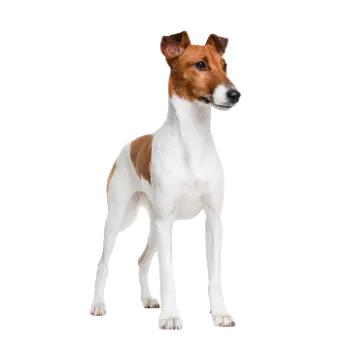
The Smooth Fox Terrier is a small, compact, and visibly athletic dog that carries more substance than its size might suggest at first glance. The correct impression is of a dog that is tightly built and alert, not fragile or toy-like. Standing it up and looking at it, you see a terrier with real muscle and bone, short backed and square in the body, with a carriage that communicates confidence and readiness. This is not a gentle lap dog trapped in a small package; it is a working dog scaled down to tunnel into fox dens.

The head is distinctive and a key feature of the type. The skull is flat, moderately narrow, and slightly wedge-shaped when viewed from above. The stop is moderate rather than abrupt. The foreface is long relative to the skull, with a strong jaw that carries scissors bite and nostrils that are wide open. The nose is black. When viewed from the side, the top of the skull and the top of the foreface should appear nearly parallel, giving the head a characteristic clean, long look that is different from the broader, more domed head of many small breeds.

Eyes are dark, small, and round with a lively, alert expression that is one of the most immediately recognizable characteristics of the Smooth Fox Terrier. The gaze is sharp and full of attention, missing very little in the environment. The eye should be as dark as possible; light eyes are considered a fault and can dilute the breed's characteristic bold expression. The eyelids are tight and clean.

Ears are small, V-shaped, and fold forward and downward close to the head in what is called a "button" ear - the tip of the ear folds over to cover the opening of the ear canal, pointing toward the outer corner of the eye. This ear set gives the Smooth Fox Terrier a particularly alert and animated expression. Ears that fly out to the sides, hang down like a hound's ear, or prick upright are all considered faults.

The neck is clean, muscular, and of moderate length, with a slight arch that flows smoothly into the shoulders. Shoulders are well laid back. The body is compact, with a short, level back and a loin that is short and powerful. The chest is moderately deep rather than barrel-like, and the ribs are well-sprung without becoming round. The underline shows a slight tuck-up at the loin.

The tail is traditionally docked to three-quarters of its natural length in countries where docking is still permitted. In European countries where docking is restricted or prohibited, the natural tail is carried gaily above the level of the back, and correctly carried, it complements the dog's animated, upright posture. The tail should not curl over the back or be flagged to one side.

Forequarters are straight, with good bone and upright pasterns. The feet are small, round, and compact with arched toes and thick, durable pads - the terrier foot designed for digging and hard use. Hindquarters are well-angulated, with strong thighs and well-let-down hocks, providing good driving power. Movement at the trot is ground-covering for the dog's size, with a level topline and good reach and drive.

The coat is the breed's defining visual characteristic: short, flat, dense, and with a hard texture that resists mud and debris effectively. It lies close to the body without gaps and should feel hard to the touch rather than soft. A silky or wavy coat is a fault. The coat is predominantly white with black, tan, or black-and-tan markings. Brindle, liver, or red markings are considered objectionable. The white is a hard requirement of the standard, reflecting the functional origin of the coat color for hunting identification.

The Smooth Fox Terrier is noticeably more refined in head and body than many terrier breeds, with an elegance of line that comes from the Greyhound and Beagle blood that is believed to have contributed to the type early in its development. This refinement is not weakness - the correct dog has substantial bone and muscle for its size - but it gives the breed a cleaner, more streamlined appearance than heavier-set terriers like the Bull Terrier or Staffordshire. The overall package is one of quality, balance, and readiness, a dog that looks capable of quick movement in any direction at a moment's notice, which is exactly what it was built to be.

Sexual dimorphism is moderate. Males are slightly larger and stronger in build than females and should weigh toward the upper end of the breed's weight range. Females are finer in bone and lighter in the head but should still present the same athletic solidity, not a toy-like delicacy. A judge or experienced breeder looking at a good female should see the same fundamental terrier character as in the male, simply expressed in a lighter package.

Affectionate With Family
Smooth Fox Terriers are genuinely attached to their people and enjoy physical closeness with those they trust. Their affection is expressed with energy and enthusiasm rather than quiet cuddling.
Good With Young Children
They enjoy active play and can be good companions for older children who match their energy. The breed's independence and intensity can be too much for toddlers, and rough handling brings out the terrier's quick response.
Good With Other Dogs
The Smooth Fox Terrier tends to be dog-selective, particularly with same-sex dogs. Their assertive terrier nature means they rarely back down from a challenge, even when the other dog significantly outweighs them.
Shedding Level
The short dense coat sheds moderately year-round with heavier shedding in seasonal transitions. Weekly brushing keeps it manageable, but white hair on dark upholstery will be noticed.
Coat Grooming Frequency
The smooth, short coat is among the lowest-maintenance in the terrier group. A weekly go-over with a rubber curry comb or bristle brush is all that is required under normal circumstances.
Drooling Level
The Smooth Fox Terrier is completely dry-mouthed. Drooling is not a characteristic of this breed under any normal circumstance.
Coat Type
The short, flat, dense coat is practical and easy to maintain. It sheds mud and debris readily and requires only minimal grooming to stay clean and healthy.
Openness To Strangers
Outgoing and curious by nature, Smooth Fox Terriers are generally not shy with new people. They may be investigative and bold rather than immediately warm, but they are not typically suspicious.
Playfulness Level
Few dogs match the Smooth Fox Terrier's enthusiasm for play. These dogs approach nearly every situation as a potential game and maintain this puppy-like energy for most of their lives.
Watchdog/Protective Nature
Alert and vocal, the Smooth Fox Terrier is an excellent watchdog that misses very little happening in or around its household. Their willingness to announce everything can tip into excessive barking without management.
Adaptability Level
Adaptable to different living situations if their exercise and mental stimulation needs are genuinely met. They can manage apartment life with sufficient daily exercise but are not well-suited to quiet, inactive households.
Trainability Level
Intelligent and capable of learning quickly, but the independent terrier mind means they decide whether your request is worth complying with. Consistent, engaging training works; repetitive drilling does not.

Smooth Fox Terrier History & Development

The Smooth Fox Terrier's origins lie in the English countryside of the seventeenth and eighteenth centuries, when organized fox hunting became one of the defining sporting pursuits of the British landed classes. The mounted fox hunt required two categories of working dog: the hound that pursued the fox by scent across open country, and the terrier that went into the earth when the fox went to ground, bolting it out so the hunt could continue or dispatching it underground if necessary. The terrier's role was the dangerous one - going into a confined space to confront a cornered animal that would fight back.

The dogs that were developed for this earth work needed a specific combination of qualities: small enough to fit into a fox's burrow, courageous enough to face a defending fox at close quarters, loud enough to bark underground so the hunters could hear where the fox had gone, and sturdy enough to take rough handling. The Smooth Fox Terrier that emerged from this selection process carries all of these traits - even in dogs that have never seen a fox or an earth.

The exact ancestry of the Smooth Fox Terrier is somewhat disputed, as with many old British breeds. Beagles, old English terriers, Greyhounds for speed and refinement, and Bull Terrier crosses for courage and gameness have all been proposed as contributors at various points in the breed's development. The result of these crossings, refined over generations, produced a dog that was white-bodied (to distinguish it from the fox in the field), short-backed, strong-jawed, and game without being uncontrollable.

The breed was already well established as a recognized type by the time formal dog shows emerged in Britain in the 1860s. The Fox Terrier quickly became a darling of the Victorian show ring, one of the most popular and most exhibited breeds at early Kennel Club shows. The American Kennel Club recognized the Fox Terrier in 1885, one of its earliest recognized breeds and a reflection of how thoroughly British dog culture had transferred to the United States by the late nineteenth century.

The breed's popularity peaked in the early twentieth century and then declined steadily as fox hunting became less culturally central in Britain and as urban living made maintaining high-energy terriers more challenging. The 1984 AKC decision to split Smooth and Wire Fox Terriers into separate breeds gave each variety its own show class structure, which satisfied breeders but did not reverse the overall trend of declining registration numbers. Today, the Smooth Fox Terrier is maintained by a committed enthusiast community that values the breed's history, working character, and distinctive personality above popularity. The breed's AKC registration numbers are modest, placing it in the category of breeds that are well-established but uncommon outside dedicated breed circles.

The Smooth Fox Terrier's place in popular culture during its peak years was considerable. The breed appeared in advertising, film, and illustration as a symbol of British sporting life translated into American middle-class aspiration. Asta, the famous wire-coated Fox Terrier from the Thin Man film series, brought the Fox Terrier type wide public recognition in the 1930s and 1940s, though it was the Wire rather than the Smooth that appeared on screen. The Smooth Fox Terrier's historical prominence in the show ring is reflected in its long record as one of the top-winning breeds at early Westminster Kennel Club Dog Shows, where Fox Terriers dominated Best in Show results during the late nineteenth and early twentieth centuries.

Smooth Fox Terrier Temperament & Personality

The Smooth Fox Terrier is not a breed for someone who wants a calm, amenable small dog that blends into a quiet household. This is a dog with genuine opinions, considerable energy, a loud voice, and the self-confidence of an animal that was bred to argue with cornered foxes in the dark. It is also funny, charming, devoted to its people, and capable of being a wonderful companion - but only in the hands of someone who understands what they are dealing with.

The baseline behavioral reality of the Smooth Fox Terrier flows directly from its purpose. This was a dog that went underground alone, navigated in darkness, and held its own against a defensive wild animal. That required independence of thought, physical courage, and a powerful instinct to stay engaged regardless of how uncomfortable the situation became. In a modern household, independence of thought looks like selective listening. Physical courage looks like a dog that does not back down from larger dogs and is not intimidated by firm corrections. The instinct to stay engaged looks like a dog that does not give up on interesting smells, sounds, or holes in the yard.

Barking and digging are not problem behaviors in this breed; they are behavioral signatures that the breed has carried for centuries. The Smooth Fox Terrier barks to communicate, to announce, to express frustration, and for the pleasure of it. The barking was historically useful - it was how hunters located their dog underground. In a suburban neighborhood, it is how neighbors locate their irritation. Training can reduce the barking, but it cannot eliminate it, and owners who need a truly quiet dog should not choose this breed. The digging is the same: a terrier digging in the garden is not misbehaving, it is working its instincts in the only way available to it.

With family, the Smooth Fox Terrier is genuinely affectionate, playful, and engaged. They enjoy physical contact and closeness with people they trust, but they express affection through play and activity more than through passive cuddling. They tend to be better with children who are old enough to handle an energetic, quick-moving small dog appropriately. Young children who grab, squeeze, or handle roughly will get the terrier's rapid and definitive response, which is not aggression in the breed-aggression sense but is absolutely a quick, definitive communication.

With other dogs, the Smooth Fox Terrier's assertive nature means they are rarely submissive and often provocative. They are not reliably good in multi-dog households without careful management and selection of compatible temperaments. Same-sex pairings are particularly prone to conflict. Small animals - rodents, rabbits, birds - are prey, and this is not trainable away. A Smooth Fox Terrier with access to small animals will pursue and catch them. This is what it was made to do.

The intelligence of this breed is genuine and quick. Smooth Fox Terriers learn rapidly, remember what they have learned, and also learn things you did not intend to teach them. They are watchful observers of routine and will exploit any gap in management. A Smooth Fox Terrier that has learned to open a cabinet door is amused by this; the owner who then finds the pantry reorganized is less so.

For owners who can match this dog's needs and appreciate its particular kind of cleverness, the Smooth Fox Terrier is a genuinely rewarding companion - funny, engaged, demonstrably loyal, and never boring. For those who want an easy, cooperative small dog, this breed will be a source of constant frustration. Understanding which category you fall into before acquiring one is the most important decision in the process.

Smooth Fox Terrier Family Life & Living Requirements

The Smooth Fox Terrier can live in a variety of settings, from a house with a yard to an urban apartment, but the living situation is only as important as the daily activity that happens within it. This is a high-energy breed that needs at least an hour of genuine exercise daily - not a couple of casual leash walks, but actual running, active play, or structured mental engagement that depletes the dog's considerable reserves. A Smooth Fox Terrier that does not get sufficient daily exercise is a vocal, restless, destructive presence in the house. A Smooth Fox Terrier that is well exercised is a charming and entertaining companion.

Fencing must be taken seriously. The Smooth Fox Terrier is a hunter by instinct, and when it picks up an interesting scent, its recall reliability drops dramatically. A yard needs a secure fence that the dog cannot climb, jump, or dig under. Smooth Fox Terriers are accomplished diggers and will work methodically at a fence line if motivated. Underground barriers, patio blocks along the fence perimeter, or extending the fence horizontally inward at the base are options owners use to prevent fence-base digging.

The compact size makes the Smooth Fox Terrier physically manageable in a way that large working breeds are not, but size should not lead owners to underestimate the exercise requirement. A ten-pound dog with terrier energy and drive needs more active engagement than a thirty-pound dog of a calmer breed. The Smooth Fox Terrier is a perpetually active small animal, not a small animal that happens to be a dog.

Shedding is moderate. The short white coat on dark upholstery is visible. Weekly brushing with a rubber curry or a bristle brush manages loose hair reasonably well, and the coat is otherwise very low maintenance. Bathing is infrequent. The grooming commitment is among the lowest of any breed, which is one genuine lifestyle advantage the Smooth Fox Terrier offers.

With other pets, careful assessment is essential. The same-sex dog aggression issue means that households with multiple dogs need to select compatible temperaments and monitor interactions. Cats and the Smooth Fox Terrier can coexist with early introduction and appropriate management, but small animals like rodents, guinea pigs, and birds should not be trusted with this breed. The prey drive is not a training failure; it is a functional characteristic deeply embedded in the breed.

The Smooth Fox Terrier suits active individuals or families who appreciate a spirited, quick-minded companion and who can provide the daily exercise and engagement the breed needs. Experienced dog owners who have managed terrier independence before will find the Smooth Fox Terrier's particular brand of cleverness entertaining. First-time dog owners who expect straightforward compliance will find this breed challenging.

Smooth Fox Terrier Training & Exercise Needs

Training a Smooth Fox Terrier is most successful when the trainer accepts the basic reality of the terrier mind: this dog is smart enough to understand what you want and independent enough to decide whether it is going to do it. That is not defiance in a willful sense; it is the operating system of a breed that was historically required to make its own decisions underground, without human direction, in a difficult and dangerous situation. Acknowledging that reality and working with it rather than against it produces better outcomes than trying to force compliance through repetition and corrections.

Positive reinforcement training works well with this breed. Food motivation is typically strong, and a Smooth Fox Terrier that is offered meaningful rewards for the right behavior learns quickly. The sessions need to be varied and relatively short, because the terrier mind finds boredom deeply unappealing and a bored Smooth Fox Terrier in a training session begins looking for more interesting ways to spend its time. End sessions before the dog loses interest, not after. Keep each session moving and introduce new elements regularly.

Socialization during puppyhood is critical. The Smooth Fox Terrier's confidence and quickness can become edgy reactivity if the dog is not broadly exposed to different dogs, people, environments, and sounds during the first few months of life. A well-socialized Smooth Fox Terrier is manageable and pleasant in public. An under-socialized one is not.

Recall is the area of training that requires the most sustained commitment and realistic expectation. Off-leash in an open environment with interesting sights, sounds, and smells, the Smooth Fox Terrier's recall reliability cannot be fully trusted. Building a strong recall requires consistent practice with high-value rewards from early puppyhood through adulthood, and even then, a Smooth Fox Terrier that locks onto prey has an extremely narrow attention channel. Fenced areas and on-leash management near roads and unfenced spaces are not optional precautions.

Exercise should be vigorous and should include mental components. Off-leash running in a safely enclosed area, retrieving games, earthdog trials, agility training, and interactive puzzle toys all address different aspects of the breed's needs. Earthdog trials, which are AKC-sanctioned events designed specifically for dogs bred to go underground after quarry, are particularly well-suited to Smooth Fox Terriers. They provide an outlet for the instincts that define the breed in a controlled, safe environment, and many dogs light up in ways that simpler exercise never achieves.

Barking management is part of the training picture for most Smooth Fox Terrier owners. The breed's tendency to bark at everything that moves can be reduced through consistent training that rewards quiet and redirects barking, but eliminating it entirely is not realistic. Owners in close proximity to neighbors should address this early and consistently.

Smooth Fox Terrier Health Concerns

The Smooth Fox Terrier is a generally healthy breed with a documented lifespan of 13 to 15 years, which is excellent for any breed and reflects the breed's working-dog constitution. However, several specific hereditary conditions are well-documented in Smooth Fox Terriers, and prospective owners should understand these before purchasing from a breeder.

Congenital deafness, associated with the white pigmentation that the breed was specifically bred for, is a documented concern. BAER testing (Brainstem Auditory Evoked Response) can detect deafness in puppies as young as five weeks. Responsible breeders should BAER test puppies before placement.

Common Health Issues

  • Primary Lens Luxation - PLL, : A hereditary condition in which the ligaments holding the eye lens in position degenerate, causing the lens to dislocate. When the lens moves into the anterior chamber, it causes acute glaucoma and blindness within hours if not treated as an emergency. A DNA test is available and is an essential part of responsible pre-breeding screening.
  • Legg-Calve-Perthes Disease: Disruption of blood supply to the femoral head causes bone death and joint degeneration - Typically presenting as rear limb lameness in puppies under one year. Surgical correction generally produces good outcomes when performed early.
  • Von Willebrand's Disease: An inherited blood clotting disorder causing prolonged bleeding after injury or surgery due to insufficient von Willebrand factor - A DNA test is available and should be completed on all breeding stock before any pairing.
  • Idiopathic Epilepsy: A hereditary seizure disorder requiring lifelong medical management - Dogs with a history of seizures in their lineage should not be used for breeding.
  • Congenital Deafness: Associated with the predominantly white coat pigmentation that is a breed standard requirement - BAER testing detects deafness in puppies from five weeks of age and should be conducted by responsible breeders before puppy placement.
  • Urinary Stones: Calcium oxalate and urate stone formation in the bladder or kidneys occurs with notable frequency in this breed - Causing painful obstruction requiring veterinary intervention.

Preventive Care & Health Monitoring

  • DNA testing for Primary Lens Luxation - PLL, is essential for all breeding stock. Ask the breeder for documentation of clear or carrier status for both parents, and never purchase from untested dogs.
  • BAER (Brainstem Auditory Evoked Response) testing for all puppies before placement to screen for congenital deafness associated with the breed's white coat pigmentation. - BAER (Brainstem Auditory Evoked Response) testing for all puppies before placement to screen for congenital deafness associated with the breed's white coat pigmentation.
  • DNA testing for von Willebrand's Disease in breeding stock - With documentation provided to buyers, to reduce the risk of producing affected offspring.
  • Annual OFA eye examination by a board-certified veterinary ophthalmologist to monitor for progressive eye conditions - In addition to the one-time PLL DNA test.
  • Regular urinalysis monitoring - Particularly in dogs with a history of straining to urinate or blood in urine, to detect urinary stone formation before it causes obstruction.

Smooth Fox Terrier Grooming & Maintenance

The Smooth Fox Terrier offers one of the most straightforward grooming situations in the entire dog world. The short, dense coat does not mat, does not require professional trimming, does not develop ear tangles, and stays reasonably clean with minimal intervention. For owners who dread grooming complexity, this breed is genuinely easy.

Weekly brushing with a rubber curry comb, a hound mitt, or a natural bristle brush removes loose dead hair and brings up the coat's natural sheen. This takes five minutes and is most of what the coat needs under normal circumstances. After muddy outings, the coat sheds dirt easily once dry, and a quick brushing once the mud dries is typically sufficient. Bathing as needed - which for most Smooth Fox Terriers is once a month or after particularly messy adventures - with a gentle canine shampoo keeps the coat clean and the white areas bright.

Shedding is moderate and ongoing, with heavier periods during seasonal transitions. The white coat against dark furniture is particularly visible, so owners with dark upholstery will notice dog hair. Keeping a lint roller nearby and brushing the dog regularly are the practical solutions.

Ear care is simpler in this breed than in drop-eared breeds because the button ear, which partially covers the canal rather than hanging fully closed, allows better air circulation than completely folded ears. Still, weekly visual inspection for redness, odor, or discharge is good practice. Clean when needed with a veterinarian-approved ear solution.

Nail care is important and often overlooked in small breeds. Smooth Fox Terriers are active and may wear nails somewhat on hard surfaces, but most dogs still need monthly trimming to prevent nails from growing long enough to alter gait and cause discomfort. Start nail handling early in puppyhood so the dog accepts it without drama.

Dental hygiene is the area where most Smooth Fox Terrier owners should invest more effort than they typically do. Small breeds are significantly more prone to periodontal disease than large breeds, and the Smooth Fox Terrier's longevity means dental disease has many years to accumulate and cause systemic damage if unaddressed. Brushing teeth several times weekly with canine toothpaste is the most effective prevention, supplemented by annual professional dental evaluations.