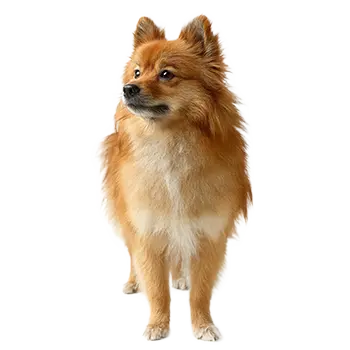
The Deutscher Spitz makes an immediate visual impression thanks to its coat, which frames the dog's body in a cloud of stand-off fur that gives it a distinctly full, rounded silhouette. The breed is compact and well-proportioned beneath all that coat, with a body that is slightly longer than it is tall and a build that suggests both agility and sturdiness. The size varies by variety, with the Mittelspitz standing roughly 12 to 15 inches at the withers and the Kleinspitz running slightly smaller at around 9 to 11 inches. Weights correspond proportionally, with the Mittel averaging in the mid-twenties of pounds and the Klein somewhat lighter.
The head is the focal point of the dog's expression and is fox-like in character. The skull is moderately broad and slightly domed, tapering through a well-defined stop to a muzzle that is moderately long and refined. The muzzle should not be excessively pointed or snipey, but it carries a refined quality that contributes to the alert, intelligent expression the breed is known for. The lips are close-fitting and clean. The nose is typically dark, matching the coat color in self-colored dogs.
The eyes are medium-sized, almond-shaped, and set slightly oblique. They are dark in color, and the expression they create, combined with the pointed muzzle and erect ears, produces the look that owners often describe as bright and foxy. Dark eye rims add definition. The ears are small, triangular, and held fully erect. They are set close together on top of the skull and their upright carriage contributes significantly to the dog's characteristic alert expression. Inside the ears the fur is dense but shorter than the surrounding coat.
The neck is of moderate length and arches slightly. It is set well into the shoulders and is framed by the profuse mane and ruff that gives the Spitz its characteristic lion-like neck appearance, particularly pronounced in the Mittel variety. The chest is moderately deep, reaching to the elbows. The back is short and straight. The belly is moderately tucked up. The overall body impression is compact without being cobby.
The tail is one of the breed's defining features. It is set high, carried curled over the back, and densely furred. The double curl is particularly prized in some varieties. This tail carriage is characteristic of the spitz family broadly and the Deutscher Spitz specifically - a tail that hangs or droops is considered a serious fault.
The coat is the breed's most dramatic physical characteristic and requires detailed description. There are two components: a long, straight, stand-off outer coat and a dense, woolly undercoat. The undercoat is what creates the volume and the characteristic stand-off appearance of the outer coat - without the dense undercoat, the outer coat would lie flatter. The mane and ruff around the neck are especially profuse. The front legs have feathering. The hindquarters are covered in full, dense fur. The tail is plumed. Colors recognized across the varieties include white, black, brown, orange, sable, and cream, with parti-color acceptable in some varieties. The Mittel and Klein are typically shown in solid colors.
Movement in the Deutscher Spitz should be lively and free, reflecting the breed's inherent energy and structural soundness. The gait at a trot shows good reach in the front and strong drive from the rear. There should be no wasted movement, paddling, or rolling. The back remains level and stable during movement. When standing at attention, the overall impression is one of compact readiness - a small but capable dog fully aware of its surroundings and comfortable in its own skin.
Affectionate With Family
★★★★★
The Deutscher Spitz bonds closely with its household and shows consistent warmth and attentiveness toward family members, often following them from room to room throughout the day.
Good With Young Children
★★★☆☆
Better suited to homes with older, calmer children who understand how to handle a small dog with respect. Very young children and their unpredictable movements can be stressful for this breed.
Good With Other Dogs
★★★☆☆
Generally sociable with other dogs when raised with them or properly introduced, though some individuals carry a boldness that exceeds their actual size when meeting strange dogs.
Shedding Level
★★★★☆
The profuse double coat sheds consistently year-round with heavier seasonal blowouts. Regular brushing manages the volume but this breed is not a light shedder.
Coat Grooming Frequency
★★★★☆
The dense, stand-off coat needs brushing several times per week to prevent matting, particularly around the collar area, behind the ears, and in the leg feathering.
Drooling Level
★☆☆☆☆
Clean, dry mouthed, and tidy in that regard. Drool is simply not part of life with a Deutscher Spitz.
Coat Type
★★★★★
The stand-off double coat is the breed's most visually striking feature - a dense undercoat pushes the straight outer coat away from the body, creating that characteristic full, cloud-like silhouette.
Openness To Strangers
★★★☆☆
Typically reserved on first meeting but warms up once an introduction has been made. Not aggressive toward strangers, but not immediately welcoming either.
Playfulness Level
★★★★☆
Lively and enthusiastic about play, with good energy for games and activities throughout the day. This is a dog that stays engaged and spirited well into adulthood.
Watchdog/Protective Nature
★★★★☆
Historically bred as a farm watch dog and alert to anything that changes in the environment. The Deutscher Spitz announces visitors reliably and has the voice to make its alert known.
Adaptability Level
★★★★☆
Adapts well to apartment or house living given moderate daily exercise. The smaller varieties in particular are practical for urban life without large outdoor spaces.
Trainability Level
★★★☆☆
Intelligent and capable of learning quickly, but also independent-minded enough to decide whether a given exercise is worth its attention. Positive, engaging training methods work considerably better than repetitive or harsh approaches.