Catahoula Cur

Catahoula Leopard Dog

Quick Facts

🐕 Breed Group
Herding Group
📏 Size Category
Medium-Large
📏 Height
Males: 22-26 inches, Females: 20-24 inches
⚖️ Weight
Males: 50-95 lbs, Females: 50-95 lbs
⏱️ Life Expectancy
10-14 years
🧣 Coat Type
Short, single, smooth
🎨 Coat Colors
Merle, brindle, solid, patched - wide variety
😀 Temperament
Energetic, Loyal, Independent, Assertive
🏃 Exercise Needs
Very High
🎓 Training Difficulty
Moderate to Difficult
👶 Good with Children
Yes, with older children
🐾 Good with Other Pets
Selective

Other Names & Breed Recognition

Catahoula Cur is the name this breed carried before it carried any other. The formal title Louisiana Catahoula Leopard Dog arrived in 1979 when the state of Louisiana designated the breed as its official state dog and assigned the name by decree. Before that designation, and still today among the hunting and livestock communities of the rural South, this dog was and is the Catahoula Cur - or simply the Cur, in the shorthand of people who know exactly what they mean and who they are talking to.

The word Cur is worth addressing directly because it causes confusion when people encounter it outside its working-dog context. In everyday English usage, cur is a pejorative for a mongrel or a worthless dog. In Southern American working-dog culture, Cur refers to a specific tradition of purpose-bred American hunting and stock dogs that developed independently of European kennel club traditions. These were dogs bred for function by practical people who had no interest in show standards or formal registries - they bred to performance. The Catahoula Cur is the Louisiana expression of that tradition, and within it the name carries respect, not insult.

Other names for the same animal include Catahoula Hog Dog, Hog Dog in field contexts, and of course the full formal name Louisiana Catahoula Leopard Dog and its shortened version Catahoula. The Leopard Dog in the formal name refers to the spotted merle coat that many examples carry, giving the dog its visually striking appearance. Not all Catahoulas carry merle - solids, brindles, and patchwork dogs occur regularly - but the merle pattern is the one that drew widespread attention from outside the working dog community.

Registry standing for the breed includes United Kennel Club recognition in 1995 as the Louisiana Catahoula Leopard Dog, placement in the AKC Foundation Stock Service in 1996, and recognition by the National Association of Louisiana Catahoulas and the Catahoula Owners, Breeders and Research Association as the primary parent-club organizations. The name Catahoula Cur appears in UKC documentation as an acknowledged alternate designation and remains the name most commonly used in Louisiana and across the working dog communities of the American South where the breed has its deepest roots.

Catahoula Cur Organizations & Standards

The two primary organizations serving the Catahoula Cur in the United States are the National Association of Louisiana Catahoulas and COBRA, the Catahoula Owners, Breeders and Research Association. Both organizations maintain breed standards and ethics codes for breeders and serve as resources for current and prospective owners. COBRA's breeder ethics code specifies that puppies should not be placed before 12 weeks of age, prohibits sales through pet stores, and requires recommended health clearances before breeding - including OFA hip evaluation and BAER testing for deafness. Prospective buyers should seek out breeders affiliated with one of these organizations and willing to show health documentation for breeding dogs.

The United Kennel Club recognized the breed in 1995 under the full name Louisiana Catahoula Leopard Dog, placing it in the Herding Dog Group. The UKC standard emphasizes working soundness and overall balance over narrow conformation points, reflecting the breed's practical working origin. Size ranges in the standard are deliberately broad - males from 22 to 26 inches, females from 20 to 24 inches - acknowledging the natural variation between working lines bred for different purposes and terrain types.

The American Kennel Club Foundation Stock Service has included the breed since 1996. This designation allows basic record-keeping and eligibility for AKC companion events including agility, obedience, and rally, but does not constitute full recognition. Full AKC recognition has not yet been achieved, and debate exists within the breed community about whether pursuing it is desirable given the potential influence of show-breeding priorities on a dog whose value is entirely in its working ability.

Health testing guidance from both COBRA and the NALC emphasizes OFA hip radiographic evaluation and BAER hearing testing as the two primary health clearances for breeding dogs. Both conditions - hip dysplasia and congenital deafness - are documented in the breed and heritable, making pre-breeding screening a meaningful tool for responsible breeders seeking to improve the health of future generations.

The debate within the breed community about pursuing full AKC recognition reflects a genuine tension in working-dog culture. Show-breeding selection historically drifts toward conformation characteristics at the expense of working function, and many Catahoula Cur enthusiasts are wary of that outcome for a breed whose entire value lies in its performance. The current situation - UKC recognition with emphasis on working soundness, and AKC Foundation Stock Service status allowing companion event participation without full recognition requirements - suits many in the breed community reasonably well.

Kennel Club Recognition

  • United Kennel Club (UKC): Recognized, Herding Dog Group

Catahoula Cur Physical Description

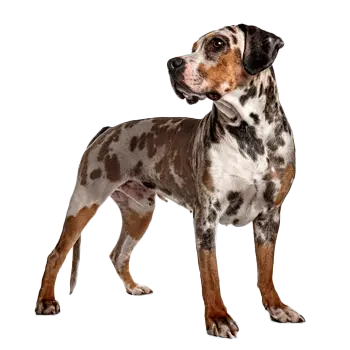
The Catahoula Cur is a dog that looks like it means business, because it does. The frame is muscular and substantial without being heavy, built for sustained work over difficult terrain. Its movement reflects that purpose: efficient, ground-covering, and free-striding rather than showy. The UKC standard's emphasis on overall balance and working soundness rather than specific conformation measurements captures the right priority for this breed.

The head is broad and flat across the skull, with a well-defined but moderate stop and a muzzle that is approximately equal in length to the skull - strong jaws with tight, clean lips and appropriate pigmentation matched to coat color. The neck is muscular and of moderate length. Males are noticeably larger and more masculine than females throughout the body and head, and the sexual dimorphism is appropriate and visible.

The eyes are the Catahoula Cur's most immediately recognizable feature. Glass eyes - pale blue, nearly white in appearance - are the most famous, but the breed's eye presentation is far more varied than any single description can capture. Cracked glass eyes, where blue and colored pigment share the same iris in an irregular pattern, occur regularly. Marbled eyes with multiple colors within one iris are documented. Standard brown eyes occur, as do bi-color combinations with one eye of each color. The effect, particularly against a merle coat and a white or pale face, is genuinely striking - a visual identity unlike any other breed.

The ears are set at the side of the head, drop forward moderately, and end in a rounded tip. They are not hound-heavy and do not hang long.

The chest is deep and provides the lung capacity appropriate for a dog that historically worked hard and long in hot, humid conditions. The ribs are well-sprung without being barrel-chested. The topline is straight and strong, with a compact, well-muscled body from shoulder to loin. The tail is naturally long, set level with the topline, and carried upright when the dog is alert or working.

The feet are compact and notably webbed - the Catahoula Cur's webbed toes extend further than in most breeds and are a direct adaptation to the swampy terrain of its Louisiana origin. This webbing makes the breed an effective swimmer and comfortable in the wet conditions it was developed to work in.

Coat color and pattern variation in this breed is extraordinary. The merle pattern - mottled darker patches on a lighter base - occurs in blue, red, and chocolate versions. Brindle in multiple base colors occurs. Solid blacks, reds, chocolates, and blues occur. Patchwork combinations of two or more colors with white trim occur. The coat itself is always short, smooth, single-layered, and easy to maintain.

The legs are straight and well-boned, with the hindquarters powerfully muscled and well-angulated to provide the sustained drive the breed uses when working. The feet are notably webbed - extending further between the toes than in most breeds and reflecting a specific adaptation to the swampy terrain of the breed's Louisiana origin. This webbing makes the Catahoula Cur a natural swimmer, and the ability to navigate wet, boggy terrain without difficulty was a practical working requirement in the environments where the breed developed.

Overall size runs from 22 to 26 inches for males and 20 to 24 inches for females, with weight varying substantially based on build and line - anywhere from 50 to 95 pounds is documented across working lines. The UKC standard appropriately places more emphasis on proportion, balance, and soundness than on specific size targets, recognizing that the breed's working function has produced a range of physical presentations that all meet the practical requirement of a capable, durable field dog.

Affectionate With Family
The Catahoula Cur is intensely bonded to its family and expresses that bond through protective attention and steady companionship. Its loyalty is deep and consistent, directed at its household rather than distributed broadly.
Good With Young Children
Patient and devoted with the children it has been raised with, the Catahoula Cur's size and working-dog energy are better matched to older children who interact confidently and understand the dog's nature.
Good With Other Dogs
The Catahoula Cur can work alongside other dogs in a structured hunting or working context but shows dominance toward unfamiliar dogs, particularly of the same sex. Multi-dog households require careful management and appropriate matching.
Shedding Level
The short single coat sheds moderately throughout the year without dramatic seasonal peaks. Weekly brushing handles the maintenance and keeps loose hair from distributing across the household.
Coat Grooming Frequency
Among the lower-maintenance coats in active working breeds. The smooth, single coat requires only weekly brushing and occasional bathing, with no clipping, stripping, or specialized grooming needed.
Drooling Level
The Catahoula Cur is a dry-mouthed breed with tight, clean lips. Drooling is not a characteristic concern.
Coat Type
Short, smooth, and single-layered - a practical coat for a working dog in Southern swamps and forests. The extraordinary range of colors and patterns from merle to solid to brindle is one of the breed's most visually distinctive features.
Openness To Strangers
Reserve toward strangers is inherent to the breed's working heritage. The Catahoula Cur observes and assesses before warming up, and early socialization is the most effective tool for making that assessment calibrated rather than broadly suspicious.
Playfulness Level
Energetic and enthusiastic, the Catahoula Cur brings genuine drive and participation to play and exercise. It does not pace itself - when it engages, it engages fully.
Watchdog/Protective Nature
Territorial alertness is deeply embedded in this breed and it takes its watchdog function seriously. It will alert reliably and position itself between its family and perceived threats without hesitation or instruction.
Adaptability Level
Built for rural and working environments with space and purpose. The Catahoula Cur's needs do not adjust to smaller living situations - if the situation cannot meet the breed, the breed will demonstrate the mismatch clearly.
Trainability Level
Capable and intelligent but independent by nature. The Catahoula Cur responds to calm, consistent leadership from a handler it respects and resists training approaches that rely on repetition or compulsion.

Catahoula Cur History & Development

The Catahoula Cur name reflects the breed's actual origin story more accurately than any of its more polished designations. This is a dog that developed from the collision of Native American dog culture and European settlement in what is now Louisiana, bred not to a standard but to a purpose, over several centuries of practical selection in difficult terrain.

The foundation was the dog kept by the Choctaw and other indigenous peoples of the Gulf Coast region - wolf-like, domesticated animals used for hunting and companionship. Spanish explorers arriving in the 1500s brought mastiffs, greyhounds, and bloodhounds. These European working dogs interbred with the indigenous dogs, producing hybrid-vigor animals that the French settlers who arrived later in the 17th and 18th centuries continued to develop by adding their own hound breeds. The Catahoula Cur emerged from this layered cross-breeding as the product of multiple generations of selection for a specific task: driving feral hogs and wild cattle from the swamps and forests of Louisiana to market or to slaughter.

The working method the breed developed for this task is distinctive and worth understanding as a window into the dog's character. The Catahoula Cur did not herd in the flowing, eye-pressure style of border-type herding breeds. It hunted. A group of two or three Catahoulas would locate a hog, bay it - surrounding it and holding it at bay with barking and body positioning - and maintain that bay until the hunter arrived to take control. Against a full-grown feral boar, this required extraordinary nerve and physical toughness. The dogs that could do the job and survive it were the ones that reproduced. The breed's fearlessness, coordination, and independent decision-making capacity are direct products of that selection.

In 1979 the state of Louisiana named the breed the Louisiana State Dog and assigned the formal name Louisiana Catahoula Leopard Dog. The United Kennel Club followed in 1995 with official recognition, and the AKC Foundation Stock Service enrolled the breed in 1996. The Catahoula Cur name was not retired by any of these events - it continues in active use among hunting communities, ranch operations, and the working dog enthusiasts who identify more strongly with the breed's practical heritage than its recent registry recognition.

The breed's Cur identity places it in a broader tradition of American working dogs - breeds like the Mountain Cur, the Black Mouth Cur, and others - that developed on the American frontier for specific working purposes outside the influence of European kennel standards. These are dogs that earned their characteristics through performance rather than conformation, and the Catahoula Cur's fearlessness, coordination, and endurance are the direct products of that selection process carried out over centuries in the swamps and forests of Louisiana.

Catahoula Cur Temperament & Personality

The Catahoula Cur is a working dog first and a companion dog second, and the households that live most successfully with this breed are the ones that understand and accept that sequence. The breed's independence, assertiveness, and high drive are not personality quirks to be softened - they are the core of what the dog was built to be, and they require appropriate outlets and experienced handling to be expressed constructively.

Within its family, the Catahoula Cur is a different animal from what strangers encounter. The intense loyalty and affection it reserves for its household is genuinely remarkable - the dog forms deep bonds and expresses them through protective attention, steady presence, and the kind of devotion that makes owners of this breed enthusiastic advocates despite the management demands. It wants to be with its people and communicates that preference clearly.

The assertive quality is real and must be managed rather than ignored. This is not an aggressive breed by temperament, but it is a confident one that will test unclear leadership and fill any authority vacuum it perceives. A household with consistent structure and clear expectations produces a Catahoula Cur that channels its assertiveness into appropriate watchfulness. A household without those things produces a dog that has decided to provide the structure itself, which tends to conflict with the preferences of the human occupants.

The high energy is sustained and purposeful - not the frantic energy of anxiety or boredom but the purposeful energy of a dog that was built to work hard and long in difficult terrain. That energy needs an outlet that matches its character. Running, swimming, hunting, stock work, and structured dog sports all work. Expecting the dog to self-regulate in a small yard with no genuine exercise does not.

Strangers receive a measured assessment. The Catahoula Cur is territorial by nature and approaches unfamiliar people with the caution appropriate to a dog with its protective function. Broad socialization from puppyhood is the most effective tool for calibrating this caution, preventing it from becoming a generalized suspicion that makes the dog difficult to manage in social situations. The breed is also notably vocal - it communicates in a range of sounds including howls and what owners describe as a singing quality in addition to standard barking, and prospective owners should factor that characteristic into their living situation.

The combination of intelligence, drive, loyalty, and independence in the Catahoula Cur produces an unusually capable animal that rewards the right owner genuinely. This is not a dog for someone who wants a dog that is easy from the first day - it requires investment, patience, and consistent engagement. The owners who stay the course describe a bond that is different in quality from what they have experienced with other breeds: intensely loyal, highly attentive, and deeply satisfying in the way that a working relationship between two capable beings tends to be.

Catahoula Cur Family Life & Living Requirements

The Catahoula Cur is built for rural and working environments, and its needs reflect that origin honestly. The ideal situation is one where the dog has genuine outdoor space to patrol and a job to do - whether that is working livestock, accompanying hunters, or patrolling a farm property. In those contexts the breed is extraordinarily capable and rewarding. In suburban settings without meaningful outlets for its working instincts, it is a management challenge.

Fencing must be genuinely secure. The Catahoula Cur is territorial and physically capable, and it will test boundaries that it perceives as inadequate. Invisible fence systems that rely on deterrence rather than physical containment are not reliable for a breed with this drive and pain tolerance. Physical fencing that actually contains the dog is non-negotiable.

With family children, the Catahoula Cur is patient and protective with the kids it has been raised alongside. Its size and energy create a mismatch with very young children that warrants supervision, not because the breed is aggressive toward family members but because a large, energetic dog navigating a small space can knock a toddler down without any intent whatsoever. Older children who interact confidently and understand working dog behavior are well-matched companions.

Other animals require careful management. The Catahoula Cur's dominance toward unfamiliar dogs, particularly same-sex combinations, is a consistent characteristic that makes it selective in multi-dog households. Animals it has been raised alongside from puppyhood are usually treated as part of its group and protected accordingly. Introductions to new animals in adulthood require patient management.

This is not a breed that does well isolated from its family. It bonds deeply and needs daily interaction and engagement with its people. Dogs kept exclusively in kennels or backyard situations without meaningful human contact and stimulation deteriorate behaviorally in predictable ways. The Catahoula Cur's best life is one where it participates fully in the household it has committed to protecting.

Catahoula Cur Training & Exercise Needs

Training the Catahoula Cur is a project in establishing respect and communicating clearly, not a project in breaking an independent will. This is an intelligent dog that is entirely capable of high-level learning and performance - it excels in the field, it has the athleticism for competitive dog sports, and it has the intelligence for complex obedience work. What it requires from the handler is calm consistency, earned authority, and training approaches that make compliance feel worthwhile.

Begin training from the day the puppy arrives home. The Catahoula Cur is always learning, and leaving it to its own choices during puppyhood is teaching it that its own judgment governs behavior. That lesson is very difficult to revise once established. Early obedience training, consistent expectations, and immediate reinforcement of correct behavior with high-value food rewards are the tools that build the working relationship this breed responds to.

Socialization is the most critical early investment. A Catahoula Cur puppy exposed broadly to varied people, environments, sounds, and situations before six months of age develops into an adult with well-calibrated wariness - watchful and appropriately cautious rather than broadly suspicious. Puppy classes, regular outings to varied public environments, and positive encounters with a wide range of people during the first four months are among the highest-value things an owner of this breed can provide.

Exercise requirements are genuine and high. An hour or more of vigorous daily activity is the appropriate baseline - running, swimming, hiking, hunting, or field work rather than neighborhood walking. The breed's webbed feet and water-adapted background make it a natural swimmer, and water-based exercise is an excellent outlet in warm weather. Dog sports including agility and tracking engage the breed's athleticism and intelligence in structured ways. Any working arrangement that gives the Catahoula Cur a real job - livestock, hunting, farm patrol - meets its needs at the deepest level and produces the most settled, manageable companion.

Catahoula Cur Health Concerns

The Catahoula Cur is a robust breed whose working heritage maintained meaningful health pressure over generations. Dogs that could not perform in demanding field conditions were not used in breeding, and this practical selection history has produced an animal with a relatively clean health profile compared to breeds with longer histories of show-oriented selection. Two specific heritable conditions are documented and important for prospective owners and breeders to understand.

Dental disease is documented as an elevated concern in veterinary resources covering the breed, and regular tooth brushing is the most practical preventive measure owners have available to them.

Common Health Issues

  • Hip Dysplasia - Heritable abnormal hip joint formation producing progressive arthritis and lameness; the primary structural health concern documented in the breed and a required health evaluation for breeding dogs per COBRA standards.
  • Congenital Sensorineural Deafness - Linked to merle coat genetics; both unilateral and bilateral deafness occur; BAER testing is the only reliable diagnostic tool and should be performed on breeding dogs and ideally on all puppies before placement in litters from merle-producing parents.
  • Periodontal Disease - Elevated documented risk of dental disease in this breed; several-times-weekly tooth brushing is the primary preventive measure available to owners.
  • Obesity - An under-exercised Catahoula Cur can develop weight-related problems that worsen joint function; appropriate measured feeding combined with the high daily exercise this breed requires prevents this.

Preventive Care & Health Monitoring

  • OFA Hip Radiographic Evaluation - Required health screening for breeding Catahoulas per COBRA ethics standards; hip results should be available for review from any breeder before purchasing a puppy.
  • BAER Testing - Brainstem Auditory Evoked Response testing for congenital deafness; recommended for all breeding dogs and for all puppies from litters producing merle-colored offspring.
  • Socialization from Puppyhood - Broad positive exposure to varied people, environments, and situations before six months of age is a critical management investment that shapes the adult dog's response to strangers and novel situations.
  • Daily Vigorous Exercise - The Catahoula Cur's working heritage means its physical and mental health depend on consistent vigorous daily activity; adequate exercise is preventive care for this breed, not optional enrichment.
  • Dental Hygiene Routine - Several-times-weekly brushing from puppyhood, with periodic professional veterinary dental cleanings, manages the elevated periodontal disease risk documented in this breed.

Catahoula Cur Grooming & Maintenance

The Catahoula Cur's coat is one of the easier coats in active working breeds to maintain, which suits its practical, working-dog heritage. The short, smooth single layer does not mat, does not need clipping or trimming, and stays reasonably clean in most field conditions. Weekly brushing with a rubber grooming mitt removes loose hair and distributes natural oils through the coat. Shedding is moderate and consistent rather than dramatically seasonal.

Bathing every four to six weeks is adequate for most dogs. Dogs that spend time in swampy or wet field conditions - which for this breed is not an unusual situation given its history - may need bathing more frequently when they come in from the field. The short coat dries quickly, which is practical for an active outdoor dog.

Ear care should be a weekly routine. The drop ears create a partially enclosed environment that retains moisture and warmth, and regular cleaning with a veterinarian-recommended solution prevents the buildup that leads to bacterial or yeast infections. Any persistent odor, discharge, or redness from the ears is worth a veterinary evaluation rather than continued home management.

Nails should be trimmed every three to four weeks, or more frequently for dogs kept primarily indoors that do not wear their nails down through outdoor activity on varied terrain. Long nails alter foot structure and gait over time and are worth staying ahead of.

Dental hygiene deserves consistent attention with this breed. Veterinary resources covering the Catahoula Cur note elevated periodontal disease risk, and brushing several times per week with a canine toothbrush and toothpaste is the most effective preventive tool available. Establishing this routine in puppyhood makes the adult dog far more cooperative. Regular veterinary cleanings as recommended by your veterinarian complete the dental care picture.