Bouvier

Bouvier des Flandres

Quick Facts

🐕 Breed Group
Herding Group
📏 Size Category
Large
📏 Height
Males: 24.5-27.5 inches, Females: 23.5-26.5 inches
⚖️ Weight
Males: 70-110 pounds, Females: 60-80 pounds
⏱️ Life Expectancy
10-12 years
🧣 Coat Type
Rough double coat
🎨 Coat Colors
Fawn, black, gray brindle, salt and pepper
😀 Temperament
Intelligent, loyal, protective, energetic, independent
🏃 Exercise Needs
High
🎓 Training Difficulty
Moderate
👶 Good with Children
Yes, with early socialization
🐾 Good with Other Pets
Good with proper introductions

Other Names & Breed Recognition

Bouvier is the shortened, familiar form of Bouvier des Flandres that dog people, breed owners, and enthusiasts in both North America and Europe use comfortably in everyday conversation. "Bouvier" is the French word for cowherd or cattle driver - it describes the dog's original working function rather than a place or a person, making it one of the more directly descriptive breed names in the herding group. "Des Flandres" means "of Flanders," identifying the region of Belgium where the breed was developed. The full name therefore reads as Cattle Dog of Flanders, which is as straightforward a name as any breed carries.

The shortened form Bouvier works because there is no other well-known breed called simply a Bouvier in the English-speaking world. In Europe, particularly in French-speaking regions, the name requires more precision - there are other bouvier breeds, including the Bouvier des Ardennes, the Bouvier de Roulers, and the now-rare Bouvier de Moerman - and dropping "des Flandres" in those contexts could cause genuine confusion. In North America, Bouvier used alone is understood as Bouvier des Flandres without ambiguity.

The AKC recognized the Bouvier des Flandres in 1931 and places it in the Herding Group, where it has competed with distinction ever since. The breed is also recognized by the UKC, the Canadian Kennel Club, the FCI (Group 1, Section 2 - Cattle Dogs), and The Kennel Club in the UK under the Pastoral Group. The American Bouvier des Flandres Club is the AKC parent club and participates in the Canine Health Information Center program, requiring OFA hip, elbow, and cardiac evaluations plus CERF eye exams for CHIC certification.

If you have been searching for information about the Bouvier, you have found the right breed. Everything said here about the Bouvier applies fully to the Bouvier des Flandres - the name Bouvier is simply what owners and admirers of this remarkable breed have called it for generations. Whether you're just researching or you already have one at your feet, you already know this dog goes by many names but has one consistent character: serious, loyal, capable, and deeply tied to its family.

Bouvier Organizations & Standards

The American Bouvier des Flandres Club (ABdFC) is the AKC parent club for the Bouvier in the United States, and it is one of the more active breed clubs in terms of health research and educational programming. The ABdFC participates fully in the Canine Health Information Center program through the Orthopedic Foundation for Animals. For a Bouvier to achieve CHIC certification, the dog must have OFA hip evaluation, OFA elbow evaluation, OFA cardiac evaluation, and CERF eye clearance registered in the public database. The ABdFC recommends that CERF eye exams be repeated every two years until the dog reaches eight years of age, reflecting the breed's documented risk of developing heritable eye conditions, including glaucoma, at various life stages.

The Bouvier Health Foundation operates alongside the parent club and conducts research specifically focused on heritable conditions affecting the breed. The foundation has worked to identify the genetics behind degenerative myopathy - a progressive muscular disorder that causes difficulty swallowing and is uniformly fatal in affected dogs - and to develop a DNA test that allows breeders to identify carriers and avoid producing affected offspring. Breeders who prioritize health should be testing their breeding stock for degenerative myopathy DNA status in addition to the standard CHIC evaluations.

The FCI standard, maintained through the Societe Royale Saint-Hubert of Belgium as the FCI member responsible for Belgian breeds, defines the Bouvier des Flandres as a rough-coated, powerfully built herding dog of medium to large size. Males stand between 62 and 68 centimeters at the withers, females 59 to 65 centimeters. Weight for males runs approximately 35 to 40 kilograms, females 27 to 35 kilograms. The coat is described as rough and harsh to the touch on the outer layer, with a dense, fine undercoat for weather protection. Accepted colors include fawn, black, gray brindle, and salt and pepper. White markings are not acceptable in competition. The characteristic beard and mustache are defining features of the breed's expression.

In Belgium, France, and the broader French-speaking world, the breed's working tradition has always been taken seriously. Bouviers have served as police dogs, military dogs, search and rescue dogs, and guide dogs in addition to their herding origins. The Ring sport tradition in Belgium and France has maintained the Bouvier as a serious protection sport competitor, and many European Bouviers carry working trial titles alongside their conformation titles. This dual purpose tradition - showing and working - is considered important by serious breeders on both sides of the Atlantic.

Kennel Club Recognition

  • American Kennel Club (AKC): Recognized in 1931, Herding Group
  • United Kennel Club (UKC): Recognized, Herding Dog Group
  • Canadian Kennel Club (CKC): Recognized, Herding Group
  • FCI: Recognized, Group 1 - Sheepdogs and Cattle Dogs
  • The Kennel Club (UK): Recognized, Pastoral Group

Bouvier Physical Description

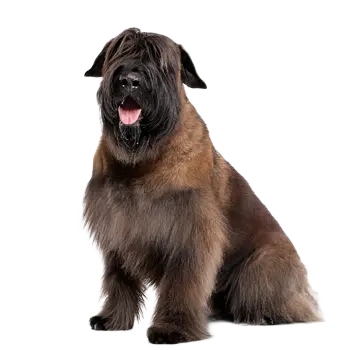
The Bouvier is a big, powerful dog with a look that communicates purpose and solidity in equal measure. Males stand 24.5 to 27.5 inches at the shoulder and carry 70 to 110 pounds of dense, working muscle. Females are somewhat smaller but carry the same fundamental character in their structure. When you see a Bouvier for the first time, particularly a well-conditioned working dog, the impression is of a dog built to pull carts, drive cattle, and handle whatever the Belgian countryside required - because that is precisely what it was built to do.

The head is large and well-proportioned to the body, framed by the thick beard and mustache that define the breed's expression and give it the unmistakable Bouvier look. The skull is broad and flat, approximately equal in length to the muzzle, with a moderate stop. The beard and mustache are dense and full, providing real protection in cold and wet conditions while also creating the distinctive walrus-like appearance that Bouvier owners either embrace immediately or spend time getting used to. The eyes are alert and dark, neither too prominent nor too deeply set, with a direct, confident expression. Eye color should be dark brown; light eyes are considered a fault. The ears are set high and, in countries where cropping is practiced, are typically cropped to a triangular upright shape. In countries where cropping is prohibited, the natural ears fold forward, which changes the dog's silhouette but not its fundamental character.

The neck is strong and well-arched, blending cleanly into powerful shoulders. The body is compact and short-backed, with a broad, deep chest, well-sprung ribs, and a firm, level topline from withers to croup. There is no sagging or softness in the back - this is a dog whose structural strength is genuine, not cosmetic. The hindquarters are well-angulated and heavily muscled, providing the driving force behind the breed's strong, ground-covering movement. The front legs are straight and well-boned, the feet round and compact with tight, well-arched toes.

The coat is one of the most demanding aspects of owning a Bouvier. The outer layer is rough, harsh, and tousled - it resists water and debris reasonably well in field conditions, but it also captures burrs, seeds, mud, and anything else it comes into contact with during outdoor activity. The undercoat is dense and fine, providing genuine insulation in cold weather. This double-coat combination requires regular, committed brushing to prevent matting, particularly in the armpits, groin, and behind the ears where friction and moisture concentrate. The beard and mustache need special attention - they collect food, water, and debris at every meal and drink.

Colors include fawn in various shades, black, gray brindle, and salt and pepper. Some degree of grizzling or ticking in the coat is acceptable. White markings on the chest and extremities may appear but are not preferred in the show ring. The overall impression of color in a well-maintained coat is a warm, textured, natural tone - neither flashy nor dull.

Movement in the Bouvier is free, balanced, and purposeful. The breed should cover ground efficiently without excessive side action or high knee action. A choppy, stilted gait indicates structural problems inconsistent with the breed's working origins.

Standing next to a well-built Bouvier is a different experience than seeing one in a photograph. The physical density of the dog, the rough texture of the coat, and the combination of beard, eyebrows, and watchful dark eyes give it an almost archetypal working-dog presence. This is a dog that looks like it can handle serious work, because that is precisely what it was built to do.

Affectionate With Family
The Bouvier is deeply loyal and bonds closely with its household. It is a dog that takes family seriously and shows its affection through steady presence and attentiveness.
Good With Young Children
A well-socialized Bouvier is patient and protective with children in its family. Its size requires management around small children, but the temperament itself is sound.
Good With Other Dogs
Bouviers can develop same-sex aggression, particularly males. Early socialization and proper introductions make a significant difference in how they relate to other dogs.
Shedding Level
The dense double coat sheds moderately year-round with heavier periods seasonally. Regular brushing is the most effective way to manage the volume of loose coat.
Coat Grooming Frequency
The rough outer coat mats if not maintained and requires brushing multiple times per week. The beard accumulates food and water and needs regular cleaning.
Drooling Level
The Bouvier drools minimally under normal circumstances, but the beard will drip after drinking and needs wiping after meals to avoid odor and staining.
Coat Type
The double coat has a rough, harsh outer layer and a dense undercoat. It accumulates significant debris from outdoor activity and requires dedicated maintenance.
Openness To Strangers
The Bouvier is naturally reserved with strangers and will watch and assess before accepting someone new. This is a core guarding trait that proper socialization refines but does not eliminate.
Playfulness Level
Athletic and energetic, the Bouvier plays hard and stays enthusiastic well into adulthood. It enjoys games that challenge both its body and its mind.
Watchdog/Protective Nature
Few breeds match the Bouvier's natural protective instincts. It is alert, confident, and capable of real protective action when it judges that action is warranted.
Adaptability Level
The Bouvier adapts reasonably well to different living environments, but it requires significant daily exercise and consistent human leadership regardless of where it lives.
Trainability Level
Highly intelligent and quick to learn, the Bouvier responds well to consistent, positive training. Its independent streak means it needs a handler who earns its respect.

Bouvier History & Development

The Bouvier developed in the Flanders region of Belgium as a general-purpose farm and cattle dog. Belgian farmers needed a dog that could herd cattle, pull heavy carts, haul milk, serve as a watchdog, and carry messages in wartime, and they bred for that utility with the practicality of working people rather than the aesthetic standards of show-ring culture. For most of its history, what we now call the Bouvier des Flandres was not a single defined breed but a type - working farm dogs of similar character and capability found across Flanders, varying in appearance from farm to farm but sharing essential traits of strength, intelligence, and tractability.

The name Bouvier - cowherd in French - attached to these dogs because cattle driving was one of their primary documented functions. Various regional names circulated alongside it: Vuilbaard (dirty beard in Flemish, a reference to the distinctive facial furnishings), Toucheur de Boeuf (cattle driver), and Pic (a more obscure regional term). These names were largely interchangeable in everyday farming contexts. It was the development of formal dog shows and breed clubs in the early 20th century that consolidated these working dogs into the Bouvier des Flandres as a recognized breed, attaching the Flanders geographic identifier to distinguish it from other Belgian bouvier types.

The shortened nickname Bouvier has been in use for as long as the breed has been known in North America, which dates to the first imports in the early 20th century. American military personnel and dog fanciers who encountered Belgian military dogs in Europe during both World Wars returned home with enormous respect for the breed, and some brought dogs back with them. The Bouvier's wartime service - carrying messages, pulling ambulance carts, and working as sentries - was extensive and documented, and it established the breed's reputation as more than a farm worker.

World War I nearly destroyed the breed in its home country. Much of Flanders was devastated, and the Bouvier population suffered accordingly. Belgian breeders worked after the war to consolidate the remaining dogs and establish a unified standard. The first standard was developed in 1912 and revised several times before the current version stabilized. The breed reached North America in growing numbers through the 1920s and 1930s, and AKC recognition followed in 1931.

Today the Bouvier is recognized worldwide and maintains a strong presence in herding, obedience, protection sports, police work, search and rescue, and guide dog programs. The nickname Bouvier has followed the breed wherever it has gone - a natural shortening used with easy familiarity by the people who know and work with this dog most closely. It is, in a very real sense, the name earned by a dog that made itself indispensable across a century of work in Belgium, wartime Europe, and the homes and working kennels of North America - and continues earning it every day in police departments, search and rescue teams, herding competitions, and family living rooms around the world.

Bouvier Temperament & Personality

The Bouvier is a serious dog, and anyone who brings one home should understand that from the start. This is not a dog that asks for little and accepts everything - it is intelligent, assertive, and deeply engaged with its environment. It needs consistent leadership and clear expectations, not because it is aggressive or unstable, but because a Bouvier that has not been taught what is expected of it will decide on its own what the rules are. And it is smart enough to make those decisions effectively.

At its best, the Bouvier is one of the most loyal and responsive dogs available to an experienced owner. It bonds with extraordinary depth to its household and treats that relationship with seriousness. The protection instinct is genuine and instinctive - a Bouvier that senses a real threat to its family does not need to be told what to do. This quality is a major part of the breed's appeal, but it comes with responsibility. A dog with real protective capability needs to be well-socialized and properly trained so that it can discriminate between actual threats and normal social situations. Without that foundation, protective instincts can become problematic.

With strangers, the Bouvier is typically reserved and watchful before it warms up. This is not shyness - a shy dog is anxious; a Bouvier is simply assessing. Proper early socialization, which means consistent positive exposure to a wide range of people, places, and situations during the critical developmental window, produces a dog that is confident, polite, and approachable with people it has been introduced to, while maintaining its natural alertness toward people it has not. Dogs that are not socialized adequately tend toward excessive suspicion or territorial behavior that makes them difficult to manage in public.

With other dogs, same-sex aggression is documented in the breed, particularly among males. A Bouvier with a well-socialized foundation can live harmoniously with other dogs, but this is not a breed to pair carelessly. Introductions should be managed thoughtfully, and households adding a Bouvier to a multi-dog home should pay attention to gender combinations.

The Bouvier's energy level is substantial. This is a working dog with a working dog's need for daily physical and mental engagement. A bored Bouvier in an understimulating environment is not a peaceful Bouvier. The breed thrives when it has a job - herding, tracking, Schutzhund, agility, search and rescue, or simply a rigorous daily exercise routine with obedience training woven in. Meeting those needs consistently produces the serene, confident companion the breed is fully capable of being.

Bouvier Family Life & Living Requirements

Living with a Bouvier is a full commitment, and households that thrive with this breed tend to be active, experienced with dogs, and genuinely willing to engage with a large, intelligent animal as a real working partner. Apartment living is not impossible for a Bouvier, but it requires an exceptional exercise commitment to offset the limited space. A house with a securely fenced yard is a more natural fit. The fence matters - a Bouvier has the physical capability to clear inadequate barriers, and its protective instincts combined with a perimeter gap are a liability.

The breed sheds and produces significant coat debris. Bouvier owners quickly accept that dog hair, muddy pawprints, and a beard-shaped watermark on the kitchen floor after every drink are part of the deal. The rough coat also produces flatulence - a documented and well-known Bouvier characteristic that is mentioned matter-of-factly in most breed resources. These are not dealbreakers, but they are real. A household that prizes immaculate carpets and odor-free air should think carefully before choosing a Bouvier.

With children, the Bouvier is typically protective and patient, treating the family's children as members of its inner circle. Its size means supervision is appropriate around small children, particularly during active play. The same instincts that make the Bouvier protective of children in its family can also cause it to intervene protectively when it perceives rough play or loud conflict, even when none is warranted. Teaching children how to interact calmly and respectfully with the dog reduces the chance of misunderstandings.

With other pets, early introductions and socialization produce the best outcomes. Other dogs are usually manageable with thoughtful pairing; small animals that trigger prey drive require more careful management. A Bouvier that was raised alongside cats typically tolerates them well. One introduced to cats as an adult with no prior experience requires more deliberate management.

The households that work best with Bouviers tend to have one thing in common: they understand that this dog is a partner, not a possession. It needs engagement, leadership, and purpose. Give it those things consistently and it will be one of the most devoted, capable companions you will ever have. Treat it as an afterthought and it will communicate its dissatisfaction clearly and persistently until you get the message.

Bouvier Training & Exercise Needs

Training a Bouvier well is one of the most rewarding experiences in the working dog world, and training one poorly is one of the more frustrating. The difference is usually the handler's consistency and willingness to establish clear leadership from the start. This is a dog that learns extremely quickly - it picks up what you are teaching, and it picks up what you are not intending to teach. Inconsistency, vacillation, and unclear expectations produce a Bouvier that has essentially trained its owner, which is not a comfortable dynamic in a 90-pound herding dog.

Positive reinforcement works well with the Bouvier. Despite the breed's independence and occasional stubbornness, it responds to praise, food rewards, and play with genuine enthusiasm when the training relationship is built on trust and clear communication. Harsh corrections are neither necessary nor advisable - a Bouvier subjected to harsh handling can become resentful or shut down, neither of which serves the training relationship. Firmness is different from harshness. Firm, consistent expectations delivered calmly are what this breed responds to best.

Begin training early and make it a daily habit rather than an occasional activity. Puppy kindergarten, basic obedience, and consistent leash manners starting at eight weeks old lay the foundation for everything that follows. Socialization should be treated as seriously as obedience training during the first year. A Bouvier puppy needs exposure to a wide range of people, environments, dogs, and situations to develop the social confidence its protective nature requires as a foundation.

Exercise requirements are substantial. Two solid exercise sessions daily, each lasting at least 20 minutes at a brisk pace, represent a starting point. Running, hiking, structured play, and dog sports like agility, herding, Schutzhund, and tracking all meet the breed's needs well. Mental exercise is equally important - obedience training, tracking, scent work, and problem-solving games keep the Bouvier's considerable intelligence engaged. A physically tired Bouvier without mental stimulation is still a demanding household companion.

The bottom line on training and exercise for the Bouvier is that investment upfront pays dividends for the entire life of the dog. A well-trained, well-exercised Bouvier is genuinely one of the great dogs to share your life with. Getting there requires consistent work through the first two years - but owners who make that investment typically describe their Bouviers as the best dogs they have ever owned, without hesitation.

Bouvier Health Concerns

The Bouvier lives 10 to 12 years on average, which is fairly typical for a large, heavily built herding dog. Several heritable conditions are documented in the breed and warrant attention from buyers and owners.

Degenerative myopathy is an inherited muscular disorder that causes progressive difficulty swallowing, leading to dehydration, weight loss, and aspiration pneumonia. A DNA test allows breeders to identify carriers and avoid producing affected offspring. Ask breeders whether their breeding stock has been tested.

Common Health Issues

  • Hip dysplasia: Malformation of the hip joint causing looseness - Chronic pain, and progressive arthritis. The Bouvier's large, muscular frame increases the mechanical load on affected joints, making hip screening an important part of responsible breeding.
  • Elbow dysplasia: A group of developmental conditions affecting the elbow joint that produce lameness and degenerative joint disease - Screened through OFA elbow radiographic evaluation at 24 months.
  • Gastric dilatation-volvulus - GDV, : Life-threatening condition in which the stomach fills with gas and twists. The Bouvier's deep chest creates elevated risk. Owners should know the emergency signs and discuss prophylactic gastropexy with their veterinarian.
  • Subaortic stenosis: Heritable narrowing of the tissue below the aortic valve that restricts blood flow from the heart - Ranges from subclinical to significant cardiac compromise. Screened through OFA cardiac evaluation by a board-certified cardiologist.
  • Autoimmune hypothyroidism: The immune system attacks the thyroid gland - Causing low thyroid hormone levels and symptoms including lethargy, weight gain, and coat thinning. Develops in middle age in affected dogs.
  • Glaucoma: Increased pressure within the eye that damages the optic nerve and can progress to blindness - One of the more serious heritable eye conditions documented in the breed.
  • Degenerative myopathy: An inherited progressive muscular disorder that causes increasing difficulty swallowing - Leading to aspiration pneumonia and death. A DNA test exists to identify carriers.

Preventive Care & Health Monitoring

  • OFA hip and elbow evaluation at 24 months - Required for CHIC certification through the American Bouvier des Flandres Club. PennHIP is a valid alternative for hip evaluation.
  • OFA cardiac evaluation by a board-certified veterinary cardiologist to screen for subaortic stenosis - Required for CHIC certification.
  • CERF eye examination by a board-certified veterinary ophthalmologist - Repeated every two years until age 8, per ABdFC recommendation, to screen for glaucoma, cataracts, and other heritable eye conditions.
  • OFA thyroid evaluation annually for breeding dogs to screen for autoimmune hypothyroiditis. - OFA thyroid evaluation annually for breeding dogs to screen for autoimmune hypothyroiditis.
  • Degenerative myopathy DNA testing of all breeding stock to identify carriers and prevent producing affected offspring. - Degenerative myopathy DNA testing of all breeding stock to identify carriers and prevent producing affected offspring.
  • Discuss prophylactic gastropexy with your veterinarian at the time of spay or neuter to prevent life-threatening stomach torsion. - Discuss prophylactic gastropexy with your veterinarian at the time of spay or neuter to prevent life-threatening stomach torsion.

Bouvier Grooming & Maintenance

Grooming a Bouvier honestly is a significant time commitment, and potential owners should factor that into their decision before bringing one home. The rough outer coat and dense undercoat require brushing multiple times per week to prevent the matting that forms quickly in areas of friction and moisture - armpits, groin, behind the ears, and around the collar line are the typical trouble spots. A slicker brush, a wide-toothed comb, and a dematting tool are the core implements. If you let the coat go for more than a week without attention, you will spend considerably more time undoing the matting than you would have spent with regular maintenance.

The beard and mustache are a dedicated maintenance item. They collect food at every meal, drip water after every drink, and accumulate odor faster than the body coat. Wiping the beard after eating and drinking, and keeping the facial furnishings clean with regular washing, prevents the sourness that develops quickly when they are neglected. Some owners trim the beard shorter for manageability; others maintain the full traditional length. Either choice is a valid personal preference.

Bathing is needed every four to six weeks for most Bouviers. The rough outer coat resists water reasonably well but holds odor when it gets wet from rain or outdoor activity. A thorough bath and complete drying - ideally with a dryer to blow out the undercoat - keeps the coat in good condition. Incomplete drying after a bath is a frequent cause of skin issues in heavy-coated breeds.

Ears, nails, and teeth complete the maintenance picture. The ears need checking and cleaning regularly. Nails need trimming every three to four weeks. Dental care through regular brushing or dental chews prevents the tartar accumulation that leads to gum disease - a genuinely common problem in dogs that are not given consistent dental attention.

Owners who commit to regular grooming from puppyhood - turning brush sessions into a familiar, positive routine - find the process much more manageable than those who try to establish it with an adult dog that has never been conditioned to it. Start early, keep it positive, and the Bouvier will tolerate grooming willingly. It is one of those aspects of ownership where consistency early pays off significantly later.