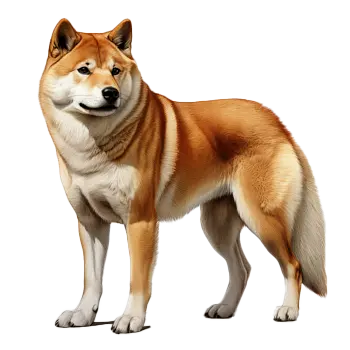
The Ainu-Ken is a medium-sized spitz-type dog built for cold climates, demanding terrain, and physical endurance. The overall impression is one of compact power - this is not a large dog, but every part of its structure suggests capability. Males typically stand between 19.5 and 21.5 inches at the shoulder, females slightly smaller, and weight generally falls between 44 and 66 pounds for both sexes. The body is rectangular in proportion, with the length from chest to hindquarters slightly exceeding the height at the withers. This gives the dog a capable, forward-leaning silhouette rather than the square outline of some spitz breeds.
The head is a classic spitz construction - broad skull with a moderate stop, strong muzzle that tapers cleanly without being snipey, and a black nose that provides excellent scenting capability. The eyes are small and triangular in shape, set slightly oblique, and typically dark brown in color. They convey intelligence and alertness without the soft open expression you see in companion-oriented breeds. The ears are small, triangular, and fully erect, carried forward and slightly outward - always mobile and working, tracking sounds with the attentiveness of a dog built to hunt bear and deer through dense mountain forest.
The chest is deep rather than broad, allowing for effective lung capacity during sustained effort. Ribs are moderately sprung, and the loin is short and muscular. The back is straight and firm, transferring power from the hindquarters efficiently during movement. The Ainu-Ken moves with a purposeful, ground-covering trot that reflects its original function as a long-distance hunting partner. Movement should be sound and elastic, with the dog covering ground economically rather than flashily. The hindquarters are well-angulated with strong thighs, and the breed is noted in its standard for particularly powerful rear legs that provide the push needed for steep terrain navigation.
The tail is one of the breed's signature features - set high and carried in a tight curl over the back, or in a sickle curve. The tail hair is thick and spreads as it opens, creating a plume that adds to the breed's overall visual balance. The neck is moderately thick and well-muscled, blending into the shoulders without apparent break, and the withers are moderately high and well-defined. Feet are thick-padded and tightly knit, providing traction and protection across varied surfaces.
Four-season adaptability is built into the coat. The outer layer consists of straight, harsh guard hairs that shed water and resist snow accumulation. Beneath that lies a soft, dense undercoat that traps air and maintains body temperature in temperatures well below freezing. This double-coat system was essential for a dog working in Hokkaido's winters, and it remains a defining structural feature. The coat lies close to the body along the back, neck, and sides, with the mane area around the neck and shoulders showing somewhat heavier furnishing in males.
Coat colors include red, white, black, brindle, sesame, and black and tan. Unlike some breeds where color is heavily weighted in the show ring, all recognized colors are functionally equivalent. The white Ainu-Ken can look almost ghostly in snow - which was likely practical camouflage during the breed's working years. Brindle Hokkaidos carry a striking striped pattern that is unique among Japan's six native breeds. Sesame coloring - red with black-tipped hairs throughout - produces a rich layered appearance. Pigmentation should be consistent with coat color, with dark pigment on nose, lips, and eye rims in most color varieties.
Affectionate With Family
★★★★☆
The Ainu-Ken forms a tight bond with household members and shows warmth and loyalty within the family circle. That affection stays close to home - this is not a dog who distributes attention indiscriminately.
Good With Young Children
★★★☆☆
When raised alongside children and properly socialized, the Ainu-Ken can be a steady companion. Their high energy and bold nature call for supervision with very young children.
Good With Other Dogs
★★☆☆☆
Same-sex aggression is documented in the breed, and the Ainu-Ken can be selective and assertive in dog-to-dog interactions. Early socialization matters, but careful management is realistic for life.
Shedding Level
★★★★☆
The double coat blows heavily twice a year, and routine shedding happens year-round. During seasonal coat changes, expect fur on everything - brushing frequency needs to increase significantly.
Coat Grooming Frequency
★★★☆☆
Weekly brushing keeps the coat in reasonable shape outside of shedding season. The outer coat's natural harshness resists dirt well, which cuts down on bath frequency.
Drooling Level
★☆☆☆☆
The Ainu-Ken is essentially drool-free. Clean lips and a tidy face are standard for the breed.
Coat Type
★★★☆☆
A firm, straight outer coat over a thick insulating undercoat - built for the brutal winters of Hokkaido prefecture. The coat is protective rather than glamorous.
Openness To Strangers
★★☆☆☆
Reserve around unfamiliar people is a hallmark trait. The Ainu-Ken watches and assesses before warming up, which is consistent with its history as a watchful hunting companion.
Playfulness Level
★★★☆☆
Playful with family and motivated by games that engage their mind and body. They are not constant clowns but they do have a lively side that comes out in the right environment.
Watchdog/Protective Nature
★★★★★
Alert, attentive, and quick to sound the alarm - the Ainu-Ken's watchdog instinct is deep and reliable. They were bred to track and confront large game, and that boldness transfers directly to home protection.
Adaptability Level
★★★☆☆
Adaptable within reason, though this is a breed that does best with space and an active household. Apartment living is manageable only with serious daily exercise commitment.
Trainability Level
★★★☆☆
Intelligent but independent-minded. The Ainu-Ken learns quickly when the training approach respects their nature rather than trying to override it. Experienced handlers consistently get better results.