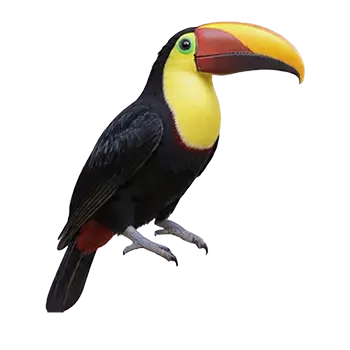

The Swainson's Toucan (Ramphastos swainsonii) is named after William Swainson, a 19th-century English naturalist, ornithologist, and illustrator who made significant contributions to natural history. The bird was scientifically described and named in his honor, following the common practice of naming species after prominent scientists and explorers. However, this species is more commonly known by its descriptive common name, the Chestnut-mandibled Toucan, referencing the distinctive chestnut or maroon coloring on the upper mandible (the upper part of the bill) that distinguishes it from closely related toucan species. Both names are used interchangeably in aviculture, with "Chestnut-mandibled Toucan" being particularly common.
Taxonomically, Swainson's Toucan belongs to the genus Ramphastos within the family Ramphastidae (toucans), a distinctive group of large, colorful, bill-heavy frugivorous birds endemic to the Neotropics. The family Ramphastidae contains approximately 35-40 species divided into several genera including the large Ramphastos toucans, medium Pteroglossus aracaris, and smaller Aulacorhynchus toucanets. Swainson's Toucan is one of the largest members of the family, rivaling the famous Toco Toucan in size.
The genus Ramphastos contains the largest toucan species and includes several closely related birds often confused or misidentified. These include the Toco Toucan (Ramphastos toco) with its enormous orange bill with black tip, the Keel-billed Toucan (Ramphastos sulfuratus) with rainbow-colored bill, the Channel-billed Toucan (Ramphastos vitellinus), and several others. Swainson's Toucan is most easily distinguished by the chestnut-maroon upper mandible combined with yellow lower mandible and distinctive facial pattern.
The scientific name Ramphastos swainsonii combines the genus name Ramphastos (derived from Greek words meaning "crooked beak" or "bill") with the species epithet swainsonii honoring William Swainson. The species was first scientifically described in 1833, relatively early in ornithological history when European naturalists were actively documenting Neotropical biodiversity.
Geographic variation within the species is minimal, with Swainson's Toucan generally considered monotypic (no recognized subspecies). However, some individual variation exists in bill coloration and size across the range, with birds from different regions showing subtle differences that have occasionally led to taxonomic debates. Most authorities currently recognize a single species without subspecies divisions.
In aviculture and among bird enthusiasts, Swainson's Toucan is recognized as one of the most commonly kept large toucan species, rivaling the Toco Toucan in popularity though considerably less famous among the general public. The species has been bred in captivity for several decades with established captive populations, though they remain relatively uncommon compared to parrots due to their specialized care requirements and limited breeding success in private collections. They are particularly popular in large private aviaries, zoos, and specialized collections where their impressive size and beauty can be properly displayed.
The common name "Chestnut-mandibled Toucan" is particularly descriptive and useful for distinguishing this species from other large toucans. The chestnut or maroon coloring on the upper mandible is immediately recognizable and represents the most reliable field mark for identification. In aviculture, both names (Swainson's Toucan and Chestnut-mandibled Toucan) are used interchangeably, with individuals using whichever name they learned first or prefer.