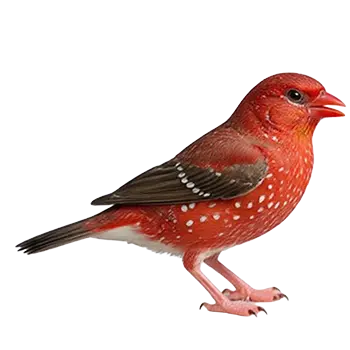

The Strawberry Finch (Amandava amandava) derives its charming common name from the breeding male's spectacular appearance, featuring brilliant red plumage dotted with numerous small white spots that resemble the seeds on a strawberry. This evocative name instantly conveys the bird's most distinctive feature and is the most commonly used name in aviculture worldwide. The species is also widely known as the Red Avadavat or Red Munia, names that emphasize the striking red coloration while using taxonomic designations common for small Asian finches. In some literature, it may appear as the Tiger Finch, though this name is less commonly used and can cause confusion with other species.
Taxonomically, the Strawberry Finch belongs to the genus Amandava within the family Estrildidae (estrildid finches or waxbills), the same diverse family that includes munias, waxbills, and numerous other small finches kept in aviculture. The genus Amandava is small, containing only two species: the Strawberry Finch (Amandava amandava) and the closely related Green Avadavat (Amandava formosa). The scientific name Amandava amandava represents a tautonym where the genus and species names are identical, derived from the city of Ahmedabad in India where early European naturalists first encountered and collected specimens of this species for scientific description.
The species exhibits geographic variation across its extensive natural range, and two subspecies are generally recognized by taxonomists. The nominal subspecies Amandava amandava amandava occurs in the Indian subcontinent and represents the most commonly encountered form in both wild and captive populations. The subspecies Amandava amandava punicea (sometimes called the Chinese Strawberry Finch) occurs in Southeast Asia including southern China, and displays slightly different coloration with deeper, more extensive red in breeding males. In aviculture, these subspecies distinctions are rarely maintained or recognized, and most captive birds represent mixed ancestry or uncertain geographic origin.
Interestingly, Strawberry Finches have been introduced to various locations outside their native range where established feral populations now exist. Notable introduced populations occur in Hawaii, Puerto Rico, Japan, Fiji, Spain, Portugal, and Singapore, demonstrating the species' adaptability and ability to colonize new environments. Some of these introduced populations have persisted for decades and are now considered naturalized, though they generally have minimal impact on native ecosystems compared to more aggressive introduced species.
In aviculture and among finch enthusiasts, the name "Strawberry Finch" is nearly universally recognized and preferred, instantly evoking the species' spectacular appearance. The species has been kept in captivity for well over a century and remains one of the most popular and commonly available small finches in the pet trade worldwide. Their combination of spectacular coloration (particularly breeding males), hardy constitution, peaceful temperament, ease of breeding, and affordability has made them staples in finch collections globally. Among finch keepers, Strawberry Finches are frequently recommended as excellent beginner finches that provide spectacular visual impact while remaining forgiving and adaptable, earning them outstanding reputations as both beautiful and practical birds for novice and experienced keepers alike.