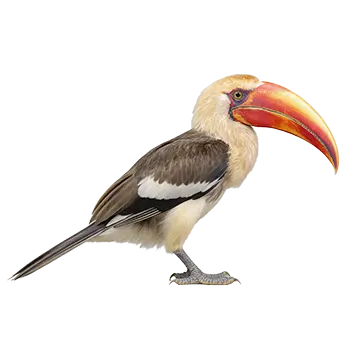
Training Red-Billed Hornbills presents unique challenges due to their independent nature and strong instincts. These birds can learn behaviors through positive reinforcement, but success requires patience, consistency, and understanding of their motivational drives. Unlike highly trainable parrot species, hornbills often prioritize their natural behaviors over human-directed activities, making training progress slower and less predictable. Starting training with hand-raised, well-socialized individuals provides the best foundation.
Basic target training forms the foundation of most hornbill training programs. Using a target stick or dowel, birds learn to touch or follow the target in exchange for food rewards. Start with very short distances and immediate rewards, gradually increasing difficulty. Target training enables other behaviors like moving to different locations, entering carriers, or positioning for health checks. Training sessions should be brief, five to ten minutes maximum, as hornbills lose interest quickly and may become frustrated with extended sessions.
Recall training teaches the bird to return to the handler on cue, which is invaluable for managing out-of-cage time safely. Begin in a small, confined space with minimal distractions, using highly motivating food rewards. Gradually increase distance and add distractions as the bird masters each level. Consistency is crucial, as hornbills remember both positive and negative experiences. Never chase a hornbill that doesn't recall promptly, as this creates negative associations and makes future training harder.
Step-up training helps with routine handling for vet visits and general management. Teach the bird to step onto your hand or a perch on command using favorite treats as motivation. Some hornbills become more comfortable stepping onto a perch rather than a hand, which is perfectly acceptable. Respect the bird's boundaries and never force physical interaction, as this damages trust and can lead to defensive behaviors.
Socialization is perhaps more important than specific trick training for hornbills. Expose birds to various people, situations, household sounds, and experiences during their critical socialization period in youth. Continue regular positive exposures throughout life to maintain comfort with change. Well-socialized hornbills cope better with necessary disruptions like vet visits or temporary housing changes.
Vocalization management focuses on understanding and working with the bird's natural calling patterns rather than suppressing them. Red-Billed Hornbills use their tok-tok calls, clucks, and cackles for communication, and these vocalizations are normal, healthy behavior. They become more vocal during activity peaks at dawn and dusk, when seeking attention, during feeding times, and when excited or alarmed. Establishing predictable routines helps reduce excessive attention-seeking calls.
These birds have limited talking ability compared to parrots, though some individuals may learn to mimic a few sounds or simple words if consistently exposed. Males tend to be more vocal and may be more likely to attempt mimicry. However, their natural vocalizations will always predominate, and owners should not acquire hornbills expecting significant talking ability. The natural calls are interesting and communicative in their own right.
Screaming or excessive calling usually indicates unmet needs, boredom, or attention-seeking. Address the underlying cause rather than punishing the behavior. Ensure adequate exercise, enrichment, social interaction, and that the bird's daily needs are met on a predictable schedule. Ignore attention-seeking calls and reward quiet or appropriate vocalizations, though understand that some level of calling is normal and healthy. Hormonal periods may increase vocalizations temporarily, particularly in breeding-age birds.
Positive reinforcement is the only appropriate training method for hornbills. Never use punishment, yelling, or aversive techniques, as these damage the human-bird relationship and can cause fear-based behavioral problems. Patience and understanding of the species' natural behaviors create the best outcomes, though owners must accept that hornbills will never be as bidable or focused on human interaction as some other avian species.