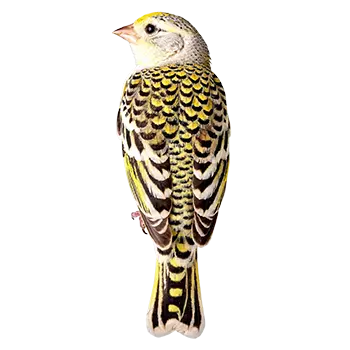

The Lizard Canary derives its distinctive name from the unique feather pattern covering much of the bird's body, where each feather displays dark crescent-shaped markings creating a spangled or scaled appearance reminiscent of lizard or reptile skin. This evocative name has been associated with the breed since its earliest documentation in the 18th century and remains the universally recognized designation. The breed is occasionally called the London Fancy Lizard or simply Lizard, though "Lizard Canary" is the standard name in aviculture worldwide.
Taxonomically, all domestic canaries including the Lizard variety belong to the species Serinus canaria domestica, representing domesticated descendants of the wild canary (Serinus canaria) native to the Macaronesian islands. The Lizard Canary is classified as a type canary, bred primarily for specific physical characteristics and feather patterns rather than song quality (song canaries) or solid color (color canaries). However, this classification is somewhat fluid as Lizard Canaries possess distinctive coloration as well as patterning, making them unique among canary varieties.
The Lizard Canary is one of the oldest established and documented canary breeds, with reliable historical records dating to the 1750s in France where the variety was first developed and standardized. English breeders refined the variety during the 19th century, establishing the detailed breed standards that persist today. This long history makes Lizard Canaries among the most historically significant canary varieties, representing living connections to early canary breeding traditions. The breed's survival through centuries of changing fashions in aviculture demonstrates its enduring appeal and the dedication of specialized breeders who maintained breeding lines.
Interestingly, the Lizard Canary nearly went extinct during the early 20th century, particularly during and after World War II when many specialty canary varieties suffered population declines due to wartime disruptions and loss of dedicated breeders. By the 1940s, only a handful of true Lizard Canaries remained. Concerted preservation efforts by dedicated enthusiasts in England and elsewhere gradually rebuilt populations through careful breeding programs, saving the variety from extinction. Today, while still relatively uncommon compared to more popular varieties, the Lizard Canary maintains stable breeding populations among specialty canary fanciers worldwide.
Lizard Canaries are recognized in two primary ground color varieties: Gold Lizard (yellow ground color with dark spangling) and Silver Lizard (white or buff ground color with dark spangling). These color varieties represent the two main recognized forms, though subtle variations exist within each category. The ground color is independent of the spangling pattern, allowing expression of the characteristic Lizard markings on different background colors.
The breed is also categorized by cap marking, a distinctive clear area on the head that represents one of the variety's most important defining features. Birds may be Clear-capped (possessing a neat, well-defined clear yellow or buff area on the crown), Non-capped (lacking clear cap marking, with spangling extending over the entire head), or Broken-capped (showing irregular or incomplete cap marking). Clear-capped birds are generally most prized in show competitions, though all cap types are recognized within the breed standard.
In aviculture and among canary enthusiasts, Lizard Canaries occupy a special niche as historical, classic birds appreciated by connoisseurs and show breeders. They are less common than popular varieties like Yorkshire Canaries, Border Canaries, or Gloster Canaries, making them somewhat specialty birds. However, their hardy nature, distinctive beauty, and historical significance ensure continued interest and breeding by dedicated fanciers. Show competitions include specific Lizard Canary classes where birds are judged on spangling quality, cap definition, ground color, and overall conformation according to detailed breed standards maintained by canary clubs and societies.