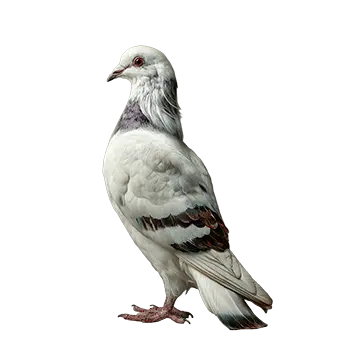

The Jacobin Pigeon is a domesticated variety of Columba livia domestica, the domestic pigeon, which itself is descended from the Rock Dove or Rock Pigeon (Columba livia), a wild species native to Europe, North Africa, and Asia. All domestic pigeon breeds, including Jacobins, belong to the same species and can interbreed, with breed differences representing human-selected variations in appearance, behavior, or performance rather than distinct species. Domestic pigeons have been bred by humans for thousands of years, with over 800 recognized fancy breeds developed through selective breeding for characteristics including plumage patterns, feather structures, body shapes, flying abilities, and behavioral traits.
The name 'Jacobin' refers to the Order of Jacobin friars (Dominican monks) who wore distinctive cowls or hoods as part of their religious habit. The pigeon's spectacular hood of feathers rising around the head and neck resembles these monastic cowls, giving the breed its common name. This comparison between the bird's feathered hood and religious garments reflects the breed's European development during periods when religious orders were prominent cultural references. The name has been used consistently for centuries, appearing in pigeon literature from the 1500s onward, making Jacobin one of the oldest documented fancy pigeon breed names.
Alternate names and historical designations include Capuchin in some early European texts, referencing another monastic order with distinctive hoods, Jack or Jack Pigeon as informal shortened forms used by pigeon fanciers, Hooded Pigeon descriptively referencing the defining characteristic though this name could apply to other breeds and is not standard, and various language-specific names including Perückentaube in German (wig pigeon), Capucin in French, and Jacobino in Italian and Spanish. However, Jacobin remains the universally recognized standard name in English and international pigeon fancy contexts.
The Jacobin's origins are ancient and somewhat obscure, with the breed being one of the oldest fancy pigeons. Documentation exists from the 1500s describing pigeons matching Jacobin characteristics, and the breed may be considerably older. Historical speculation suggests possible origins in India, Cyprus, or Europe, with various theories about development pathways. Some historians believe Jacobins may have originated in India and spread westward through trade routes, while others argue for European development possibly in England or Continental Europe. Definitive proof of exact origins is impossible given the centuries involved and limited early documentation. What is certain is that by the 1600s-1700s, Jacobins were well-established in European pigeon fancy and were being systematically bred and refined for increasingly elaborate hoods. The breed reached particularly high development in England during the Victorian era when pigeon fancy flourished, and English breeders established detailed standards and systematic breeding programs that shaped modern Jacobins.
As a fancy pigeon breed within the species Columba livia domestica, the Jacobin is closely related to all other domestic pigeon breeds descended from the Rock Dove including other structure breeds like Fantails, Pouters, and Frillbacks, flying breeds like Tipplers and Rollers, and utility breeds like Kings and Carneau. However, the Jacobin's distinctive hood structure makes it instantly recognizable and dramatically different in appearance from most breeds. The hood represents one of the most extreme structural modifications achieved through selective breeding in any pigeon breed, requiring centuries of careful selection to develop and maintain.
The elaborate hood structure defines the breed and consists of elongated, inverted feathers rising from the back of the head, neck, and upper back that curve forward and upward around the head, creating a dramatic ruff or collar. Ideal Jacobin hoods are large, full, and symmetrical, rising high and curving smoothly around the sides and front of the head in a continuous chain of feathers. The hood should be balanced, neither leaning to one side nor showing gaps or irregularities. Additional features valued in exhibition Jacobins include a mane of longer feathers running down the back, rose or frills on the legs formed by elongated leg feathers, and overall good body conformation with smooth, compact build. The breed is shown in numerous color varieties including white (most traditional and popular), black, red, yellow, blue, and various other colors and patterns. Show standards established by national pigeon organizations including the National Pigeon Association (USA) and fancy clubs worldwide specify detailed requirements for hood structure, body proportions, and other characteristics.
The breeding and exhibition of Jacobins represents a specialized niche within pigeon fancy. Breeders work to maintain and improve hood quality, size, and symmetry while ensuring birds remain healthy and functional despite their elaborate plumage. Breeding quality Jacobins requires extensive knowledge of genetics, careful pair selection, and commitment to both aesthetic excellence and bird welfare. Exhibition Jacobins compete in shows where specialized judges evaluate them against breed standards, with champion birds commanding high prices and being valuable breeding stock. The show Jacobin represents the pinnacle of the breed, while utility or pet-quality Jacobins may show less perfect hoods but still possess the characteristic structure and gentle temperament making them appealing companions.
The cultural and historical significance of Jacobins in pigeon fancy is substantial. As one of the oldest fancy breeds with documentation spanning centuries, Jacobins appear in historical art, literature, and pigeon treatises. Famous naturalist Charles Darwin discussed Jacobins in his work on variation and selection, using them as examples of extreme domestic modification. The breed has been maintained by dedicated fanciers across generations, preserving both the remarkable hood structure and the knowledge required to breed and care for these distinctive birds. Today, Jacobins remain popular in pigeon fancy worldwide, prized by exhibitors for their beauty and by hobbyists for their unique appearance and gentle nature, though they require more specialized care than simpler pigeon breeds.