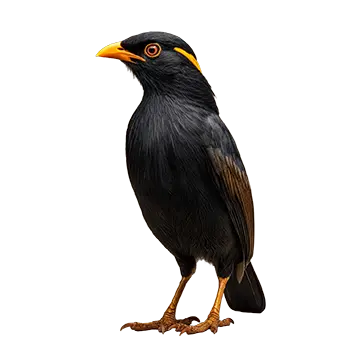

The Hill Mynah, scientifically classified as Gracula religiosa, derives its common name from its natural habitat in forested hill and mountain regions of Southeast Asia and its membership in the mynah family Sturnidae. This species is also widely known simply as Mynah or Myna (alternate spellings of the same word derived from Hindi "maina"), Common Hill Mynah emphasizing it is the most frequently encountered hill mynah species, Greater Hill Mynah distinguishing it from the Lesser Hill Mynah (Gracula indica), and Talking Mynah referencing its exceptional vocal mimicry abilities. In various parts of its range, it's known by local names including "Beo" in Indonesia, "Sali" or "Shalik" in parts of India, and various other regional designations.
Taxonomically, Hill Mynahs belong to the family Sturnidae, which includes starlings and mynahs, within the order Passeriformes, the perching birds or passerines. The genus Gracula contains several species of hill mynahs, with G. religiosa being the most widespread and commonly kept in aviculture. Within Gracula religiosa, multiple subspecies are recognized based on geographic distribution and morphological differences, though taxonomic treatments vary between authorities. Generally accepted subspecies include G. r. religiosa (the nominate subspecies from India), G. r. intermedia (found across much of mainland Southeast Asia), G. r. peninsularis (southern India and Sri Lanka), G. r. andamanensis (Andaman Islands), G. r. venerata (Java and Bali), and several others, with some authorities recognizing as many as 10+ subspecies while others consolidate these into fewer groups. These subspecies show subtle differences in size, extent of yellow wattles, and plumage details.
The scientific name Gracula religiosa has interesting etymology and history. "Gracula" is derived from Latin "graculus," meaning jackdaw or similar corvid, though mynahs are starlings rather than corvids. "Religiosa" means religious or sacred in Latin, referencing the species' association with religious sites and temples in parts of its native range where these birds are often seen around Buddhist and Hindu temples, sometimes kept as sacred birds. The species was formally described by Linnaeus in 1758, making it one of the earlier birds to receive scientific classification.
Historically, Hill Mynahs have been kept as pets and for their talking ability for centuries, particularly in their native Asia where they have been prized for vocal mimicry since ancient times. Records indicate that mynah keeping dates back at least 2,000+ years in India and other parts of Asia. The birds' exceptional talking ability made them valuable, with trained talking mynahs commanding high prices. European colonizers encountered mynahs in Asia beginning in the 16th-17th centuries and were amazed by their vocal abilities, introducing them to European and eventually worldwide aviculture. By the 19th-20th centuries, Hill Mynahs had become internationally recognized as premier talking birds, though they remained less common than parrots in Western aviculture due to their specialized care requirements.
The comparison between Hill Mynahs and parrots, particularly regarding talking ability, has been debated among aviculturists for decades. Hill Mynahs are widely considered to produce the clearest, most human-sounding speech of any bird species, with voice quality, tone, and inflection that closely mimic human speech patterns. Individual mynahs can sound remarkably like specific people, reproducing voices so accurately that listeners cannot distinguish mynah speech from actual humans. In terms of pure clarity and voice quality, mynahs generally surpass even the best talking parrots including African Greys. However, parrots, particularly African Greys, may develop larger vocabularies and show more contextual understanding and interactive communication. The debate continues, with most experts concluding that mynahs produce the highest quality speech while some parrots may show more complex language use.
The common name "mynah" or "myna" has become somewhat confusing in aviculture and ornithology, as it refers to multiple different species within the starling family, some closely related to Hill Mynahs and others quite different. Common Mynahs (Acridotheres tristis), for instance, are different species entirely, more terrestrial, less arboreal, and substantially poorer talkers than Hill Mynahs. Bank Mynahs, Jungle Mynahs, and various other mynahs are different species with different characteristics. When people refer to mynahs as exceptional talkers or premium pet birds, they almost always mean Hill Mynahs specifically rather than other mynah species, making proper species identification important.