Half-Moon Conure

Half-Moon Conure
📸 Photo Gallery Coming Soon

Furry Critter Network Etsy Shop

Quick Facts

🔬 Scientific Name
Aratinga canicularis
🦜 Bird Type
Parrot
📊 Care Level
Moderate
😊 Temperament
Playful, Affectionate, Social
📏 Adult Size
9-10 inches
⏱️ Lifespan
20-30 years
🔊 Noise Level
Moderate
🗣️ Talking Ability
Limited
🍽️ Diet Type
Pellet-based
🌍 Origin
Central America (Mexico to Costa Rica)
🏠 Min Cage Size
24x24x24 inches
📐 Size
Small

Half-Moon Conure - Names & Recognition

The Half-Moon Conure is most commonly known by this name in aviculture, referring to the distinctive orange half-moon or crescent shape on its forehead. The species is also widely called the Orange-fronted Parakeet or Orange-fronted Conure, which more literally describes this characteristic marking. In scientific literature and ornithology, the bird is classified as Aratinga canicularis, placing it within the genus Aratinga, which includes several other New World parakeets and conures.

Regional variations in naming exist across its native range in Central America. In Mexico, where much of its wild population resides, it may be referred to as "Perico Frentinaranja" or "Perico Frente Naranja," both Spanish names that translate to "orange-fronted parakeet." The species name "canicularis" derives from Latin, relating to the Dog Star Sirius or dog days of summer, possibly referencing the bird's habitat in hot, dry regions.

Three recognized subspecies exist with slight variations in size and coloring. The nominal subspecies, Aratinga canicularis canicularis, is found from western Mexico to Nicaragua. Aratinga canicularis clarae occurs in the Tres Marías Islands off Mexico's Pacific coast. Aratinga canicularis eburnirostrum inhabits southern Mexico and is distinguished by its ivory-colored upper mandible. Some historical texts may refer to this species under older generic names such as Eupsittula or Psittacara, though Aratinga remains the most widely accepted classification. In the pet trade, these birds are almost exclusively marketed as Half-Moon Conures, a name that has become standard among breeders, avian veterinarians, and bird enthusiasts worldwide.

Half-Moon Conure Physical Description

The Half-Moon Conure is a small to medium-sized parrot measuring approximately 9 to 10 inches in length from beak to tail tip, with a weight range of 75 to 90 grams. These compact, well-proportioned birds have the characteristic stocky build of conures, with a relatively large head, strong curved beak, and a long, tapered tail that comprises nearly half of their total length. Their overall appearance is elegant yet robust, perfectly suited for their active, arboreal lifestyle.

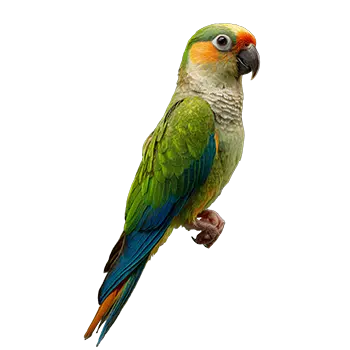
The most distinctive feature of the Half-Moon Conure is the vibrant orange crescent or half-moon shaped patch on the forehead, which gives the species its common name. This orange coloring extends from just above the cere to the crown, creating a striking contrast against the bright green plumage that dominates the rest of the body. The face, throat, and breast are a brilliant lime to yellowish-green, while the back, wings, and tail display deeper forest green tones. The tail feathers often show blue tips and edging, adding another dimension to their coloration.

The underside of the wing and tail feathers reveals beautiful yellow-olive tones that become visible during flight. The eyes are dark brown to black, surrounded by a pale gray to white bare eye ring that gives these birds an alert, inquisitive expression. The beak is horn-colored or ivory white, particularly in the eburnirostrum subspecies, and the legs and feet are gray. Some individuals may display scattered orange or yellow feathers on the breast or throat, and this variation can become more pronounced with age.

Sexual dimorphism in Half-Moon Conures is minimal, making visual sexing nearly impossible. Males and females are virtually identical in appearance, coloring, and size. DNA testing or surgical sexing is required for definitive sex determination. Juvenile birds can be identified by their duller, less vibrant coloration overall, with a paler orange forehead marking that intensifies as the bird matures. Young birds also have darker irises that lighten slightly with age. The full adult plumage is typically achieved by 12 to 18 months of age, at which point the bird displays its complete, brilliant coloration.

Affection Level
Half-Moon Conures are extremely affectionate birds that form deep bonds with their owners. They love cuddling, preening their human's hair, and snuggling under clothing. These little parrots crave physical contact and will often fall asleep in their owner's hands, making them ideal lap birds for those seeking a truly affectionate companion.
Sociability
These highly social parrots thrive on interaction and should never be left alone for extended periods. They enjoy being part of family activities and can bond well with all household members. Half-Moon Conures do well as single pets with adequate attention or in pairs, and they generally integrate well into multi-bird households.
Vocalization
Half-Moon Conures are moderately vocal with a pleasant, musical quality to their calls. While they can be noisy during morning and evening, they're quieter than many other conure species. They produce contact calls throughout the day and enjoy chattering, but their voice is less piercing than Sun or Jenday Conures, making them more apartment-friendly.
Intelligence
These intelligent parrots demonstrate excellent problem-solving abilities and quick learning capacity. Half-Moon Conures can master tricks, learn routines, understand cause and effect, and figure out puzzle toys. They're observant birds that pick up on household patterns and can recognize individual family members and their behaviors.
Exercise Needs
Half-Moon Conures are active, energetic birds requiring several hours of daily out-of-cage time for flying and playing. They need space to exercise their wings, climb, and explore their environment. These athletic birds enjoy swinging, hanging upside down, and engaging in acrobatic play. Insufficient exercise can lead to behavioral problems and obesity.
Maintenance Level
These conures require moderate maintenance with daily cage spot-cleaning, weekly thorough cleaning, and regular toy rotation. They're relatively neat eaters compared to larger parrots but still create some mess. Half-Moon Conures need nail trims every few months, occasional baths, and daily interaction. Their care is manageable for committed owners but requires consistent attention.
Trainability
Half-Moon Conures are highly trainable and eager to learn when motivated by positive reinforcement and treats. They readily master step-up commands, recall training, simple tricks, and target training. These intelligent birds respond well to clicker training and enjoy learning new behaviors. Consistent, patient training sessions yield excellent results with this species.
Independence
Half-Moon Conures are not particularly independent birds and prefer constant companionship. They can become demanding of attention and may develop screaming or feather plucking if left alone too long. Best suited for homes where someone is present most of the day, or for owners who can provide a companion bird. They thrive on interaction and involvement in daily activities.

Natural Habitat & Range

The Half-Moon Conure is native to the Pacific slope of Central America, with a natural range extending from western and southern Mexico through Guatemala, El Salvador, Honduras, Nicaragua, and into northwestern Costa Rica. This distribution covers approximately 500,000 square kilometers of varied terrain, primarily in lowland and foothill regions. The species shows a strong preference for areas below 1,200 meters in elevation, though some populations have been recorded at heights up to 1,800 meters in certain mountain valleys.

In the wild, Half-Moon Conures inhabit a variety of woodland and semi-open environments. They favor tropical dry forests, gallery forests along rivers and streams, deciduous woodlands, agricultural areas with scattered trees, and semi-arid scrubland. These adaptable birds have successfully colonized human-modified landscapes including coffee plantations, orchards, and suburban areas with sufficient tree cover. They particularly favor regions with fig trees, which provide both food and nesting sites. The species tends to avoid dense rainforest, preferring more open canopy areas where they can forage and fly more freely.

The climate throughout their range is predominantly tropical to subtropical, characterized by distinct wet and dry seasons. During the dry season, which typically extends from November through April, these conures often congregate near water sources and remaining fruiting trees. The wet season brings an abundance of food, and this is when most breeding activity occurs. Temperatures in their native habitat generally range from 70°F to 95°F year-round, with the coastal and lowland areas experiencing more consistent warmth than higher elevation populations.

In their natural environment, Half-Moon Conures are highly social birds that live in flocks ranging from pairs to groups of 30 or more individuals. They roost communally in tree cavities or dense foliage, gathering in noisy assemblies before settling for the night. These flocks travel together during daily foraging flights, which can cover considerable distances as they search for ripe fruits, seeds, flowers, and other food sources. Their wild diet includes figs, berries, tree seeds, blossoms, and occasionally agricultural crops such as corn and sorghum, which sometimes brings them into conflict with farmers.

The conservation status of the Half-Moon Conure is currently listed as Least Concern by the International Union for Conservation of Nature (IUCN). While the species maintains stable populations across much of its range, it faces pressures from habitat loss due to deforestation and conversion of land to agriculture. Historical trapping for the pet trade also impacted some populations, though international trade regulations have reduced this threat. Local populations remain abundant in protected areas and regions with suitable habitat, and the species' adaptability to human-modified landscapes has helped maintain overall numbers.

Temperament

The Half-Moon Conure is celebrated for its affectionate, playful, and social personality, making it one of the most endearing small parrot species in aviculture. These birds form exceptionally strong bonds with their human caregivers and thrive on interaction, physical contact, and being included in daily household activities. They possess a gentle, sweet nature combined with the characteristic conure playfulness and curiosity, creating a delightful companion bird that appeals to both experienced and novice bird owners.

Affection is perhaps the defining characteristic of the Half-Moon Conure's personality. These birds absolutely love physical contact and will often seek out their owners for cuddling, preening, and simply being near. They enjoy snuggling into necks, under chins, or even inside shirt pockets, and many will fall asleep contentedly in their owner's cupped hands. Half-Moon Conures are known as "velcro birds" in avian circles because of their desire to be constantly near their favorite person. They'll follow their owners from room to room and want to be involved in whatever activity is happening, whether that's watching television, working on a computer, or preparing meals.

The social needs of Half-Moon Conures are substantial. These are not birds that do well with minimal interaction or being left alone for long periods. They require several hours of direct interaction daily and benefit from living in households where someone is home most of the time. Without adequate socialization and attention, Half-Moon Conures can develop behavioral problems including excessive screaming, feather plucking, aggression, or depression. They're ideal for retirees, work-from-home professionals, or families with members home throughout the day.

Half-Moon Conures are playful and energetic, displaying the typical conure love of acrobatics, toys, and exploration. They enjoy hanging upside down, swinging from ropes, rolling balls, and investigating anything new in their environment. Their curiosity can sometimes lead them into mischief, so bird-proofing is essential during out-of-cage time. These birds have a wonderful sense of fun and can be quite comical in their antics, providing endless entertainment for their owners. They particularly enjoy foraging toys, puzzle feeders, and anything they can destroy with their beaks.

Vocally, Half-Moon Conures are moderately noisy, which is actually quieter than many other conure species. They have a pleasant, musical quality to their calls rather than the harsh, piercing screech of some of their relatives. They'll typically call loudly at dawn and dusk, which is natural behavior, and use contact calls throughout the day to keep tabs on their flock (human or avian). While they can learn a few words, they're not known as exceptional talkers, with most individuals learning to mimic sounds, whistles, or perhaps a handful of words. Their talking ability is generally limited, but what they lack in vocabulary they make up for in their use of body language and the expressive quality of their vocalizations.

Mood indicators in Half-Moon Conures are fairly easy to read once you become familiar with your bird. A happy, content bird will have sleek, smooth plumage, bright eyes, and an alert posture. They'll engage readily with toys and people, vocalize pleasantly, and display relaxed body language. An agitated or frightened bird may raise their head feathers, crouch low, or fan their tail. Aggressive posturing includes pinning their pupils (rapidly constricting and dilating), leaning forward with an open beak, and sometimes charging. A bird seeking attention will often hang on the side of the cage nearest to their owner, call repeatedly, or perform attention-getting behaviors.

These conures are generally good with gentle handling once properly tamed and socialized. However, they can go through a hormonal phase during sexual maturity (around 1-3 years of age) where they may become nippy, territorial, or more aggressive. This phase is usually temporary with consistent, patient handling. Overall, Half-Moon Conures tend to maintain their sweet, playful disposition throughout their lives when provided with proper care, socialization, and environmental enrichment.

Care Requirements

Proper housing is fundamental to the health and happiness of Half-Moon Conures, and selecting an appropriate cage is the first step in providing excellent care. The minimum cage size for a single Half-Moon Conure should be 24 inches wide by 24 inches deep by 24 inches tall, though bigger is always better, and a cage measuring 30x24x30 inches or larger provides more comfortable living space for these active birds. For pairs or multiple birds, substantially larger accommodations are necessary to prevent territorial conflicts and ensure adequate space for exercise. The cage should be constructed of stainless steel or powder-coated metal with bar spacing of 1/2 to 3/4 inch to prevent escape or injury, as wider spacing could allow the bird to get its head stuck while narrower spacing restricts climbing.

Cage location significantly impacts your bird's wellbeing and behavior. Position the cage in a family-frequented area such as a living room or den where the bird can observe and participate in household activities, as Half-Moon Conures are social creatures that suffer when isolated. Avoid placing the cage in kitchens due to cooking fumes, especially those from non-stick cookware which release potentially fatal fumes, or in direct sunlight, near heating or cooling vents, in drafty areas, or in rooms with excessive humidity like bathrooms. The cage should be elevated so the perches are at or slightly above human eye level, as birds feel more secure when not positioned too low, but should not be so high that interaction becomes difficult. Ensure at least one side of the cage is against a wall to provide a sense of security.

Perch variety is essential for foot health and exercise. Provide multiple perches of different diameters, materials, and textures throughout the cage, including natural wood branches with bark, rope perches, and therapeutic grooming perches near food and water. Avoid sandpaper-covered perches as these can cause foot abrasions and sores. Natural branches from safe, non-toxic trees such as manzanita, java wood, or fruit trees (apple, pear) provide varying diameters that exercise foot muscles and help naturally wear down nails. Position perches at different heights and angles to encourage climbing and movement, but ensure none are positioned directly above food or water bowls to prevent contamination.

Toy selection and rotation keeps Half-Moon Conures mentally stimulated and physically active. These intelligent, playful birds need a variety of toys including items for chewing, foraging, climbing, and manipulation. Provide destructible toys made from safe materials like palm leaves, balsa wood, paper, and vegetable-tanned leather that satisfy their need to chew and shred. Foraging toys that hide treats or require problem-solving to access food encourage natural behaviors and mental engagement. Swings, ladders, and bells provide entertainment and exercise. Rotate toys weekly to maintain novelty and interest, but keep a few favorite items permanently available for comfort.

Out-of-cage time is absolutely essential for Half-Moon Conures and should be provided daily for a minimum of 3-4 hours in a safe, bird-proofed area. These active birds need space to fly, stretch their wings, and burn energy that cannot be adequately met within cage confines alone. Create a bird-safe room by closing windows and doors, covering mirrors and large windows, securing ceiling fans (turn them off), removing toxic plants, and supervising carefully to prevent accidents. Establish a play gym or designated perching area outside the cage where your bird can spend supervised time with toys and foraging activities.

Safety hazards require constant vigilance in homes with Half-Moon Conures. Toxic substances include heavy metals (lead, zinc), Teflon and non-stick coating fumes, aerosol sprays, scented candles, essential oil diffusers, cigarette smoke, and many common household cleaners. Toxic plants include pothos, philodendron, dieffenbachia, oleander, and many others. Physical dangers include ceiling fans, open toilets, large windows without visual barriers, hot stoves, unattended water containers, and other pets (particularly cats whose saliva contains bacteria deadly to birds). Electrical cords should be covered or made inaccessible to prevent electrocution from chewing.

Environmental enrichment strategies extend beyond basic toys to include opportunities for foraging, bathing, and social interaction. Hide food throughout the cage or in puzzle feeders to encourage natural foraging instincts. Provide fresh branches regularly for stripping and chewing. Offer bathing opportunities through shallow dishes, spray bottles, or sink/shower perches several times weekly. Play music or leave a radio on when you're away to provide auditory stimulation. Consider training sessions as enrichment activities that strengthen bonds while challenging your bird mentally.

Temperature and humidity requirements for Half-Moon Conures are relatively flexible given their adaptable nature, though extremes should be avoided. Comfortable temperature range is 65-80°F, with special care needed during very hot or cold weather. Humidity levels of 40-60 percent are ideal, with misting or humidifiers helpful in very dry climates. These birds can acclimate to normal household conditions in most regions.

Lighting requirements include 10-12 hours of light and 12-14 hours of uninterrupted darkness for sleep. Full-spectrum lighting designed for birds provides beneficial UV rays that aid in vitamin D synthesis when outdoor access isn't possible. Cover the cage at night if household activities continue after bird bedtime, as insufficient sleep can lead to behavioral problems and health issues. Establishing consistent sleep schedules supports natural circadian rhythms and hormonal regulation, reducing breeding behaviors and aggression that can develop with prolonged light exposure.

Feeding & Nutrition

Proper nutrition is one of the most critical aspects of Half-Moon Conure care, directly impacting health, longevity, behavior, and quality of life. In their natural habitat, these birds consume a varied diet of fruits, seeds, nuts, berries, blossoms, and occasionally insects, traveling considerable distances to find seasonal food sources. Replicating this dietary diversity in captivity requires offering multiple food types and ensuring nutritional balance rather than relying solely on seeds, which was the standard practice in decades past but is now understood to be inadequate.

The foundation of a captive Half-Moon Conure diet should be high-quality, nutritionally complete pellets specifically formulated for small to medium parrots. Pellets should comprise approximately 60-70 percent of the total daily diet. Premium brands such as Harrison's, TOP's, Roudybush, or PRES formulate their products with veterinary nutritionists to ensure balanced vitamins, minerals, proteins, and carbohydrates. Organic, natural ingredient pellets without artificial colors or preservatives are preferable. Converting seed-addicted birds to pellets requires patience, gradual introduction, and persistence, but the health benefits make this transition worthwhile. Monitor weight during conversion to ensure the bird is eating adequately.

Fresh vegetables should constitute 20-30 percent of the daily diet and should be offered twice daily, removing uneaten portions after a few hours to prevent spoilage. Excellent vegetable choices include dark leafy greens (kale, collards, dandelion greens, chard), carrots, sweet potato, squash, broccoli, bell peppers (all colors), snap peas, green beans, and sprouted seeds or legumes. Vegetables provide essential vitamins, minerals, antioxidants, and fiber that pellets alone cannot fully replicate. Chop vegetables into appropriate sizes for easy handling, or offer larger pieces that can be held in the foot, which provides enrichment through foraging behavior.

Fruits should comprise approximately 5-10 percent of the diet and can be offered daily in small quantities as treats or mixed with vegetables. Appropriate fruits include apples (remove seeds), berries (blueberries, strawberries, blackberries), mango, papaya, melon, grapes (cut in half), pomegranate, kiwi, and banana. While Half-Moon Conures enjoy fruits, these should be limited due to high natural sugar content, which can contribute to obesity and yeast infections if overfed. Remove fruit after 1-2 hours to prevent bacterial growth and attraction of pests.

Seeds and nuts should be offered sparingly as training treats or occasional supplements rather than dietary staples. While seeds contain beneficial fats, proteins, and some vitamins, a seed-only or seed-heavy diet leads to nutritional deficiencies, obesity, and fatty liver disease over time. Offer small amounts of millet spray, safflower, or small seed mixes a few times per week. Nuts such as almonds, walnuts, or pine nuts can be given as high-value training rewards but should be limited due to high fat content.

Foods to avoid are numerous and critically important, as many common human foods are toxic to parrots. Never feed avocado (highly toxic), chocolate, caffeine, alcohol, salt, sugar, fatty or fried foods, dairy products (birds are lactose intolerant), onions, garlic, mushrooms, apple seeds, stone fruit pits, or rhubarb. While small amounts of some human foods are safe, it's best to stick with bird-appropriate items and avoid sharing most table foods. Artificial sweeteners, particularly xylitol, are extremely dangerous. Raw or undercooked beans contain toxins and must be thoroughly cooked before offering.

Treats and supplements have specific roles in Half-Moon Conure nutrition. Healthy treat options include millet spray, whole grain crackers or pasta, cooked brown rice or quinoa, scrambled or hard-boiled eggs (excellent protein source), and small amounts of cooked chicken or turkey. Commercial bird treats should be evaluated carefully, as many contain excess sugars, artificial colors, or poor quality ingredients. Training treats should be small, high-value items that motivate your bird without contributing excessive calories.

Calcium and mineral supplementation is particularly important for breeding females and growing juveniles. Provide a cuttlebone or mineral block continuously in the cage for birds to self-select when needed. Calcium supports bone health, egg production, and numerous metabolic processes. Some owners also provide crushed oyster shells or calcium supplements recommended by avian veterinarians.

Vitamin supplementation in powdered form may be recommended by your avian veterinarian, particularly if your bird refuses pellets or fresh foods. However, birds eating balanced diets of pellets and fresh foods typically receive adequate vitamins without supplementation. Avoid adding vitamin drops to water, as this promotes bacterial growth and makes monitoring intake difficult. If supplementation is necessary, powder can be lightly dusted on moist fresh foods.

Water requirements are straightforward but essential. Provide fresh, clean water daily in a secure bowl or bottle. Change water at least once per day, and more frequently if contaminated with food debris. Some birds enjoy bathing in their water bowls, necessitating multiple changes. Filtered or bottled water may be preferable in areas with highly chlorinated or poor quality tap water. Never add vitamins, minerals, or medications to water unless specifically directed by a veterinarian, as this alters taste and may discourage drinking.

Foraging opportunities should be incorporated into feeding routines whenever possible. Rather than simply placing food in bowls, hide treats throughout the cage, wrap vegetables in paper, stuff food into foraging toys, or use puzzle feeders that require manipulation to access contents. This mental stimulation and physical activity mirrors natural behaviors and prevents boredom, obesity, and behavioral problems. Foraging reduces the time birds spend eating, making meals last longer and providing sustained enrichment throughout the day.

Half-Moon Conure Health & Lifespan

Half-Moon Conures are generally hardy, robust birds that can enjoy long, healthy lives of 20 to 30 years or more when provided with proper care, nutrition, and veterinary attention. Like all parrot species, they are susceptible to certain health conditions that owners should be aware of to ensure early detection and treatment. Psittacosis, also known as parrot fever or chlamydiosis, is a bacterial infection that can affect all parrot species including Half-Moon Conures, causing respiratory symptoms, lethargy, and digestive upset, and requires immediate veterinary care as it can also be transmitted to humans. Feather plucking is a behavioral and medical concern that may develop from stress, boredom, poor diet, or underlying medical conditions, and addressing this requires identifying and resolving the root cause through environmental enrichment, social interaction, and veterinary examination. Respiratory infections are relatively common in birds kept in drafty, dusty, or poorly ventilated areas, and Half-Moon Conures may develop bacterial or fungal respiratory conditions that manifest as nasal discharge, labored breathing, tail bobbing, or changes in vocalization. Aspergillosis, a fungal infection of the respiratory system, is particularly dangerous and often results from exposure to moldy food, bedding, or damp environments, emphasizing the importance of maintaining excellent cage hygiene. Polyomavirus is a highly contagious viral infection that primarily affects young birds and can be fatal, though vaccination protocols are available for breeding facilities and multi-bird households. Psittacine Beak and Feather Disease (PBFD) is another viral condition that affects the immune system and causes feather abnormalities and beak deformities, though it is less commonly seen in conures than in cockatoos and other susceptible species. Fatty liver disease, or hepatic lipidosis, develops in birds fed seed-heavy diets high in fat and low in essential nutrients, leading to liver dysfunction that can be life-threatening if not addressed through dietary modification. Egg binding can occur in female Half-Moon Conures, particularly those with calcium deficiencies, obesity, or inadequate nesting conditions, and represents a life-threatening emergency requiring immediate veterinary intervention. Beak and nail overgrowth may develop in birds lacking appropriate perches and chewing opportunities, necessitating regular trimming by a qualified avian veterinarian or experienced bird owner. Preventive care is essential for maintaining Half-Moon Conure health and catching potential problems before they become serious. Regular veterinary checkups with an avian veterinarian should be scheduled at least annually, with more frequent visits recommended for senior birds or those with chronic conditions, and these wellness exams typically include physical examination, weight monitoring, and sometimes blood work or fecal testing. Proper diet and nutrition form the foundation of good health, with a balanced diet of high-quality pellets supplemented with fresh vegetables, fruits, and occasional seeds supporting the immune system, maintaining healthy weight, and preventing nutritional deficiencies. Environmental enrichment through varied toys, foraging opportunities, social interaction, and mental stimulation prevents the stress and boredom that can lead to feather plucking, screaming, and other behavioral issues that compromise wellbeing. Cage cleanliness cannot be overstated, as maintaining a sanitary environment through daily spot cleaning, weekly thorough cage washing, and regular replacement of perches and toys prevents the buildup of bacteria, fungi, and parasites that cause illness. UV lighting benefits captive birds by enabling natural vitamin D3 synthesis, which is crucial for calcium absorption and bone health, and can be provided through special full-spectrum avian bulbs or supervised outdoor time in appropriate weather. Annual wellness exams allow veterinarians to detect subtle changes in weight, body condition, or behavior that may indicate developing health issues, and establishing a relationship with an avian veterinarian before emergencies arise ensures quick access to specialized care when needed.

Common Health Issues

  • Psittacosis, also known as parrot fever or chlamydiosis, is a bacterial infection that can affect all parrot species including Half-Moon Conures, causing respiratory symptoms, lethargy, and digestive upset, and requires immediate veterinary care as it can also be transmitted to humans.
  • Respiratory infections are relatively common in birds kept in drafty, dusty, or poorly ventilated areas, and Half-Moon Conures may develop bacterial or fungal respiratory conditions that manifest as nasal discharge, labored breathing, tail bobbing, or changes in vocalization.
  • Aspergillosis, a fungal infection of the respiratory system, is particularly dangerous and often results from exposure to moldy food, bedding, or damp environments, emphasizing the importance of maintaining excellent cage hygiene.
  • Polyomavirus is a highly contagious viral infection that primarily affects young birds and can be fatal, though vaccination protocols are available for breeding facilities and multi-bird households.
  • Psittacine Beak and Feather Disease (PBFD) is another viral condition that affects the immune system and causes feather abnormalities and beak deformities, though it is less commonly seen in conures than in cockatoos and other susceptible species.
  • Fatty liver disease, or hepatic lipidosis, develops in birds fed seed-heavy diets high in fat and low in essential nutrients, leading to liver dysfunction that can be life-threatening if not addressed through dietary modification.
  • Egg binding can occur in female Half-Moon Conures, particularly those with calcium deficiencies, obesity, or inadequate nesting conditions, and represents a life-threatening emergency requiring immediate veterinary intervention.

Preventive Care & Health Monitoring

  • Half-Moon Conures are generally hardy, robust birds that can enjoy long, healthy lives of 20 to 30 years or more when provided with proper care, nutrition, and veterinary attention.
  • Feather plucking is a behavioral and medical concern that may develop from stress, boredom, poor diet, or underlying medical conditions, and addressing this requires identifying and resolving the root cause through environmental enrichment, social interaction, and veterinary examination.
  • Egg binding can occur in female Half-Moon Conures, particularly those with calcium deficiencies, obesity, or inadequate nesting conditions, and represents a life-threatening emergency requiring immediate veterinary intervention.
  • Regular veterinary checkups with an avian veterinarian should be scheduled at least annually, with more frequent visits recommended for senior birds or those with chronic conditions, and these wellness exams typically include physical examination, weight monitoring, and sometimes blood work or fecal testing.
  • Proper diet and nutrition form the foundation of good health, with a balanced diet of high-quality pellets supplemented with fresh vegetables, fruits, and occasional seeds supporting the immune system, maintaining healthy weight, and preventing nutritional deficiencies.
  • Environmental enrichment through varied toys, foraging opportunities, social interaction, and mental stimulation prevents the stress and boredom that can lead to feather plucking, screaming, and other behavioral issues that compromise wellbeing.

Preventive care is essential for maintaining Half-Moon Conure health and catching potential problems before they become serious. Regular veterinary checkups with an avian veterinarian should be scheduled at least annually, with more frequent visits recommended for senior birds or those with chronic conditions, and these wellness exams typically include physical examination, weight monitoring, and sometimes blood work or fecal testing. Proper diet and nutrition form the foundation of good health, with a balanced diet of high-quality pellets supplemented with fresh vegetables, fruits, and occasional seeds supporting the immune system, maintaining healthy weight, and preventing nutritional deficiencies. Environmental enrichment through varied toys, foraging opportunities, social interaction, and mental stimulation prevents the stress and boredom that can lead to feather plucking, screaming, and other behavioral issues that compromise wellbeing. Cage cleanliness cannot be overstated, as maintaining a sanitary environment through daily spot cleaning, weekly thorough cage washing, and regular replacement of perches and toys prevents the buildup of bacteria, fungi, and parasites that cause illness. UV lighting benefits captive birds by enabling natural vitamin D3 synthesis, which is crucial for calcium absorption and bone health, and can be provided through special full-spectrum avian bulbs or supervised outdoor time in appropriate weather. Annual wellness exams allow veterinarians to detect subtle changes in weight, body condition, or behavior that may indicate developing health issues, and establishing a relationship with an avian veterinarian before emergencies arise ensures quick access to specialized care when needed. With attentive care, appropriate diet, mental stimulation, and preventive veterinary medicine, Half-Moon Conures typically enjoy excellent quality of life well into their third decade. These resilient little parrots reward dedicated owners with years of companionship, and maintaining their health through proactive care is one of the most important responsibilities of Half-Moon Conure ownership.

Training & Vocalization

Half-Moon Conures possess excellent training potential and respond enthusiastically to positive reinforcement methods, making them ideal candidates for owners interested in teaching tricks, commands, and desired behaviors. Their intelligence, eagerness to interact, and food motivation combine to create a highly trainable species that can master a surprising variety of behaviors with patient, consistent training sessions. Understanding effective training principles and the vocal characteristics of this species helps owners develop well-behaved, confident birds that are enjoyable companions.

The foundation of all parrot training is positive reinforcement, which means rewarding desired behaviors immediately with treats, praise, or other motivators rather than punishing unwanted behaviors. Half-Moon Conures learn quickly when training remains fun, engaging, and rewarding. Training sessions should be brief (5-15 minutes), frequent (multiple times daily), and conducted when the bird is alert and motivated. Identify high-value treats your individual bird particularly enjoys, such as small pieces of almond, sunflower seeds, millet spray, or dried fruit, and reserve these exclusively for training to maintain their special value.

Step-up training is the most fundamental command and should be taught first, as it establishes the basis for handling, cage entry and exit, and overall cooperation. To teach step-up, gently present your finger or hand perch at the bird's chest level while saying "step up," applying gentle upward pressure if needed to encourage the bird to lift one foot onto your hand. Immediately reward with praise and treats when the bird steps onto your finger. Practice consistently until stepping up becomes automatic. This command prevents biting during handling and allows safe transport throughout the home.

Recall training teaches your Half-Moon Conure to fly to you on command, which enhances safety, provides exercise, and strengthens the bond between bird and owner. Begin recall training in a small, enclosed space by standing a short distance from your bird while holding a highly desirable treat. Call your bird's name followed by a command like "come" or "here," rewarding immediately when the bird flies or walks to you. Gradually increase distance as the bird masters shorter recalls. Practice in various locations and circumstances to generalize the behavior. Recall training can be literally life-saving if your bird accidentally escapes outdoors.

Trick training provides mental stimulation and can include behaviors like waving, turning around, playing dead, retrieving objects, basketball (dropping a ball in a hoop), or climbing ladders. Break complex tricks into small steps and shape behaviors gradually through successive approximation. For example, teaching basketball starts by rewarding the bird for touching the ball, then picking it up, then moving toward the hoop, then dropping it near the hoop, and finally dropping it into the hoop. Clicker training can accelerate trick learning by precisely marking the exact moment the desired behavior occurs.

Talking ability in Half-Moon Conures is generally limited compared to species renowned for their vocal mimicry such as African Greys or Amazons. Most Half-Moon Conures learn to mimic a few words or short phrases, sounds, whistles, and other noises rather than developing extensive vocabularies. Individual variation exists, with some birds proving more vocal than others, and males may be slightly more inclined toward vocal mimicry than females, though this isn't a firm rule. Birds exposed to consistent, repeated words and phrases from a young age have the best chance of learning to talk.

To encourage talking, speak clearly and enthusiastically when interacting with your bird, repeating target words or phrases frequently in context. "Hello," "goodbye," the bird's name, and "I love you" are commonly learned phrases. Speaking to your bird during routine activities like covering the cage at bedtime ("goodnight") or morning uncovering ("good morning") provides contextual learning opportunities. Reward and praise any attempts at vocalization, even imperfect ones, to encourage continued efforts.

Noise levels and vocalizations are important considerations for potential Half-Moon Conure owners, particularly those in apartments or close-quarters living situations. These birds are moderately vocal, producing contact calls, contentment chattering, and occasional louder calling, especially at dawn and dusk. Their voice is less piercing and harsh than some other conure species like Suns or Jendays, having a more musical, pleasant quality overall. However, they are still conures and should not be expected to be silent, quiet birds.

Managing vocalizations begins with understanding that some noise is natural and healthy—birds call to locate flock members, express emotions, and communicate needs. Contact calling is normal behavior where the bird calls out to locate you and expects a response to know you're nearby. Responding to contact calls prevents escalation into screaming, as the bird receives reassurance that you're present. However, avoid running to the bird every time it calls loudly, as this can inadvertently reinforce screaming for attention.

Socialization is crucial for developing well-adjusted Half-Moon Conures that are comfortable with various people, situations, and environments. Early and ongoing exposure to different people, other pets (under close supervision), travel carriers, car rides, and novel situations builds confidence and reduces fear-based behaviors. Properly socialized birds are more flexible, less prone to phobias, and easier to handle in situations like veterinary visits or boarding when necessary. Introduce new experiences gradually and positively, using treats and praise to create positive associations.

Bonding techniques for Half-Moon Conures leverage their affectionate nature and desire for closeness. Spend quality one-on-one time with your bird daily through training, playing, talking, and simply being together. Allow supervised out-of-cage time where your bird can be near you during quiet activities like reading or watching television. Hand-feeding treats, gentle scratching around the head and neck, and respecting your bird's body language builds trust. Some Half-Moon Conures enjoy cuddling in pockets, under clothing, or tucked against their owner's neck, and this physical closeness strengthens bonds significantly.

Behavioral challenges in Half-Moon Conures typically relate to their high social needs and sensitivity. Screaming often develops when birds feel neglected, bored, or are demanding attention. Address excessive screaming by ensuring adequate social interaction, mental enrichment, and establishing consistent routines while not reinforcing screaming with attention. Biting may occur during hormonal periods, if the bird is fearful or territorial, or if handled incorrectly. Identify triggers for biting and address underlying causes rather than punishing the bird. Never hit or yell at your bird, as this damages trust and increases fear-based aggression. Patience, consistency, and positive methods resolve most behavioral issues, though serious problems may benefit from consultation with an avian behaviorist.

Children & Other Pets

Half-Moon Conures can make wonderful family pets and often develop bonds with all household members when properly socialized and supervised. However, the suitability of these birds for homes with children or other pets depends on several factors including the age and temperament of the children, the species and personality of other pets, the individual bird's temperament, and the commitment of adult family members to ensuring safe, positive interactions. Understanding the dynamics between Half-Moon Conures and other household members is essential for creating a harmonious, safe environment for all.

Families with children can successfully keep Half-Moon Conures, but careful consideration of children's ages and maturity levels is important. These small parrots have delicate bones and can be easily injured by rough handling, squeezing, or dropping, making very young children (under age 5) generally too young to handle the bird directly without extremely close supervision. Young children often lack the impulse control and gentle touch necessary for safe bird interactions and may not understand the bird's body language warnings before a defensive bite occurs. Children ages 6-10 can participate in bird care and supervised interaction when taught proper handling techniques, the importance of calm behavior around the bird, and how to read the bird's body language. Older children and teenagers can take on more responsibility for bird care when properly educated and supervised.

Educating children about appropriate bird interaction is crucial for safety and positive relationships. Teach children to approach the bird calmly without sudden movements, speak in normal tones rather than squealing or yelling, offer treats with flat palms to avoid finger bites, respect the bird's space and signs of discomfort, and understand that birds are not toys but living creatures with feelings and needs. Supervise all interactions between young children and the bird, even after trust is established, as accidents can happen quickly. Establish rules about when and how the bird can be handled, such as requiring an adult present, only interacting when the bird is out of the cage on a play stand, or limiting handling to specific family members who have demonstrated appropriate skill.

Half-Moon Conures generally tolerate gentle children well when properly socialized and when children respect their boundaries. These birds can form sweet bonds with respectful children who participate in care, training, and play. However, children should understand that birds are sensitive creatures that may bite if frightened, in pain, or feeling territorial, and that even well-socialized birds can have unpredictable moments. Teaching children to take responsibility for bird welfare—ensuring the bird has food, water, and attention, understanding the bird's behavioral cues, and respecting when the bird needs space—creates positive outcomes for both the child and the bird.

The interaction between Half-Moon Conures and other household pets requires even more caution and supervision. Dogs pose significant risks to small birds, and while some dogs coexist peacefully with birds, others have high prey drives that make safe cohabitation impossible. Even gentle, bird-friendly dogs can accidentally harm or kill a small parrot through overly enthusiastic play or a momentary instinct-driven action. Never allow dogs and birds to interact unsupervised, keep the bird's cage elevated and secure where dogs cannot reach it, and carefully observe initial introductions to assess the dog's interest level and prey drive. Some families successfully maintain both species, but this requires constant vigilance and management.

Cats represent an even greater danger to Half-Moon Conures due to their predatory nature and the deadly bacteria in their saliva. A bite or scratch from a cat, even seemingly minor, can cause fatal infections in birds within 24-48 hours if not immediately treated with antibiotics. The movement of birds naturally triggers cats' hunting instincts, making even well-behaved cats potential threats. Cat and bird households can coexist only with extreme caution: the bird should be housed in a room cats cannot access, out-of-cage time should occur only when cats are secured elsewhere, and the bird should never be unattended outside the cage. Many avian experts recommend against keeping cats and birds in the same household due to the inherent risks.

Other pet birds can cohabitate successfully with Half-Moon Conures, though several considerations apply. These conures are generally social with their own and other species, often enjoying flock dynamics in multi-bird households. However, individual personalities vary, and some Half-Moon Conures may display aggression toward other birds, particularly during breeding season or around nesting cavities. Quarantine all new birds for a minimum of 30-45 days before introducing them to resident birds to prevent disease transmission. Initial introductions should occur on neutral territory such as a shared play gym, with supervision to ensure compatibility. Some Half-Moon Conures strongly prefer being solo birds and become stressed or aggressive with cage mates, while others thrive in pairs or groups.

Supervision requirements cannot be overstated when Half-Moon Conures interact with children or other pets. Adults must always be present and attentive during these interactions, ready to intervene immediately if problems arise. Never leave children or other pets alone with the bird, even for "just a moment," as tragedy can occur in seconds. Supervision means active observation, not simply being in the same house—the adult should be in the same room, watching interactions closely, and prepared to redirect behavior or separate the parties if needed.

Establishing safe interaction spaces helps manage multi-species households. Designate the bird's cage and immediate area as off-limits to other pets and small children. Create specific, supervised interaction times and locations such as a play stand in the living room during family time when dogs and cats are secured elsewhere. This structure allows the bird to participate in family life while maintaining safety boundaries. Children and other family members should understand and respect these rules consistently.

Successful integration of Half-Moon Conures into families with children and other pets requires commitment, education, supervision, and management. When these elements are in place, these charming little parrots can become beloved family members who enrich household life with their playful, affectionate personalities. However, families unwilling or unable to provide constant supervision, establish and enforce safety rules, and prioritize the bird's wellbeing should carefully reconsider whether a Half-Moon Conure is the right pet for their situation.