Green Aracari

Green Aracari
📸 Photo Gallery Coming Soon

Furry Critter Network Etsy Shop

Quick Facts

🔬 Scientific Name
Pteroglossus viridis
🦜 Bird Type
Softbill
📊 Care Level
Expert
😊 Temperament
Playful, Social, Active
📏 Adult Size
12-16 inches
⏱️ Lifespan
15-20 years
🔊 Noise Level
Moderate to Loud
🗣️ Talking Ability
None
🍽️ Diet Type
Fruit-based
🌍 Origin
South America (Amazon Basin)
🏠 Min Cage Size
6x4x6 feet (minimum)
📐 Size
Medium

Green Aracari - Names & Recognition

The Green Aracari, scientifically classified as Pteroglossus viridis, derives its common name from its predominantly green plumage combined with its classification as an aracari - the name given to small to medium-sized members of the toucan family Ramphastidae. The word "aracari" (pronounced ah-rah-SAR-ee or sometimes ar-uh-CAR-ee) originates from indigenous South American languages, likely Tupi, referring to these small colorful toucans. This species is also known by several alternate names including Green-billed Aracari emphasizing the distinctive green coloration of the upper mandible, and in various parts of its South American range, local indigenous names exist though these are less commonly used internationally. In aviculture and among bird enthusiasts, the species is typically referred to simply as Green Aracari.

Taxonomically, Green Aracaris belong to the family Ramphastidae, which includes all toucans, toucanets, and aracaris, within the order Piciformes, which also includes woodpeckers, barbets, and honeyguides. The genus Pteroglossus contains approximately 15 species of aracaris, all characterized by relatively smaller size compared to large toucans like Toco Toucans, more slender bills, and generally more slender body proportions. Pteroglossus viridis is one of the smaller aracari species, though individual and geographic variation exists. The species is monotypic with no recognized subspecies, though subtle geographic variation in size and coloration has been noted across the range.

The scientific name Pteroglossus viridis has straightforward etymology. "Pteroglossus" derives from Greek "pteron" meaning wing and "glossa" meaning tongue, referring to the feathered or wing-like appearance of toucan tongues which are long, narrow, and feathered along the edges. "Viridis" is Latin meaning green, directly referencing the species' predominant green plumage coloration. The species was formally described by Shaw in 1811, making it one of the earlier scientifically described aracari species.

The relationship between aracaris and larger toucans within the family Ramphastidae represents interesting evolutionary diversification. While all share the characteristic large colorful bills, aracaris are generally smaller, more slender, and show different ecological adaptations and behaviors compared to larger toucans. Aracaris tend to be more gregarious, living in small flocks year-round, while many larger toucans are more solitary or pair-living. Aracaris also tend to be more agile and active, constantly moving through the forest canopy, while larger toucans may be somewhat more sedentary. These behavioral differences create different care requirements in captivity, with aracaris being even more demanding regarding space, exercise, and social needs than larger toucan species.

In aviculture, Green Aracaris are considered among the most challenging softbills to maintain successfully, requiring expertise beyond that needed for most parrots or even other toucan species. Their small size compared to large toucans might suggest easier care, but their extreme activity level, intense social needs, and specialized dietary requirements make them extraordinarily demanding. Only a relatively small number of highly experienced aviculturists successfully maintain breeding populations of Green Aracaris, and the species is rare in private aviculture compared to more commonly kept parrots. Their spectacular beauty and engaging personalities attract interest, but the reality of their care demands quickly overwhelms unprepared keepers.

The toucan family's evolutionary adaptations center on their remarkable bills - large, colorful, lightweight structures composed of a keratin shell supported by internal bony struts with air pockets creating surprisingly lightweight construction despite impressive size. These bills serve multiple functions including reaching fruits on branch tips, thermoregulation through blood flow adjustment in the bill, social signaling and display, feeding young, and potentially defense. The bills' colors and patterns likely serve important roles in species recognition, mate selection, and social communication. In Green Aracaris, the distinctive multi-colored bill combining green, yellow, red, and black creates stunning visual displays during social interactions.

The name "aracari" is used collectively for the genus Pteroglossus, distinguishing these smaller, more social, more active toucans from larger genera like Ramphastos (large toucans including Toco Toucans and Keel-billed Toucans) and Andigena (mountain toucans). Other aracari species that occasionally appear in aviculture include the Collared Aracari, Chestnut-eared Aracari, Curl-crested Aracari, and several others, each with distinctive coloration patterns and geographic ranges. Green Aracaris are considered among the most attractive aracari species due to their vibrant coloration, though they are also among the most challenging to maintain successfully in captivity.

Green Aracari Physical Description

The Green Aracari is a medium-sized, sleek, elongated bird measuring approximately 12 to 16 inches in length from beak tip to tail tip, with the large bill accounting for a substantial portion of total length. The body itself is relatively small and compact, approximately 8-10 inches, with the bill adding 3-4+ inches and the tail contributing additional length. Adults typically weigh between 110 to 160 grams (approximately 4 to 5.5 ounces), making them lightweight birds despite their moderate length, with much of the apparent size being bill and tail rather than body mass. The body structure is slender, streamlined, and adapted for active movement through forest canopy, with relatively short wings, long graduated tail, strong legs and feet, and the characteristic massive bill creating the distinctive toucan silhouette.

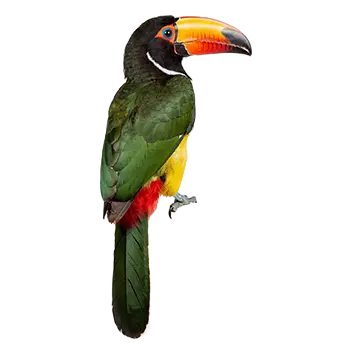
The most immediately striking and defining feature of Green Aracaris is their spectacular, large, multi-colored bill, which dominates their appearance and serves as their most distinctive characteristic. The bill is substantial relative to body size, measuring approximately 3-4 inches in length and appearing almost comically oversized. Despite its impressive dimensions, the bill is surprisingly lightweight due to its hollow internal structure with bony struts, allowing aracaris to maneuver without being unbalanced. The bill coloration is complex and beautiful: the upper mandible (maxilla) shows predominantly deep green coloration along most of its length with a broad yellow vertical band near the base and red coloration at the culmen (ridge along the top). The lower mandible (mandible) is predominantly black with yellow along the base and cutting edge. The bill's colors are vivid and glossy, creating stunning visual impact. The exact pattern and intensity of colors vary slightly between individuals, with some showing more extensive yellow or red. The bill's serrated tomia (cutting edges) create a saw-toothed appearance visible up close.

The head is relatively small in proportion to the bill, predominantly covered in dark greenish-black plumage. The crown and nape show this dark green-black coloration. Behind the eye, a distinctive bare skin patch shows bright blue coloration, creating striking contrast with the dark plumage and adding additional color to the already spectacular appearance. The eyes themselves are surrounded by this blue bare skin. The eyes are red to reddish-brown in adults, creating another vivid color element. The combination of green bill, blue eye skin, and red eyes creates an extraordinary array of colors concentrated in the head region.

The throat and upper chest display bright yellow coloration, creating a bib or collar effect contrasting with the darker plumage above and green plumage below. This yellow throat is one of the Green Aracari's distinctive field marks. A black band extends across the chest below the yellow throat, separating it from the lower body plumage. The extent and width of this black band vary slightly between individuals.

The body plumage is predominantly bright yellowish-green to emerald-green throughout the back, wings, and underparts below the chest band. This green plumage shows varying intensity and shade depending on lighting, appearing brilliant emerald in good light. The feathers have a sleek, smooth texture creating a glossy appearance in healthy birds. The rump shows bright red coloration, visible when birds perch or move, adding yet another color to the already spectacular palette. The wings show the green coloration with darker flight feathers. The upperwing coverts are green while the primaries and secondaries are darker, creating subtle contrast visible in flight.

The tail is long and graduated (longer central feathers with progressively shorter outer feathers creating a wedge shape), predominantly dark green to blackish-green with the central tail feathers showing the longest length. The tail serves important functions in balance during perching and maneuvering through branches, with aracaris frequently flicking, spreading, or adjusting tail position.

The legs are relatively short and strong, gray-blue to bluish-gray in color. The feet are zygodactyl (two toes forward, two back) like woodpeckers and other Piciformes, differing from the anisodactyl arrangement of most perching birds. This foot structure is adapted for gripping branches and hopping along limbs rather than perching in typical passerine fashion. The toes are strong with sharp claws providing secure grip.

Sexual dimorphism in Green Aracaris is minimal, with males and females appearing essentially identical in plumage, bill coloration, and size. Behavioral differences exist, particularly regarding courtship behaviors and breeding roles, but visual sexing is unreliable. DNA sexing through blood or feather analysis provides the only reliable gender determination method. Some sources suggest males may average very slightly larger with marginally longer bills, but this difference is too subtle and inconsistent for practical identification.

Juvenile Green Aracaris show distinctly different appearance from adults, making age determination relatively straightforward. Young birds display shorter bills that gradually lengthen as birds mature, reaching adult proportions by 6-9 months. The bill coloration in juveniles is duller with less vibrant colors and more brownish or olive tones rather than the brilliant colors of adults. The plumage is duller overall with less intense green coloration and more olive or brownish tones. The bare blue eye skin is less extensive and less brightly colored. The eyes may show browner coloration rather than the bright red of adults. These juvenile characteristics gradually disappear through successive molts over the first year, with birds achieving full adult appearance and coloration by 12-18 months of age.

The overall impression of Green Aracaris is stunning beauty combining multiple vivid colors - green, yellow, red, black, and blue - in a compact, active package. Their appearance in good lighting is truly spectacular, with the iridescent greens, glossy bill colors, and bright accents creating one of nature's most colorful birds. This extraordinary beauty makes them highly desired in aviculture despite their extreme care demands. However, maintaining the vibrant plumage and glossy bill requires proper nutrition, appropriate housing, and excellent care, with poor conditions causing dull, lifeless appearance.

Affection Level
Green Aracaris show moderate affection levels that vary considerably between individuals and are expressed differently than typical parrots. Hand-raised aracaris can become quite bonded to their owners, seeking interaction through play, food sharing, and proximity rather than cuddling. They may regurgitate for favored humans showing pair-bonding behavior. However, they are less physically affectionate than cockatoos or similar species, showing affection through active engagement, playful interaction, and social inclusion rather than extensive physical contact. Their affection is energetic and dynamic rather than gentle and cuddly.
Sociability
Green Aracaris are extremely social birds with intense conspecific companionship needs, naturally living in small flocks of 5-15 individuals in the wild. They require either constant human interaction serving as flock substitutes or preferably housing with compatible conspecifics. Single aracaris demand enormous daily attention and often develop behavioral problems without adequate social engagement. Pairs or small groups housed together show natural behaviors and significantly reduced human-dependency. This extreme sociability represents one of their most demanding care requirements, making them inappropriate for anyone unable to provide constant companionship.
Vocalization
Green Aracaris are moderately to loud vocal birds producing distinctive croaking, yelping, and rattling calls audible for considerable distances. Their vocalizations are harsh and not particularly melodious, consisting of repetitive croaks, mechanical-sounding rattles, and sharp yelps used for contact calls and social communication. They vocalize frequently throughout the day, particularly during morning and evening activity peaks. While not as ear-splitting as large cockatoos, their calls are persistent, penetrating, and potentially annoying. They cannot talk or mimic speech, making their vocalizations purely natural calls.
Intelligence
Green Aracaris are highly intelligent birds demonstrating sophisticated problem-solving abilities, complex social cognition, excellent memory, curiosity driving extensive environmental exploration, and capacity for learning through observation and experience. They quickly learn cage layouts, understand cause-and-effect, figure out latches and closures, and manipulate objects creatively. Their intelligence requires substantial mental stimulation through environmental enrichment, foraging opportunities, novel objects, and interactive engagement. Understimulated aracaris become bored and develop destructive or neurotic behaviors, making their intelligence both appealing and demanding.
Exercise Needs
Green Aracaris have extremely high exercise needs, ranking among the most active pet bird species. They are in constant motion, hopping energetically between perches, flying short distances, investigating everything, playing with objects, and engaging in social interactions. They require enormous cages or preferably aviaries allowing extensive movement, multiple hours of daily supervised out-of-cage time, and constant activity opportunities. Their hyperactive nature makes them exhausting companions requiring owners who can accommodate their relentless energy. Inadequate exercise causes obesity, health problems, and severe behavioral issues.
Maintenance Level
Green Aracaris demand extreme maintenance levels matching or exceeding the most demanding parrots. Their specialized fruit-based diet requires extensive daily fresh food preparation and creates explosive, projectile droppings necessitating hours of daily cleaning of cages, surrounding areas, walls, and floors. They need enormous housing, complex social management if keeping groups, constant enrichment rotation, iron storage disease monitoring, and intensive daily care. The messiness alone is overwhelming, with fruit splatter and droppings creating constant cleaning demands. Only highly experienced, extremely dedicated aviculturists with unlimited time should consider these spectacular but extraordinarily demanding birds.
Trainability
Green Aracaris show moderate trainability, being intelligent and food-motivated but also hyperactive and easily distracted, making sustained training challenging. They can learn basic behaviors through positive reinforcement including step-up, target training, and simple tricks, though their constant motion and short attention spans require patience. They readily learn to manipulate enrichment devices and solve food puzzles. However, they cannot learn speech or complex trained routines like parrots. Training provides valuable mental stimulation but requires understanding their unique learning style and accommodating their hyperactive temperament.
Independence
Green Aracaris have extremely low independence, requiring constant companionship either from conspecifics or dedicated human caretakers serving as flock substitutes. They are intensely social birds who become severely stressed, depressed, and behaviorally disturbed without adequate social engagement. Single aracaris demand many hours of daily interaction, while pairs or groups require less human interaction but complex social management. This profound lack of independence makes them among the most demanding pet birds regarding social needs, appropriate only for people who can provide constant companionship or maintain appropriate groups.

Natural Habitat & Range

Green Aracaris inhabit the tropical rainforests of northern South America, with their range extending across the Amazon Basin region including parts of Venezuela, Guyana, Suriname, French Guiana, and northern Brazil primarily north of the Amazon River. This distribution covers extensive lowland tropical rainforest regions characterized by dense vegetation, high biodiversity, and stable warm humid conditions year-round. The species shows strong habitat specificity, occurring almost exclusively in primary and mature secondary tropical rainforest rather than degraded, open, or significantly modified habitats. Within appropriate forest habitat, they range from sea level to approximately 3,900 feet elevation, though they are most common in lowland regions below 2,600 feet.

Within their rainforest range, Green Aracaris inhabit the forest canopy and upper mid-story, rarely descending to ground level or lower forest strata. They prefer areas with abundant fruiting trees providing consistent food resources, mature forest with complex canopy structure offering numerous perching, roosting, and nesting sites, forest edges and clearings within predominantly forested landscapes where fruit availability may be enhanced, and gallery forests along rivers where forest extends along watercourses. They avoid completely open areas, heavily degraded forests lacking adequate canopy cover and fruit resources, and human-modified agricultural landscapes. Their ecology is intimately connected with intact tropical forest ecosystems.

The climate throughout the Green Aracari range is consistently tropical, characterized by warm temperatures year-round typically averaging 75-85°F with minimal seasonal variation, very high humidity generally 80-95%+ in undisturbed forest understory and canopy, heavy rainfall with annual precipitation typically exceeding 80-120+ inches depending on specific location, and relatively consistent conditions throughout the year though some areas experience slightly drier periods. These stable, warm, wet conditions support the lush rainforest ecosystems Green Aracaris require, with the continuous availability of fruiting trees ensuring year-round food resources.

Green Aracaris are highly social, gregarious birds living in small permanent flocks typically numbering 5-15 individuals year-round, including both breeding and non-breeding seasons. This permanent group living distinguishes them from many bird species that form pairs during breeding but flock at other times. Aracari flocks maintain cohesion through frequent vocal communication including contact calls, yelps, and rattles keeping group members aware of each other's locations while foraging through dense canopy. These vocalizations are loud and carry well through forest, functioning as important social bonds maintaining flock integrity.

The remarkable social behavior of wild Green Aracaris includes communal roosting in tree cavities, with entire flocks sleeping together in single cavities - an unusual behavior among birds. Multiple birds enter the roost cavity at dusk, arranging themselves in close contact often in stacked or overlapping positions due to limited space. This communal roosting provides thermoregulation benefits, predator protection through group vigilance, and reinforces social bonds. Finding adequate roost cavities limits flock size in some areas. In captivity, this communal roosting instinct means aracaris greatly benefit from enclosed sleeping boxes where they can huddle together, replicating natural behavior.

The daily activity pattern begins at dawn when flocks emerge from communal roost cavities with considerable vocalization, stretching, and social interaction before departing to forage. Morning hours are spent actively foraging in the forest canopy for fruits, their primary food source. Wild Green Aracaris feed predominantly on various fruits from numerous rainforest tree species, showing strong preference for small soft fruits including wild figs (Ficus species), berries, small tree fruits, and various tropical fruits. They select ripe fruits rich in sugars, water, and nutrients. The large bill allows reaching fruits on thin branches where heavier birds cannot access, providing competitive advantage. Foraging flocks move through the canopy with frequent vocalizations, hopping energetically between branches, reaching for fruits, and constantly moving in search of productive fruiting trees.

Beyond fruits, Green Aracaris supplement their diet with animal protein including insects (beetles, caterpillars, various invertebrates encountered while foraging), small vertebrates occasionally including tree frogs, lizards, or nestling birds opportunistically taken, and eggs raided from other species' nests when discovered. This protein supplementation is important nutritionally, particularly during breeding when protein demands increase. Their opportunistic predation on eggs and nestlings makes aracaris somewhat controversial among other bird species in mixed rainforest communities.

Feeding techniques include grasping fruits with the bill tip, tossing items into the air, and catching them in open gapes, allowing fruit to slide down the throat. This distinctive feeding method is characteristic of toucans and aracaris, with the serrated bill edges helping grip slippery fruits. During midday heat, flocks rest in shaded canopy areas, preening extensively, engaging in social interactions including allopreening (mutual grooming), and conserving energy during the hottest hours. Social behaviors are prominent, with flocks maintaining close proximity, touching, and interacting frequently. Late afternoon brings renewed intense foraging activity before flocks return to traditional roost sites at dusk with loud vocalizations and social interactions before entering roost cavities.

Breeding behavior in wild Green Aracaris occurs seasonally, typically timed with periods of peak fruit abundance ensuring adequate resources for raising young. Despite living in flocks, only one pair within each flock typically breeds per season in most cases, though occasionally multiple pairs may breed if conditions are optimal. The breeding pair is monogamous during the breeding attempt. Non-breeding flock members remain with the group and may assist with chick-rearing in some cases, showing cooperative breeding behaviors. Green Aracaris are cavity nesters, seeking natural tree cavities or occasionally using old woodpecker holes. Competition for suitable cavities can be intense. Both sexes participate in nest preparation, lining cavities with plant materials.

The female typically lays 2-4 white eggs which both parents incubate for approximately 16-17 days. Both parents and occasionally flock helpers feed chicks after hatching, providing regurgitated fruits and insects. Young fledge at approximately 45-50 days but remain dependent on parents and flock for additional weeks while learning to forage independently. Family groups remain together, with young birds often remaining with natal flocks for extended periods, contributing to the multi-generational flock structure observed in this species.

The conservation status of Green Aracaris is currently Least Concern according to the IUCN Red List, with reasonably stable populations across much of their range. The large overall range and presence in protected areas including numerous national parks and reserves provide some protection. However, the species faces ongoing threats including habitat loss from deforestation for agriculture, logging, and development destroying rainforest habitat, habitat fragmentation isolating populations and reducing genetic diversity, and illegal trapping for the pet bird trade with wild-caught birds unfortunately still entering trade despite legal protections and CITES regulations. Climate change may affect rainforest conditions and fruit availability long-term.

International trade in wild-caught Green Aracaris is regulated under CITES Appendix II, requiring permits and monitoring. Many range countries have implemented domestic laws protecting the species. However, enforcement is often inadequate, and illegal capture continues. The captive breeding population remains small, with only specialized aviculturists successfully reproducing these challenging species. Conservation efforts including rainforest habitat protection in parks and reserves, enforcement of wildlife trade laws, and promoting captive breeding reducing wild capture pressure are important for ensuring long-term wild population survival.

Temperament

Green Aracaris possess playful, highly social, extremely active, curious, and engaging temperaments that make them fascinating companions for highly experienced aviculturists, though their intense energy, complex social needs, potential for aggression, and demanding care requirements make them appropriate only for experts with extensive softbill experience, unlimited time, and realistic expectations about the extraordinary challenges these beautiful birds present. Understanding Green Aracari temperament requires recognizing these are not parrots and show fundamentally different behavioral patterns, social structures, and care needs compared to psittacines, making experience with toucans or similar softbills essential before attempting to maintain these spectacular but extraordinarily demanding birds.

The most defining characteristic of Green Aracari temperament is their extreme sociability and profound need for constant companionship, reflecting their natural ecology living in permanent small flocks year-round. Single aracaris kept without conspecific companions require enormous amounts of daily human interaction serving as flock substitutes - ideally many hours of direct contact, play, and engagement throughout waking hours. Without adequate social interaction, single aracaris develop severe behavioral problems including feather plucking, stereotypic pacing, aggression, excessive vocalization, depression, and neurotic behaviors indicating serious welfare compromise. This intense social dependence makes single aracari keeping extremely demanding and often unsuccessful.

The ideal housing situation for Green Aracaris is pairs or small groups (3-5 birds) housed together in very large aviaries, allowing natural flock behaviors, social interactions, and significantly reduced human-dependency. Compatible aracari groups show natural behaviors including communal roosting, allopreening, play, foraging together, and complex social dynamics observed in wild flocks. However, group management requires expertise understanding social compatibility, introducing birds carefully, monitoring for aggression, and managing potential breeding complications. Incompatible individuals can seriously injure or kill each other, requiring immediate separation. Group keeping, while more natural and welfare-positive, adds substantial complexity and requires very large housing.

The activity level of Green Aracaris is extraordinarily high, ranking among the most hyperactive pet bird species. These birds are in perpetual motion, rarely sitting still for more than brief moments. They hop energetically between perches with rapid, bouncing movements, fly short distances constantly within their enclosures, investigate every object, crack, and surface within reach, manipulate and toss objects, play with toys and enrichment devices, engage in social interactions, and maintain this frenetic pace throughout waking hours with only brief rest periods. This relentless activity is exhausting to observe and demands enormous housing providing adequate space for constant movement. Inadequately housed aracaris showing restricted movement develop obesity, health problems, and severe frustration manifesting as behavioral disturbances.

Playfulness is prominent in Green Aracari temperament, with these intelligent, curious birds showing great interest in toys, novel objects, and interactive activities. They enjoy tossing objects, playing catch or keep-away games with owners or other birds, investigating new enrichment, manipulating puzzle feeders, and engaging in creative play with available materials. They are less destructive than parrots, lacking the powerful crushing beaks of psittacines, but are persistent investigators who dismantle, explore, and manipulate everything within reach. Providing constant rotation of toys and enrichment is essential for mental stimulation. Understimulated aracaris become bored quickly and develop behavioral problems.

Curiosity drives much Green Aracari behavior, with these birds investigating their environment extensively and showing great interest in novel stimuli. This curiosity is appealing when observing their explorations but problematic when their investigations lead to dangerous situations. Aracaris have no fear of new objects or situations, boldly approaching and investigating anything interesting regardless of potential danger. This fearlessness requires extreme vigilance during out-of-enclosure time, as they readily investigate electrical cords, toxic materials, small gaps where they become trapped, or other hazards.

Bonding patterns in hand-raised Green Aracaris can be strong, with birds forming attachments to their caretakers and showing clear preferences. However, their bonding differs from parrots - less focused on physical contact and cuddling, more expressed through shared activities, play, proximity, and food sharing. Bonded aracaris may follow owners, vocalize excitedly when owners appear, seek interaction through play and food begging, and show obvious excitement during interactions. However, they are less likely to sit quietly cuddling compared to many parrots, with their interactions being more dynamic and energetic. Some aracaris may regurgitate for favored humans, showing pair-bonding behavior typically directed toward mates, indicating strong attachment.

Aggression can be significant in Green Aracaris, particularly during breeding condition or when territorial. Their bills, while less powerful than parrot beaks, can deliver painful, deep pecks causing bleeding and injury. Aracaris may attack hands reaching into enclosures, show aggression toward certain people while accepting others, defend food or favored items, or display unpredictable aggressive outbursts. Understanding body language indicating aggression - raised feathers, spread wings, open bill, direct stare - helps avoid attacks. Breeding pairs become particularly aggressive defending nest sites. Managing aggression requires patience, respect for their space, and avoiding situations triggering attacks.

Vocalization in Green Aracaris is moderate to loud, consisting of distinctive croaking, yelping, rattling calls used for contact and social communication. Their natural vocalizations are harsh, mechanical-sounding, and not particularly melodious, though most owners find them less annoying than parrot screaming due to the calls' rhythmic, predictable nature. Aracaris vocalize frequently throughout the day, particularly during morning and evening activity peaks, when excited, or when seeking attention. The volume is substantial, audible throughout homes and potentially to neighbors depending on housing situation. They absolutely cannot talk or mimic speech, making their vocalizations purely natural calls.

The messiness of Green Aracaris rivals or exceeds the most difficult parrots and matches other frugivorous softbills like Hill Mynahs. Their fruit-based diet produces explosive, projectile droppings that are substantial, wet, and flung considerable distances. They defecate extremely frequently - every 10-15 minutes during active periods - creating constant cleaning demands. Additionally, they are extraordinarily messy eaters, tossing fruit, flinging food particles, splashing water, and creating debris throughout and around feeding areas. The walls, floors, perches, and all surfaces within and around aracari enclosures become coated with fruit splatter and droppings requiring hours of daily cleaning. This extreme messiness is not a behavioral flaw but biological reality of frugivorous birds with rapid metabolism and efficient digestive systems producing constant waste.

Green Aracaris require owners who can provide enormous housing (large aviaries rather than cages), understand and accept extreme messiness requiring hours of daily cleaning, have extensive experience with softbills or toucans specifically, can provide highly specialized fruit-based diet with careful iron management, can accommodate intense social needs through constant interaction or maintaining compatible groups, can tolerate persistent loud vocalizations, have financial resources for expensive specialized diets and veterinary care, and have unlimited time for providing enrichment, interaction, and extensive maintenance. They are completely inappropriate for first-time bird owners, anyone without extensive softbill or toucan experience, people with limited time or resources, those unable to provide enormous housing, anyone unable to tolerate extreme messiness, and those seeking quiet, low-maintenance, or cuddly companions. However, for highly experienced expert aviculturists willing to meet their extraordinary demands - Green Aracaris provide spectacular beauty, fascinating behaviors, and engaging personalities creating truly remarkable avicultural experiences for those capable of providing appropriate care for these magnificent but extraordinarily challenging birds.

Care Requirements

Green Aracaris require extraordinarily large, specialized housing substantially exceeding typical parrot cage sizes, emphasizing both enormous space for their extreme activity level and practical design facilitating the constant intensive cleaning their messiness demands. Standard parrot cages are completely inadequate for these hyperactive birds regardless of size. The absolute minimum housing for a single Green Aracari or compatible pair is a custom-built flight cage or small aviary measuring at least 6 feet long by 4 feet wide by 6 feet tall, though significantly larger is strongly preferred - ideally 8-12+ feet long by 6+ feet wide by 6-8+ feet tall providing adequate space for their constant flying, hopping, and energetic movement. For groups of 3-5 birds, provide enormous aviaries measuring minimum 12+ feet long by 8+ feet wide by 8+ feet tall or larger. These dimensions reflect the extreme exercise needs and hyperactive nature of aracaris who literally never stop moving during waking hours.

Housing construction requires special considerations for both the birds' needs and the extreme messiness. Stainless steel frames with appropriate bar spacing (1-1.5 inches) provide durability, ease of cleaning, and resistance to corrosion from acidic fruit-based droppings. Many successful aracari keepers construct custom aviaries with walls made of easily cleanable materials including sealed concrete block, tile, or sealed wood that can be hosed down, vinyl or tile flooring with drains allowing hosing and pressure washing, enclosed or partially enclosed sides containing explosive droppings and food splatter, excellent ventilation through screened openings preventing humidity buildup while containing mess, and complete separation from living areas due to the overwhelming mess these birds create. Purpose-built toucan rooms or outdoor aviaries are often necessary for successful long-term keeping.

Outdoor aviaries in appropriate climates (warm, humid regions) work well for Green Aracaris, providing natural sunlight for vitamin D synthesis, excellent ventilation, enormous space, and easier mess management. However, outdoor housing requires protection from predators through secure construction, covered areas providing shade and weather protection, heating if temperatures drop below 60°F, and monitoring preventing escape or predator access. Many keepers use combination indoor/outdoor systems allowing birds outdoor access during suitable weather while providing indoor housing during poor conditions.

Perches should vary in diameter from approximately 3/4 to 1.5 inches, sized appropriately for aracari feet which are relatively small despite the birds' overall size. Natural wood branches from safe tree species make ideal perches providing varied diameters, textures, and angles. Position numerous perches at varying heights and locations throughout the enclosure allowing extensive hopping and short flights between perches - aracaris utilize all available space rather than staying in restricted areas. Avoid overcrowding that limits movement, but provide abundant perching options. Horizontal perches are most important as aracaris move primarily horizontally rather than climbing vertically. Expect to clean or replace perches frequently as they become heavily soiled with droppings and food debris.

Toys and enrichment are essential for these intelligent, curious, hyperactive birds requiring constant mental stimulation. Provide toys that can be manipulated including bells, balls, hanging toys they can swing, foraging devices hiding food rewards encouraging natural food-seeking behaviors, puzzle feeders requiring problem-solving, novel objects for investigation regularly rotated maintaining novelty, natural branches with leaves and buds for exploration, and play items encouraging their tossing behaviors. Aracaris are less destructive than parrots but persistent investigators. Some favorite items may last months while others are quickly disassembled or ignored. Observe individual preferences and provide accordingly.

Feeding stations require thoughtful management. Use multiple heavy, wide-based dishes or attached crock-style bowls preventing tipping positioned at various locations encouraging foraging movement rather than sedentary feeding. Expect to clean and refill dishes 3-4+ times daily as aracaris defecate in food and water constantly and fling food creating contamination. Elevated feeding stations positioning dishes slightly above perch level may minimally reduce direct defecation though this only partially helps. Provide separate dishes for different food types (various fruits, vegetables, protein sources, pellets if offered) and multiple clean water sources throughout the enclosure.

Sleeping boxes replicating the communal roost cavities aracaris use in the wild provide important welfare benefits. Install enclosed wooden boxes with entrance holes sized appropriately (4-5 inch diameter) positioned in the upper portions of enclosures allowing birds to sleep together in natural fashion. Groups huddle together in these boxes at night, maintaining social bonds and thermoregulation. Single birds also benefit from sleeping boxes providing security. Clean sleeping boxes weekly minimum as they become soiled with droppings.

Cleaning Green Aracari housing requires extraordinary commitment exceeding even demanding parrot species. Daily tasks include removing droppings from floors, perches, walls, and all surfaces (multiple times daily), washing all food and water dishes thoroughly (3-4+ times daily), wiping down walls and barriers removing fruit splatter, replacing substrate or cleaning floors, cleaning toys and enrichment devices, and removing visible debris throughout enclosure. Weekly tasks include complete enclosure disassembly if possible and comprehensive sanitization, pressure washing floors and walls in outdoor or purpose-built facilities, thorough washing or replacement of all perches, complete toy rotation and washing, deep cleaning of sleeping boxes, and sanitization of surrounding areas. The time commitment is overwhelming - expect 1-2+ hours daily cleaning and 4-6+ hours weekly for comprehensive maintenance. This cleaning burden cannot be overstated and represents one of the most significant challenges of aracari keeping.

Environmental conditions affect health and comfort. Green Aracaris tolerate temperatures 70-85°F comfortably, preferring warmth reflecting tropical origins. They are intolerant of cold, requiring heating if temperatures drop below 65°F and becoming stressed below 60°F. Maintain humidity 60-80% replicating tropical conditions and supporting respiratory health, though ensuring excellent airflow and ventilation preventing stagnant humid air promoting fungal growth is critical. This balance between adequate humidity and proper ventilation is challenging but essential. UV lighting exposure for 10-12 hours daily supports vitamin D synthesis and calcium metabolism, particularly important for birds housed indoors. Natural sunlight in outdoor or window-adjacent aviaries provides optimal UV exposure if safe and appropriate.

Out-of-enclosure time in homes is generally inadvisable for Green Aracaris due to their extreme messiness, constant droppings, fearless investigation of hazards, and difficulty recapturing once loose. Their relentless energy and curiosity lead them to investigate everything including dangerous electrical cords, toxic materials, and gaps where they become trapped. The droppings they produce every 10-15 minutes create unmanageable mess throughout exercise areas. If allowing supervised out-of-enclosure time, use designated bird-safe rooms with easily cleaned floors, remove all hazards, provide landing perches and play areas, protect walls and floors with barriers, and supervise constantly. Most successful aracari keepers provide enormous in-enclosure space rather than out-of-enclosure exercise, finding the mess and hazards of free flight impractical.

Feeding & Nutrition

Proper nutrition for Green Aracaris is absolutely critical, fundamentally different from seed-based or standard pellet-based parrot diets, requiring specialized knowledge and substantial daily commitment to fresh food preparation with meticulous attention to iron content - the most serious nutritional consideration for all toucan family members. Green Aracaris are frugivorous softbills requiring diets dominated by fresh fruits with careful supplementation, replicating their natural ecology as canopy fruit specialists. Understanding and implementing proper low-iron frugivorous nutrition is not optional but essential for preventing iron storage disease and ensuring health and longevity.

Fresh fruits should comprise 60-70% of daily diet, serving as the nutritional foundation. Appropriate fruits naturally low to moderate in iron include papaya (excellent choice, readily accepted), mango, grapes (halved preventing choking hazards), various berries including blueberries, strawberries, raspberries, and blackberries, melon including cantaloupe, honeydew, and watermelon, apple (seeds removed as toxic), pear, kiwi, figs, pomegranate, dragon fruit, star fruit, and various other tropical fruits when available. Offer extensive variety daily ensuring diverse nutrient intake, rotating fruits maintaining interest, and preventing nutritional imbalances from overreliance on limited items. Cut fruits into appropriately-sized pieces aracaris can grasp with bill tips - approximately 1/2 to 1-inch cubes or pieces depending on fruit type. Remove uneaten fruits within 2-4 hours maximum preventing bacterial growth in warm conditions and reducing attraction of pests. Wash all fruits thoroughly removing pesticides or choose organic options. Strictly avoid avocado which is toxic to birds.

Critical dietary restrictions for iron management require completely avoiding or strictly limiting high-iron foods. Never feed raisins and other dried fruits which concentrate iron through water removal, red meat which is very high in heme iron, organ meats including liver, kidney, and heart which are extraordinarily high in iron, dark meat poultry which contains more iron than white meat, iron-fortified foods including commercial bird foods listing added iron, infant cereals fortified with iron, and vitamin/mineral supplements containing iron unless specifically prescribed by avian veterinarians for documented deficiency. Read all ingredient labels carefully, rejecting any foods listing iron fortification. Even foods generally considered healthy like spinach should be fed sparingly due to high iron content. This strict iron avoidance is non-negotiable for toucan health.

Fresh vegetables should comprise 10-20% of diet providing essential nutrients, though many Green Aracaris resist vegetables requiring persistent gradual introduction. Appropriate vegetables include grated or finely chopped carrot, cooked sweet potato, bell peppers (various colors), leafy greens in moderation (due to iron content in dark greens), green beans, peas, broccoli, and others. Mix vegetables with preferred fruits sometimes improving acceptance. Offer vegetables in small pieces allowing easy manipulation and consumption.

Specialized low-iron softbill pellets formulated specifically for toucans and toucanets can comprise 10-20% of diet if birds accept pellets, providing balanced nutrition while minimizing iron content. Several manufacturers produce toucan-specific formulations including Mazuri, Pretty Bird, and others. These pellets are formulated with dramatically reduced iron compared to standard parrot pellets which contain excessive iron for toucans. Offer pellets in separate dishes or mixed with fruits. Many aracaris initially resist pellets requiring patient introduction over weeks or months. Pellet acceptance is highly desirable providing nutritional insurance, though many birds never fully accept them making proper fresh food variety essential.

Protein sources must be provided carefully, comprising approximately 10-15% of diet. Appropriate protein sources include live or freeze-dried insects (mealworms, crickets, waxworms, other commercially available feeder insects), hard-boiled eggs including finely crushed shell for calcium (limited frequency due to potential iron in yolks), and very small amounts of cooked lean white meat chicken or turkey. Strictly avoid or limit organ meats, red meat, and excessive animal protein. Insects provide the most appropriate protein replicating natural diet. Protein requirements increase during breeding season and molt, requiring adjusted feeding.

Calcium supplementation is important particularly for breeding females and growing young birds. Provide finely ground cuttlebone mixed into soft foods, calcium supplements sprinkled on fruits following veterinary recommendations, or calcium-enriched insects (gut-loaded prey items). Monitor calcium status through blood testing and adjust supplementation as needed.

Vitamin supplementation requires caution. While aracaris benefit from vitamin supplementation particularly vitamin D3 for calcium metabolism if not receiving adequate UV exposure, never use supplements containing iron. Choose vitamin supplements specifically formulated for toucans or iron-free formulations. Provide supplements 2-3 times weekly rather than daily avoiding over-supplementation. Consult avian veterinarians experienced with toucans for specific recommendations. UV lighting exposure provides vitamin D3 synthesis naturally, potentially reducing supplementation needs.

Fresh, clean water must be constantly available in multiple large, heavy, stable dishes positioned at various locations throughout enclosures. Change water 3-4+ times daily minimum as Green Aracaris defecate in water almost immediately and constantly, creating unsanitary conditions requiring frequent refreshing. Some keepers use water bottles reducing contamination though ensuring birds learn to use bottles is essential. Provide separate bathing water if possible, as aracaris enjoy bathing and will use water dishes for this purpose.

Treats should be offered sparingly, using favorite fruits like grapes, berries, or mealworms for training rewards or special occasions. Avoid high-fat treats, nuts (high in fat and potentially high in iron), and seeds which are inappropriate for frugivorous birds. Never feed chocolate, avocado, caffeine, alcohol, excessive salt, onions, garlic, or other toxic foods.

Foraging enrichment provides important mental stimulation and replicates natural food-seeking behaviors. Hide food items in toys, puzzle feeders, paper bundles, or various locations throughout enclosures encouraging active searching. Vary food presentation maintaining novelty. Scatter some fruits requiring birds to hop to different locations rather than sedentary feeding at single stations. These activities provide mental engagement while encouraging beneficial movement.

Monitor body condition regularly by visual assessment and palpation if birds tolerate handling. Healthy Green Aracaris show well-muscled bodies with prominent keels (breastbones) as normal for their body type, though keels should not be razor-sharp. Heavy, rounded bodies suggest obesity requiring dietary reduction and increased activity. Thin, emaciated appearance indicates underfeeding or illness requiring veterinary evaluation. Most Green Aracaris consume approximately 1/4 to 1/2 cup of mixed food daily depending on activity level, body size, and individual metabolism, though requirements vary. During breeding and molt, birds require increased nutrition supporting reproduction or feather growth. Work with experienced avian veterinarians to develop optimal feeding protocols.

Green Aracari Health & Lifespan

Green Aracaris are moderately delicate birds with specific health vulnerabilities requiring knowledgeable preventive care, capable of living 15 to 20 years with optimal care though achieving longevity requires excellent nutrition, appropriate housing, and attentive management of health issues particularly iron storage disease and the various conditions affecting softbills. Iron storage disease (hemochromatosis) represents the single most serious health threat to captive Green Aracaris and all toucan family members, caused by excessive dietary iron accumulation in tissues particularly the liver, ultimately causing organ failure and death, with toucans and aracaris being extraordinarily susceptible due to evolutionary adaptation to low-iron fruit diets creating inability to properly regulate iron absorption when captive diets contain typical iron levels. Prevention requires strict adherence to low-iron dietary protocols including feeding predominantly fresh fruits naturally low in iron, using specialized low-iron softbill pellets if pellets are offered, completely avoiding high-iron foods including red meat, organ meats, dark meat poultry, iron-fortified foods, raisins and other dried fruits high in concentrated iron, and never providing vitamin/mineral supplements containing iron without specific veterinary recommendation based on documented deficiency through blood testing. Regular blood testing monitoring iron levels annually or twice-yearly allows early detection and intervention. Once iron storage disease develops, treatment is extremely difficult with poor prognosis, though aggressive chelation therapy combined with strict low-iron diets may slow progression in some cases. Aspergillosis, a potentially fatal fungal respiratory infection, commonly affects softbills including aracaris kept in humid conditions with inadequate ventilation or exposed to moldy food, producing gradual respiratory deterioration requiring prolonged difficult antifungal treatment with frequent treatment failures. Bacterial infections including respiratory infections and gastrointestinal infections affect aracaris kept in unsanitary conditions or exposed to spoiled food, requiring prompt antibiotic treatment and improved hygiene. Obesity commonly affects captive aracaris fed inappropriate diets high in fat or low in activity opportunities, leading to fatty liver disease, reduced lifespan, and compromised health requiring dietary management and dramatically increased exercise. Metabolic bone disease can result from calcium deficiency or vitamin D3 deficiency particularly in young growing birds, causing weak bones, deformities, fractures, and potentially life-threatening complications requiring calcium supplementation, vitamin D3 supplementation, and UV lighting exposure. Beak abnormalities including overgrowth, misalignment, or damage can develop from nutritional deficiencies, metabolic disorders, or trauma, sometimes requiring veterinary correction including beak trimming or surgical intervention. Gout can develop in aracaris fed inappropriate high-protein diets particularly those emphasizing organ meats or excessive animal protein, causing painful joint swelling and potentially fatal complications requiring dietary modifications. Parasites including intestinal worms and external parasites affect aracaris particularly those housed outdoors or exposed to wild birds, requiring fecal testing and appropriate antiparasitic treatment. Feather plucking and self-mutilation can develop in bored, socially deprived, or stressed aracaris, requiring comprehensive behavioral evaluation and environmental modifications. Egg binding affects female aracaris laying eggs without adequate calcium or appropriate conditions, creating life-threatening emergencies requiring immediate veterinary intervention. Trauma from flying into obstacles, fighting between incompatible individuals, or injuries during handling can cause fractures, head trauma, or other serious injuries requiring emergency veterinary care. Regular veterinary checkups with experienced avian veterinarians knowledgeable about toucan and softbill-specific health issues form essential foundation of preventive care, with annual wellness examinations strongly recommended and twice-yearly exams advisable for birds over 10 years or those with health concerns. Blood testing monitoring iron levels should be performed annually minimum in all toucans and aracaris given the severe threat of iron storage disease, with twice-yearly testing advisable for at-risk birds. During wellness visits, veterinarians perform thorough physical examinations including weight assessment on gram scales, body condition evaluation, respiratory assessment, abdominal palpation checking for liver enlargement suggesting iron storage disease, beak examination, and may recommend comprehensive blood testing including complete blood counts, chemistry panels, iron studies (serum iron, total iron-binding capacity, ferritin), radiographs or other imaging, fecal testing for parasites, and other diagnostics. Proper diet and nutrition for Green Aracaris is critically important, fundamentally different from seed-based or pellet-based parrot diets, requiring specialized frugivorous feeding protocols emphasizing low-iron content. The diet should consist primarily of fresh fruits comprising 60-70% of daily intake including papaya, mango, grapes (halved to prevent choking), various berries (blueberries, strawberries, raspberries, blackberries), melon (cantaloupe, honeydew, watermelon), apple (seeds removed), pear, banana (limited due to high sugar and potential iron content), kiwi, figs, pomegranate, and various tropical fruits when available. Offer extensive variety daily ensuring diverse nutrient intake. Fresh vegetables comprising 10-20% including grated carrot, sweet potato, leafy greens, bell peppers, and other vegetables provide nutrients though many aracaris resist vegetables. Specialized low-iron softbill pellets formulated specifically for toucans can comprise 10-20% of diet if birds accept pellets, though many resist pellets. Protein sources including live or freeze-dried insects (mealworms, crickets, waxworms), small amounts of hard-boiled eggs, and very limited lean poultry should comprise approximately 10-15% of diet, avoiding red meat, organ meats, and other high-iron proteins. Avoid completely iron-fortified foods, raisins and dried fruits, red meat, organ meats, dark meat poultry, monkey biscuits, dog food, cat food, and other inappropriate high-iron items. Never use standard parrot pellets which contain excessive iron for toucans. Calcium supplementation through finely ground cuttlebone mixed into food or calcium supplements is important particularly for breeding females and growing youngsters. Fresh clean water must be constantly available in multiple heavy dishes changed 3-4+ times daily as aracaris defecate in water immediately and constantly. Environmental cleanliness is absolutely critical given extreme messiness, requiring multiple daily cleanings removing droppings and food debris from all surfaces, daily thorough washing of all dishes, perches, and toys, weekly comprehensive enclosure sanitization, and constant attention to hygiene preventing bacterial and fungal growth in food-contaminated environments. Appropriate housing providing enormous space, excellent ventilation preventing humid stagnant air promoting fungal growth, and UV lighting supporting vitamin D synthesis and calcium metabolism are essential. Extensive exercise through constant activity in large aviaries maintains health and prevents obesity.

Common Health Issues

  • Aspergillosis, a potentially fatal fungal respiratory infection, commonly affects softbills including aracaris kept in humid conditions with inadequate ventilation or exposed to moldy food, producing gradual respiratory deterioration requiring prolonged difficult antifungal treatment with frequent treatment failures.
  • Bacterial infections including respiratory infections and gastrointestinal infections affect aracaris kept in unsanitary conditions or exposed to spoiled food, requiring prompt antibiotic treatment and improved hygiene.
  • Obesity commonly affects captive aracaris fed inappropriate diets high in fat or low in activity opportunities, leading to fatty liver disease, reduced lifespan, and compromised health requiring dietary management and dramatically increased exercise.
  • Feather plucking and self-mutilation can develop in bored, socially deprived, or stressed aracaris, requiring comprehensive behavioral evaluation and environmental modifications.
  • Egg binding affects female aracaris laying eggs without adequate calcium or appropriate conditions, creating life-threatening emergencies requiring immediate veterinary intervention.
  • During wellness visits, veterinarians perform thorough physical examinations including weight assessment on gram scales, body condition evaluation, respiratory assessment, abdominal palpation checking for liver enlargement suggesting iron storage disease, beak examination, and may recommend comprehensive blood testing including complete blood counts, chemistry panels, iron studies (serum iron, total iron-binding capacity, ferritin), radiographs or other imaging, fecal testing for parasites, and other diagnostics.
  • Extensive exercise through constant activity in large aviaries maintains health and prevents obesity.\n\nOwners must recognize illness signs including lethargy or dramatic decrease in activity level (particularly concerning in normally hyperactive aracaris), loss of appetite or refusing food, difficulty breathing or respiratory sounds, changes in droppings including diarrhea, blood, or color changes, fluffed feathers, abdominal swelling potentially indicating liver disease from iron storage, weakness or inability to perch properly, and sudden behavior changes.

Preventive Care & Health Monitoring

  • Green Aracaris are moderately delicate birds with specific health vulnerabilities requiring knowledgeable preventive care, capable of living 15 to 20 years with optimal care though achieving longevity requires excellent nutrition, appropriate housing, and attentive management of health issues particularly iron storage disease and the various conditions affecting softbills.
  • Prevention requires strict adherence to low-iron dietary protocols including feeding predominantly fresh fruits naturally low in iron, using specialized low-iron softbill pellets if pellets are offered, completely avoiding high-iron foods including red meat, organ meats, dark meat poultry, iron-fortified foods, raisins and other dried fruits high in concentrated iron, and never providing vitamin/mineral supplements containing iron without specific veterinary recommendation based on documented deficiency through blood testing.
  • Metabolic bone disease can result from calcium deficiency or vitamin D3 deficiency particularly in young growing birds, causing weak bones, deformities, fractures, and potentially life-threatening complications requiring calcium supplementation, vitamin D3 supplementation, and UV lighting exposure.
  • Beak abnormalities including overgrowth, misalignment, or damage can develop from nutritional deficiencies, metabolic disorders, or trauma, sometimes requiring veterinary correction including beak trimming or surgical intervention.
  • Egg binding affects female aracaris laying eggs without adequate calcium or appropriate conditions, creating life-threatening emergencies requiring immediate veterinary intervention.
  • Trauma from flying into obstacles, fighting between incompatible individuals, or injuries during handling can cause fractures, head trauma, or other serious injuries requiring emergency veterinary care.\n\nRegular veterinary checkups with experienced avian veterinarians knowledgeable about toucan and softbill-specific health issues form essential foundation of preventive care, with annual wellness examinations strongly recommended and twice-yearly exams advisable for birds over 10 years or those with health concerns.

Regular veterinary checkups with experienced avian veterinarians knowledgeable about toucan and softbill-specific health issues form essential foundation of preventive care, with annual wellness examinations strongly recommended and twice-yearly exams advisable for birds over 10 years or those with health concerns. Blood testing monitoring iron levels should be performed annually minimum in all toucans and aracaris given the severe threat of iron storage disease, with twice-yearly testing advisable for at-risk birds. During wellness visits, veterinarians perform thorough physical examinations including weight assessment on gram scales, body condition evaluation, respiratory assessment, abdominal palpation checking for liver enlargement suggesting iron storage disease, beak examination, and may recommend comprehensive blood testing including complete blood counts, chemistry panels, iron studies (serum iron, total iron-binding capacity, ferritin), radiographs or other imaging, fecal testing for parasites, and other diagnostics. Proper diet and nutrition for Green Aracaris is critically important, fundamentally different from seed-based or pellet-based parrot diets, requiring specialized frugivorous feeding protocols emphasizing low-iron content. The diet should consist primarily of fresh fruits comprising 60-70% of daily intake including papaya, mango, grapes (halved to prevent choking), various berries (blueberries, strawberries, raspberries, blackberries), melon (cantaloupe, honeydew, watermelon), apple (seeds removed), pear, banana (limited due to high sugar and potential iron content), kiwi, figs, pomegranate, and various tropical fruits when available. Offer extensive variety daily ensuring diverse nutrient intake. Fresh vegetables comprising 10-20% including grated carrot, sweet potato, leafy greens, bell peppers, and other vegetables provide nutrients though many aracaris resist vegetables. Specialized low-iron softbill pellets formulated specifically for toucans can comprise 10-20% of diet if birds accept pellets, though many resist pellets. Protein sources including live or freeze-dried insects (mealworms, crickets, waxworms), small amounts of hard-boiled eggs, and very limited lean poultry should comprise approximately 10-15% of diet, avoiding red meat, organ meats, and other high-iron proteins. Avoid completely iron-fortified foods, raisins and dried fruits, red meat, organ meats, dark meat poultry, monkey biscuits, dog food, cat food, and other inappropriate high-iron items. Never use standard parrot pellets which contain excessive iron for toucans. Calcium supplementation through finely ground cuttlebone mixed into food or calcium supplements is important particularly for breeding females and growing youngsters. Fresh clean water must be constantly available in multiple heavy dishes changed 3-4+ times daily as aracaris defecate in water immediately and constantly. Environmental cleanliness is absolutely critical given extreme messiness, requiring multiple daily cleanings removing droppings and food debris from all surfaces, daily thorough washing of all dishes, perches, and toys, weekly comprehensive enclosure sanitization, and constant attention to hygiene preventing bacterial and fungal growth in food-contaminated environments. Appropriate housing providing enormous space, excellent ventilation preventing humid stagnant air promoting fungal growth, and UV lighting supporting vitamin D synthesis and calcium metabolism are essential. Extensive exercise through constant activity in large aviaries maintains health and prevents obesity. Owners must recognize illness signs including lethargy or dramatic decrease in activity level (particularly concerning in normally hyperactive aracaris), loss of appetite or refusing food, difficulty breathing or respiratory sounds, changes in droppings including diarrhea, blood, or color changes, fluffed feathers, abdominal swelling potentially indicating liver disease from iron storage, weakness or inability to perch properly, and sudden behavior changes. Aracaris often mask symptoms until diseases are very advanced, making regular veterinary monitoring through wellness exams and blood testing essential for early detection. With appropriate specialized diet strictly emphasizing low-iron foods, excellent environmental hygiene managing extreme messiness, regular veterinary care including annual iron level monitoring, enormous housing allowing constant exercise, and attentive observation, Green Aracaris can live 15-20+ years as spectacular companions, though achieving this longevity requires dedicated expert care throughout their lives.

Training & Vocalization

Green Aracaris show moderate trainability, being highly intelligent and food-motivated but also hyperactive, easily distracted, and possessing short attention spans making sustained training sessions challenging. They respond to positive reinforcement training methods using preferred food rewards like grapes, berries, or mealworms, learning basic behaviors and simple tricks through patient, consistent training. However, their training differs substantially from parrots in both methods and realistic goals, reflecting fundamental differences in cognitive style, attention span, and motivation between toucan family members and psittacines.

Basic training focuses on practical management behaviors essential for successful aracari keeping. Step-up training teaches birds to reliably step onto offered hands, sticks, or perches on command, facilitating safe handling for health checks, cage transfers, or emergency situations. Target training teaches birds to touch a target stick with their bills, useful for guiding movement, conducting health examinations, or beginning more complex training. Recall training can teach flight to handlers on command if birds receive supervised out-of-cage time, though this is less commonly practiced with aracaris given their extreme messiness and difficulty recapturing once loose. Station training teaches birds to remain on designated areas or perches, useful for veterinary examinations or temporary restraint.

Training sessions should be very brief - 3-5 minutes maximum - due to aracaris' short attention spans and constant need for movement. Multiple brief sessions throughout the day are more effective than single long sessions. Always end sessions positively before frustration develops, maintaining birds' enthusiasm for future training. Use high-value food rewards that birds particularly love, timing rewards precisely to mark desired behaviors. Some trainers use clicker training with aracaris, finding the distinct click sound helps communicate exactly which behaviors earn rewards, accelerating learning.

More advanced training can include simple tricks providing mental stimulation and strengthening human-bird bonds. Possibilities include turning in circles on command, spreading wings for examination, retrieving objects, playing basketball or similar games with appropriately-sized equipment, performing sequences combining multiple behaviors, and various other activities limited only by trainer creativity and bird capability. However, realistic expectations are essential - aracaris will never achieve the complex trick repertoires of talented parrots, with their training being more limited but still valuable for enrichment and relationship-building.

Foraging training and puzzle-solving provide particularly appropriate activities for Green Aracaris, engaging their intelligence while accommodating their hyperactive nature. Teaching birds to manipulate puzzle feeders, unwrap food from paper, investigate boxes or containers hiding treats, or solve increasingly complex foraging challenges provides excellent mental stimulation. Many aracaris show impressive problem-solving abilities when motivated by food rewards, figuring out latches, removing lids, or manipulating devices to access hidden treats.

Socialization throughout life helps maintain confident, well-adjusted Green Aracaris. Expose young birds to varied people, experiences, novel objects, and different environments during critical early development periods while monitoring for stress. Continue regular positive interactions with multiple people preventing extreme favoritism or fear of unfamiliar individuals. Well-socialized aracaris adapt more readily to necessary changes including veterinary visits, housing modifications, or caretaker changes.

Vocalization in Green Aracaris consists entirely of natural calls as these birds absolutely cannot talk, mimic speech, or learn sounds like parrots or mynahs. Their vocal repertoire includes distinctive croaking calls sounding somewhat frog-like, harsh yelping sounds, mechanical rattling calls, and various contact calls maintaining flock cohesion. These vocalizations serve natural communication functions including maintaining contact with flock members while foraging through dense canopy, signaling alarm at potential threats, coordinating group movements, and social bonding. The calls are loud and carry well, audible throughout houses and potentially to neighbors depending on proximity.

The volume of Green Aracari vocalizations is moderate to loud, though generally less ear-splitting than large cockatoos or macaws. Most owners find the calls less annoying than parrot screaming due to their rhythmic, predictable nature rather than mindless repetitive screaming. However, the volume is substantial and persistent, with birds vocalizing frequently throughout the day particularly during morning and evening activity peaks. Prospective owners must honestly assess noise tolerance and living situations, as aracaris are inappropriate for apartments or situations where neighbors are very close and noise-sensitive.

Vocalization frequency varies based on social context, activity level, and individual personality. Single aracaris may vocalize more seeking contact with human flock substitutes, while birds housed in compatible groups vocalize frequently in social communication but may be less attention-seeking. Excited, active birds vocalize more than calm, settled birds. Some individuals are naturally more vocal while others are relatively quiet. However, all Green Aracaris vocalize substantially as a normal aspect of their behavior.

Owners should appreciate Green Aracaris for their spectacular beauty, fascinating behaviors, engaging personalities, and remarkable activity rather than expecting trainability, vocalizations, or behaviors similar to parrots. These are fundamentally different birds requiring appreciation on their own terms, with their appeal being visual, behavioral, and interactive rather than vocal or extensively trainable. Their hyperactive energy, playfulness, and curious investigations create entertaining observations for dedicated owners willing to meet their extraordinary care demands.

Children & Other Pets

Integrating Green Aracaris into households with children or other pets is generally inadvisable and potentially dangerous, with these birds being fundamentally inappropriate for family situations due to their potential for aggression causing serious injuries, extreme messiness creating hygiene and property damage concerns, complex specialized care requirements beyond most families' capabilities, loud persistent vocalizations, and substantial costs. Green Aracaris rank among the most challenging pet birds, appropriate only for adult expert aviculturists rather than families with children, making family integration extremely problematic with rare exceptions.

Regarding children, Green Aracaris present multiple serious concerns creating substantial safety risks. These birds possess large, strong bills capable of delivering extremely painful, deep pecks causing significant bleeding, bruising, lacerations, and injuries potentially requiring medical attention including stitches. Unlike smaller birds whose bites are merely painful, aracari attacks can cause genuine harm requiring emergency care. Their bills feature serrated edges creating tearing injuries worse than clean cuts. Children's faces, hands, and exposed skin are particularly vulnerable to serious injury from aggressive aracaris.

Aggression in Green Aracaris can be unpredictable, with birds sometimes attacking without obvious provocation or warning. Territorial birds may attack anyone approaching enclosures. Breeding birds become particularly aggressive defending nest sites. This unpredictability creates serious safety concerns with children who cannot recognize subtle behavioral cues indicating impending attacks or understand appropriate precautions. Even hand-raised, previously friendly aracaris may suddenly become aggressive during breeding season or for unknown reasons, making them unreliable around children regardless of prior behavior.

The extreme messiness of Green Aracaris creates severe hygiene concerns in households with children. Their explosive, projectile droppings contaminate surrounding areas extensively, creating unsanitary conditions if cleaning is inadequate. Young children crawling, playing, or touching contaminated surfaces may be exposed to droppings containing bacteria, creating health risks. The constant mess also damages furnishings, walls, floors, and property, highly problematic in family homes. The overwhelming cleaning demands - multiple hours daily - are incompatible with the time constraints of busy families raising children.

The complex specialized care requirements including low-iron fruit-based diets requiring extensive daily fresh food preparation, enormous housing requiring substantial space and financial investment, constant environmental enrichment, and intensive veterinary care exceed most families' capabilities. Parents working full-time while raising children rarely have the unlimited time, expertise, and financial resources successful aracari keeping requires. Children's enthusiasm for exotic pets typically wanes quickly when confronted with the overwhelming reality of aracari care, leaving parents responsible for 15-20 year commitments they never desired.

The loud, persistent vocalizations of Green Aracaris throughout the day create noise that may disturb sleeping infants, interfere with children's homework or quiet activities, and create household stress. The harsh, mechanical calls are not pleasant background sounds like some bird songs but rather penetrating, attention-demanding vocalizations impossible to ignore.

However, older, responsible teenagers in households with parents who are expert aviculturists may occasionally interact appropriately with family Green Aracaris under strict supervision and with comprehensive education. The spectacular beauty and fascinating behaviors can captivate mature young people interested in aviculture as potential careers. Teaching teenagers about specialized softbill care, the importance of meticulous dietary management, and the serious responsibilities of exotic bird keeping provides valuable lessons. However, parents must maintain primary responsibility for all care throughout the birds' 15-20 year lifespans.

Families considering Green Aracaris must establish absolutely strict safety rules including no unsupervised interaction between children and birds under any circumstances, no approaching enclosures without adult permission and supervision, immediate adult notification if birds display aggressive behaviors, no touching faces or allowing faces near birds, understanding these are not pets for touching but rather observation animals, and recognition that aracaris can cause serious injuries requiring respect and caution. However, given the overwhelming challenges, most families should not acquire Green Aracaris regardless of precautions.

Integrating Green Aracaris with other household pets is highly problematic and generally inadvisable. Cats represent serious predators whose presence creates chronic stress even without direct contact. Never allow cats access to aracari enclosures or areas. The birds' loud vocalizations may attract feline attention and hunting behaviors. Dogs pose threats and may be attacked by territorial aracaris defending their space. The birds' vocalizations may stress dogs particularly noise-sensitive breeds. If dogs and aracaris must coexist, maintain complete permanent separation with secure housing preventing any contact.

Small mammals including rabbits, guinea pigs, hamsters, and rodents should never be housed near Green Aracaris. Maintain complete separation preventing stress to either species.

Regarding other birds, Green Aracaris can potentially coexist with other species in very large aviaries if carefully managed, though this adds substantial complexity and risk. Never house aracaris with small finches, canaries, or delicate species they might injure or kill through aggression or accidental injury. Larger parrots may be compatible if both species are well-socialized and neither shows excessive aggression, though careful monitoring is essential. Some mixed-species softbill aviaries successfully house toucans, aracaris, and other compatible frugivorous species, though this requires expert management, enormous space, multiple feeding stations preventing competition, and constant vigilance for aggression. Most keepers house Green Aracaris in species-specific enclosures avoiding compatibility problems and simplifying management.

Successful households with Green Aracaris require expert aviculturists with extensive toucan experience, no young children or only older responsible teenagers, commitment to overwhelming daily cleaning managing extreme messiness, appropriate housing completely preventing pet access to birds, enormous financial resources for care, realistic expectations about challenges, and prioritization of bird welfare and family safety over anthropomorphic desires for pet interactions. Green Aracaris are fundamentally inappropriate for typical family situations, better suited to adult expert aviculturists without children where the extraordinary beauty and fascinating behaviors justify accepting the overwhelming challenges these magnificent but extraordinarily demanding birds present.