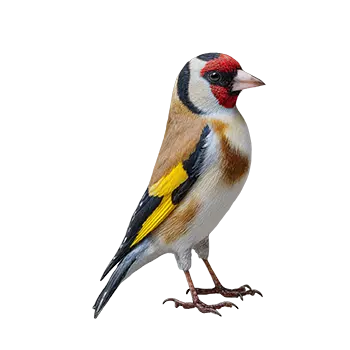

The European Goldfinch is scientifically classified as Carduelis carduelis, with both genus and species names derived from Latin 'carduus' meaning thistle, referencing the bird's strong association with and preference for thistle seeds, which form a major component of their natural diet. This nomenclature perfectly captures one of the species' most characteristic ecological relationships. The genus Carduelis historically encompassed numerous goldfinch and siskin species worldwide, though recent taxonomic revisions have led some authorities to place European Goldfinches in the genus Carduelis while others use Chloris, reflecting ongoing debate about finch phylogeny and classification.
The common name European Goldfinch directly references the species' primary geographic distribution across Europe and the striking golden-yellow wing bars that flash brilliantly during flight, creating one of the bird's most distinctive field marks. This species is distinguished from other goldfinch species including the American Goldfinch (Spinus tristis) and Lesser Goldfinch (Spinus psaltria) found in the Americas by plumage pattern, range, and subtle behavioral differences. In the United Kingdom, they are commonly called simply 'Goldfinch' as they are the only goldfinch species native to Britain, though the full name 'European Goldfinch' is used internationally to avoid confusion with other goldfinch species.
Historical and regional alternate names include Thistle Finch, referencing their dietary preferences, King Harry, and Draw-Water, an old folk name referring to a historical practice of using captive goldfinches in fairground attractions where trained birds would draw up small buckets of water. In various European languages, the species has names often referencing either the golden coloring or thistle association: French 'Chardonneret élégant' (elegant goldfinch), German 'Stieglitz,' Spanish 'Jilguero,' Italian 'Cardellino,' and Dutch 'Putter.' These names reflect the bird's long cultural history and widespread familiarity across Europe.
There are several recognized subspecies of Carduelis carduelis showing subtle variations in plumage and size across their extensive range. The nominate subspecies Carduelis carduelis carduelis occurs across much of western and central Europe. Carduelis carduelis britannica is found in Britain and Ireland, showing slightly darker and richer coloration. Carduelis carduelis tschusii inhabits Corsica, Sardinia, and Sicily. Carduelis carduelis balcanica occurs in the Balkans. Carduelis carduelis niediecki is found in the Middle East. Other subspecies exist across the species' extensive range, showing minor variations in the extent of red on the face, intensity of golden wing bars, and overall size. These subspecies intergrade where ranges meet, and differences are subtle, requiring expert identification.
In aviculture, European Goldfinches have been kept and bred for centuries, particularly in Europe where they have a long history as cage birds. They are sometimes referred to as 'wild canaries' in older literature, though they are unrelated to true canaries. Various color mutations have been developed through selective breeding including white, isabel (dilute), and agate variations, though the wild-type coloration remains most popular and widely available. The species' melodious song, attractive appearance, and relatively hardy nature have made them enduringly popular in aviculture, though regulations vary by country regarding their keeping, with some nations restricting or prohibiting private ownership while others allow captive-bred birds.