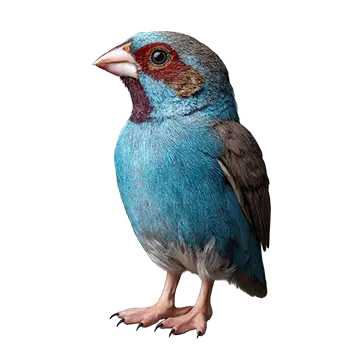

The Cordon Bleu Finch (Uraeginthus bengalus) derives its charming common name from the French phrase meaning "blue ribbon," a reference to the exquisite powder-blue plumage that adorns much of the bird's body and creates its most distinctive feature. This name evokes images of fine culinary excellence and haute cuisine, suggesting the bird's status as a prized, beautiful species among aviculture enthusiasts. The species is also commonly known as the Red-cheeked Cordon Bleu, distinguishing it from closely related species, or simply as the Cordon Bleu.
Taxonomically, the Cordon Bleu Finch belongs to the genus Uraeginthus within the family Estrildidae (estrildid finches or waxbills), a diverse group of small, often colorful finches native to Africa and Asia. The genus Uraeginthus contains several closely related species all displaying variations of blue plumage. The scientific name Uraeginthus bengalus combines Greek elements: "oura" (tail), "aix" (a waterbird), and "inthos" (small bird), while "bengalus" references Bengal, though the species does not actually occur in that region, representing a historical misattribution common in early taxonomic descriptions.
The Cordon Bleu complex includes three closely related species that are sometimes confused: Uraeginthus bengalus (Red-cheeked Cordon Bleu), the subject of this profile, which displays red cheek patches in males; Uraeginthus angolensis (Blue-breasted Cordon Bleu or Southern Cordon Bleu), which lacks red cheek patches and occurs in southern Africa; and Uraeginthus cyanocephalus (Blue-capped Cordon Bleu), which has blue extending onto the head and occurs in East Africa. These species are visually similar with subtle differences in coloration and geographic distribution, and they are all commonly referred to collectively as "Cordon Bleu Finches" in aviculture, though Uraeginthus bengalus is the most frequently kept species.
In aviculture and the pet trade, these distinctions are often blurred, with suppliers and breeders sometimes using "Cordon Bleu" to refer to any of the three species without clear specification. Prospective owners should clarify which species they are acquiring, though care requirements are similar across all three. The Red-cheeked Cordon Bleu (U. bengalus) is distinguished by males having distinctive red to rusty-red cheek patches that females lack, providing clear sexual dimorphism useful for breeding.
These beautiful finches have been popular in aviculture since the late 19th century when trade in exotic birds expanded and African finches became available to European and American bird keepers. They remain among the most sought-after and expensive softbill finches available in the pet trade today, prized for their stunning coloration, relatively peaceful temperament, and breeding success in captivity. The name "Cordon Bleu" has become synonymous with beauty and elegance in the finch-keeping hobby, commanding premium prices and devotion from specialized finch enthusiasts worldwide.