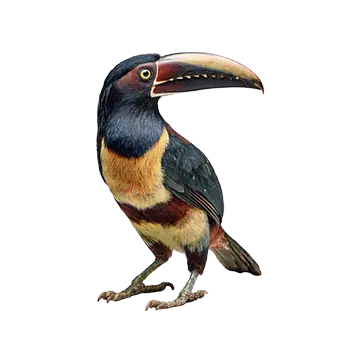

Collared Aracari

Collared Aracari
📸 Photo Gallery Coming Soon

Furry Critter Network Etsy Shop

Quick Facts

🔬 Scientific Name
Pteroglossus torquatus
🦜 Bird Type
Toucan
📊 Care Level
Expert
😊 Temperament
Active, Playful, Social
📏 Adult Size
15-16 inches
⏱️ Lifespan
15-20 years in captivity
🔊 Noise Level
Moderate to Loud
🗣️ Talking Ability
None
🍽️ Diet Type
Frugivorous (specialized)
🌍 Origin
Central America, northern South America
🏠 Min Cage Size
Large aviary required
📐 Size
Medium

Collared Aracari - Names & Recognition

The Collared Aracari is scientifically classified as Pteroglossus torquatus, belonging to the family Ramphastidae, which includes all toucans, toucanets, and aracaris. The genus name Pteroglossus derives from the Greek words 'pteron' (wing) and 'glossa' (tongue), referencing these birds' peculiar tongue anatomy. The specific epithet 'torquatus' comes from the Latin word for 'collared' or 'wearing a collar,' referring to the distinctive dark collar band separating the yellow breast from the colorful body plumage that gives the species its common name.

The common name Collared Aracari is universally used in English-speaking regions, with 'aracari' (pronounced ah-rah-SAH-ree or air-uh-SAH-ree) derived from Portuguese 'araçari,' which in turn comes from Tupian indigenous languages of Brazil where these birds are native. The term 'aracari' specifically refers to small to medium-sized members of the toucan family, distinguishing them from larger toucans (genus Ramphastos) and smaller toucanets (various genera). Alternate English names are relatively limited, though the species is sometimes called Banded Aracari in older literature, and regional common names exist in Latin American countries where the species occurs.

In Spanish-speaking regions of Central America where the species is common, it is known as Tucancillo Collarejo (little collared toucan), Arasarí de Collar, or simply Tucancillo. In Portuguese-speaking Brazil, it is called Araçari-de-colar. Indigenous names in various languages exist throughout its range, though many of these traditional names are no longer widely used or documented. German avicultural literature refers to the species as Halsbandarassari (necklace aracari), while French sources use Araçari à collier.

The Collared Aracari belongs to a genus of approximately 15 recognized aracari species distributed across Central and South America, all sharing similar general morphology including relatively large, colorful bills, slender bodies, and long tails, though each species displays distinctive coloration patterns and geographic distributions. The genus Pteroglossus forms a well-defined group within Ramphastidae, with aracaris representing an intermediate size class between the smaller toucanets and the large, iconic toucans like the Toco Toucan (Ramphastos toco).

There are currently two recognized subspecies of Collared Aracari showing slight variations in size and plumage details across their geographic range: Pteroglossus torquatus torquatus (the nominate subspecies) occurring in southern Mexico through Central America to western Colombia, and Pteroglossus torquatus erythropygius found in northern and western Colombia and possibly northwestern Venezuela, distinguished by slightly larger size and subtle plumage differences particularly in the rump coloration. Some taxonomic authorities recognize additional subspecies including P. t. nuchalis from Caribbean Colombia and P. t. frantzii from southern Central America, though these classifications remain debated. Subspecies distinctions are relatively subtle and primarily of interest to taxonomists and field ornithologists rather than aviculturists, as all subspecies share identical care requirements in captivity.

The Collared Aracari is closely related to other aracari species including the Fiery-billed Aracari (P. frantzii), sometimes considered conspecific with Collared Aracari but now generally recognized as a distinct species, the Curl-crested Aracari (P. beauharnaisii), the Many-banded Aracari (P. pluricinctus), and numerous other species distributed across the Neotropical region. These related species share similar ecological niches, behaviors, and captive care requirements, though each displays unique color patterns and geographic distributions.

The family Ramphastidae, to which all toucans belong, comprises approximately 46 species in 5-6 genera (depending on taxonomic treatment), all restricted to the Neotropics and all sharing distinctive large, colorful bills, frugivorous diets, and arboreal lifestyles. Toucans represent one of the most iconic and recognizable bird groups, with their spectacular bills making them instantly identifiable even to people unfamiliar with ornithology. The Collared Aracari, while less famous than the large Toco Toucan, represents a typical aracari in terms of size, behavior, and appearance, making it one of the more commonly encountered aracari species both in the wild and in specialized aviculture.

Collared Aracari Physical Description

The Collared Aracari is a spectacularly colorful, medium-sized bird measuring approximately 15-16 inches (38-41 centimeters) in total length from bill tip to tail tip, with roughly one-third to one-half of this length consisting of the graduated tail. Adult body weight typically ranges from 180-275 grams (6.3-9.7 ounces), making them substantially larger than most parrots of similar total length due to their elongated proportions. Sexual size dimorphism is minimal to absent, with males and females appearing essentially identical in size, though males may average very slightly larger in some populations. However, the sexes can be reliably distinguished by plumage characteristics in adult birds.

The most immediately striking feature of the Collared Aracari is its large, colorful bill, which is disproportionately large relative to body size—a characteristic shared with all toucan family members. The bill measures approximately 3-4 inches (7.5-10 centimeters) in length, appearing massive on such a relatively small bird. Despite its impressive size, the bill is remarkably lightweight, constructed from a honeycomb-like structure of bony struts covered with a thin keratin sheath, making it far lighter than its bulk suggests. The bill's coloration is striking and distinctive: the upper mandible (maxilla) is predominantly bright yellow to golden-yellow with a bold black stripe running along the culmen (upper ridge), while the lower mandible (mandible) shows complex patterning with basal yellow grading to black toward the tip, often with variable amounts of reddish or orange coloration. Both mandibles feature prominent serrations along the cutting edges, giving the bill a saw-toothed appearance and contributing to the bird's ability to grip and manipulate fruits. The bill tip is typically dark brown to blackish.

The head and face of the Collared Aracari are predominantly glossy black, creating a hood-like appearance that contrasts dramatically with the bright body colors. The black extends from the crown, through the face, and down the throat to form a distinct collar—the feature giving the species its common name. The eyes are surrounded by bare, bright red skin forming a conspicuous eye-ring that stands out vividly against the black plumage. The eyes themselves are dark brown to black with pale gray to whitish irises in adults, creating an alert, intelligent expression.

The breast and underparts display striking coloration dominated by bright yellow that appears almost luminous in good lighting. This yellow extends from below the black collar across the breast and belly, creating a bold visual impact. However, the yellow is interrupted by a distinctive pattern: a broad red band crosses the lower breast to upper belly (the exact position varies individually), bordered by narrow black lines both above and below, creating what appears like a decorative sash across the body. This red band represents one of the species' most diagnostic field marks. The undertail coverts are bright red, creating a colorful accent visible when the bird is perched or in flight.

The back, wings, and upperparts are predominantly olive-green to yellowish-green, providing excellent camouflage in the forest canopy. The rump displays a contrasting bright red patch (particularly prominent in some subspecies, hence the subspecies name 'erythropygius' meaning red-rumped), visible when the bird is in flight or stretching. The long, graduated tail is predominantly dark olive-green above and yellowish-green below, with the outer tail feathers showing variable amounts of rufous-red coloration particularly visible from below.

The legs and feet are dull blue-gray to greenish-gray, relatively short and sturdy, adapted for perching and hopping along branches rather than walking. The feet are zygodactyl (two toes forward, two back) like parrots, though aracaris are less dexterous with their feet than parrots and do not use them for manipulating food.

Sexual dimorphism in adult Collared Aracaris is subtle but consistent: males show more extensive and brighter red in the breast band and undertail coverts, while females typically show reduced red coloration with the breast band often appearing more orange or yellowish-red rather than bright scarlet. Additionally, males often show a slightly longer, more massive bill, though there is overlap and this is not reliable for individual sexing. In hand or with excellent views, these differences allow experienced observers to sex adult birds, though juveniles and immature birds are essentially impossible to sex visually.

Juvenile Collared Aracaris show duller, less vibrant plumage overall with the yellow breast appearing more greenish-yellow, the red markings being much reduced and duller orange-brown rather than bright scarlet, the bill showing duller, less contrasting coloration, and the bare facial skin appearing paler and less vibrant. As young birds mature through their first year, the plumage and soft-part colors gradually brighten, reaching full adult brilliance by approximately 12-18 months of age.

In flight, Collared Aracaris display a distinctive silhouette with large bill, elongated body, and long tail creating an unmistakable profile. Their flight consists of several rapid, shallow wingbeats followed by a brief glide, creating an undulating flight path typical of toucans. The bright yellow underparts and red undertail coverts flash conspicuously during flight, likely serving as visual signals for flock coordination.

The overall impression of an adult Collared Aracari is of a breathtakingly colorful, exotic bird combining bold primary colors—blacks, yellows, reds, and greens—in striking patterns that seem almost artificial in their vividness. Their appearance perfectly captures the extravagant beauty characteristic of tropical rainforest birds, making them instantly recognizable and visually stunning. Combined with their active, playful behaviors and complex social interactions, their appearance makes them among the most captivating birds in specialized aviculture, though their spectacular beauty comes with correspondingly spectacular care requirements that make them suitable only for the most dedicated and experienced aviculturists.

Affection Level
Collared Aracaris are not typically affectionate in the manner of parrots. They do not seek cuddling or physical contact with humans and generally remain somewhat independent. However, hand-raised individuals may tolerate gentle interaction and show curiosity about their caretakers. Their social bonds are primarily with other aracaris rather than humans, making them better suited as observational birds than hands-on companions.
Sociability
Collared Aracaris are exceptionally social birds that live in cohesive family groups in the wild, roosting together in tree cavities and foraging cooperatively. In captivity, they thrive when kept in compatible pairs or small groups, displaying complex social behaviors including mutual preening, food sharing, and coordinated activities. Solitary housing is inappropriate and causes significant psychological distress. Their high sociability represents one of their most defining characteristics.
Vocalization
Collared Aracaris produce a variety of vocalizations including croaking calls, rattling sounds, and various squeaks and chatters. Their calls are moderately loud and can be heard throughout a home, though not as piercing as some parrot species. They are particularly vocal during morning and evening activity peaks and when interacting with flock mates. While not overwhelming, their vocalizations are frequent and distinctive.
Intelligence
Collared Aracaris are intelligent, curious birds capable of learning, problem-solving, and demonstrating complex social awareness. They quickly learn feeding routines, recognize individual caretakers, and can manipulate objects with their bills. While not matching the cognitive abilities of large parrots, they show sophisticated understanding of their social and physical environments and can learn through observation and experience.
Exercise Needs
These extremely active birds require extensive daily exercise including flying, hopping, climbing, and exploring. In the wild, they spend most of their waking hours actively moving through the forest canopy. Captive aracaris need very large aviaries or flight enclosures allowing unrestricted flight and extensive movement. Inadequate space leads to obesity, muscle atrophy, behavioral problems, and poor health. Their exercise needs are among the highest of commonly kept birds.
Maintenance Level
Collared Aracaris rank among the most demanding pet birds. They require specialized fruit-based diets prepared fresh daily with careful attention to iron content, very large custom enclosures, extensive daily cleaning due to liquid droppings, careful health monitoring, and significant financial investment. Their specialized needs make them suitable only for expert aviculturists with substantial resources, experience, and unwavering long-term commitment.
Trainability
Collared Aracaris show limited trainability compared to parrots. While intelligent and curious, they lack the motivation for trick training or commands that characterizes many parrot species. They can learn to step up onto hands or perches and may participate in cooperative feeding behaviors, but formal training is minimal. Their social focus remains on other aracaris rather than human interaction, limiting training potential.
Independence
Collared Aracaris show moderate independence. While they do not require constant human attention or interaction, they are not truly independent birds—they need the presence and social interaction of other aracaris for psychological health. Within appropriate social groupings, they are self-sufficient regarding entertainment and social needs, but they remain highly dependent on proper social structures and cannot thrive in isolation.

Natural Habitat & Range

The Collared Aracari is native to the Neotropical region of Central America and northwestern South America, with a distribution extending from southern Mexico through Central America and into Colombia and northwestern Venezuela. This range encompasses diverse tropical forest habitats across a broad latitudinal and elevational gradient, making the species one of the more widespread and adaptable aracari species. The northern extent of the range begins in southern Mexico in the states of Veracruz, Oaxaca, and Chiapas, continuing south through the entire Central American isthmus including Guatemala, Belize, Honduras, El Salvador, Nicaragua, Costa Rica, and Panama. The southern portion of the range extends into Colombia on both Caribbean and Pacific slopes, reaching northwestern Venezuela in some areas. Throughout this extensive range, Collared Aracaris occupy suitable forest habitats, though they are absent from many deforested or heavily modified landscapes.

The natural habitats of Collared Aracaris consist primarily of humid lowland and foothill tropical forests, including primary evergreen rainforests with tall, continuous canopy, secondary forests in various stages of regeneration, forest edges and clearings with scattered large trees, and gallery forests along rivers and streams in otherwise more open landscapes. These birds show particular affinity for mature or regenerating forests with abundant fruiting trees and suitable nesting cavities, though they adapt remarkably well to partially disturbed habitats retaining adequate tree cover and food resources. They are often observed in forest edges, tree falls, and gaps where fruiting occurs abundantly, and they readily utilize shade-grown cacao and coffee plantations, mature citrus groves, and other agricultural areas retaining substantial tree cover and fruit resources.

Elevationally, Collared Aracaris occupy primarily lowland and foothill zones, typically occurring from sea level up to approximately 1,500-2,000 meters (4,900-6,600 feet) elevation, though they are most abundant below 1,000 meters (3,300 feet). The elevational distribution varies regionally, with birds generally occurring at lower elevations in the northern parts of their range and reaching higher elevations in more southern, montane regions. They are essentially absent from highland cloud forests and paramo habitats, being replaced at higher elevations by other toucan species adapted to cooler, montane conditions.

The climate across the Collared Aracari's range is tropical to subtropical, characterized by consistently warm temperatures, high humidity, and substantial rainfall. Mean annual temperatures typically range from 20-28°C (68-82°F) throughout most of the range, with minimal seasonal variation due to proximity to the equator. Rainfall is generally abundant, typically exceeding 2,000mm (79 inches) annually in most areas where aracaris occur, with many regions receiving 3,000-5,000mm (118-197 inches) or more. Seasonal patterns vary regionally—some areas experience relatively constant year-round rainfall (true rainforest conditions), while others show distinct wet and dry seasons with several months of reduced precipitation. These climatic conditions support the lush tropical forests that provide the fruits, insects, and tree cavities essential for aracari survival.

Within their forest habitats, Collared Aracaris are strictly arboreal, spending their entire lives in the forest canopy and mid-story levels. They are most commonly observed in the mid to upper canopy layers where fruiting trees are most abundant, though they also descend to lower levels when feeding opportunities occur. They rarely if ever descend to the ground, and terrestrial activity is essentially nonexistent in their behavioral repertoire. Their movements through the forest involve hopping and bounding along branches with remarkable agility despite their seemingly ungainly proportions, making short flights between trees, and making longer flights when moving between feeding areas or returning to roost sites.

Social structure in wild Collared Aracaris centers on cohesive family groups typically consisting of 5-10 individuals, though groups may occasionally include up to 15 birds. These groups likely represent extended families including breeding adults, offspring from current and previous breeding seasons, and possibly related individuals. Group members roost together communally in tree cavities, often squeezing remarkably large numbers of birds into single cavities with their tails folded forward over their backs to fit in confined spaces. This communal roosting serves thermoregulatory functions and likely provides protection from predators. Groups forage together throughout the day, maintaining contact through frequent vocalizations and coordinating movements through the canopy. Social bonds within groups appear strong, with members engaging in mutual preening (allopreening), food sharing, and coordinated territorial defense against neighboring groups.

Feeding ecology revolves around fruits, which comprise 80-90% or more of the diet. Collared Aracaris are particularly fond of fruits from trees in the families Moraceae (figs and relatives), Lauraceae (avocado relatives), Anacardiaceae (cashew relatives), and many others, selecting fruits based on ripeness, size, and nutritional content. Their large bills allow them to harvest and manipulate fruits too large for many other frugivorous birds, and the serrated bill edges help grip slippery fruits. After plucking fruits, aracaris typically toss them backward into the throat with quick upward flicks of the head, swallowing fruits whole or in large pieces. They serve important roles as seed dispersers, as many seeds pass through their digestive systems intact and are deposited away from parent trees. In addition to fruits, aracaris supplement their diet with insects, spiders, small lizards, bird eggs and nestlings, and occasionally nectar from large flowers, providing essential proteins and other nutrients not available from fruit alone.

Breeding behavior involves complex social dynamics. While groups may contain multiple adults, typically only one dominant pair breeds, with other group members serving as helpers in nest defense and, in some cases, chick feeding. Breeding season timing varies across the range, generally corresponding to periods of fruit abundance. Nesting occurs in tree cavities, either natural cavities in decayed trees or abandoned woodpecker holes, typically at considerable heights (10-30 meters or more above ground). Both sexes excavate and prepare the cavity, removing debris and creating a chamber. The female lays 2-4 (typically 3) white eggs directly on the cavity floor without added nesting material. Both parents incubate for approximately 16 days, with the unusual behavior of the incubating bird often remaining in the cavity continuously for many hours. Chicks are altricial (born naked, blind, and helpless) and develop slowly, fledging at approximately 6 weeks of age but remaining dependent on parents for several additional weeks while learning foraging skills. Young birds may remain with the natal group for extended periods, sometimes remaining into the following breeding season as helpers.

Conservation status of the Collared Aracari is currently assessed as Least Concern by the International Union for Conservation of Nature (IUCN), reflecting the species' extensive range, relatively large population, and occurrence in many protected areas. However, populations face ongoing threats including habitat loss from deforestation for agriculture, logging, and development; fragmentation of remaining forest tracts isolating populations; capture for pet trade in some regions, though this has declined substantially; and climate change potentially affecting forest composition and fruit availability. Despite these pressures, Collared Aracaris show good adaptability to partially modified landscapes and can persist in agricultural mosaics retaining adequate tree cover, suggesting better resilience than more sensitive species. Conservation efforts focus on habitat protection, enforcement of trade regulations, and maintaining forest corridors connecting populations. The species occurs in numerous protected areas throughout its range, providing important population strongholds.

Temperament

The Collared Aracari possesses a temperament characterized by high activity levels, strong social orientation toward conspecifics, playful curiosity, and moderate wariness combined with bold exploratory behaviors. Understanding their natural behavioral patterns and social needs is essential for anyone considering keeping these spectacular birds, as their temperament and care requirements differ substantially from the more familiar parrots that dominate the pet bird hobby. Aracaris are fundamentally different birds with fundamentally different needs, and attempting to keep them like parrots leads to stress, behavioral problems, and compromised welfare.

The most defining aspect of Collared Aracari temperament is their exceptionally high sociability and absolute requirement for conspecific companionship. In the wild, these birds live their entire lives as members of cohesive social groups, engaging in constant social interactions including communal roosting, cooperative foraging, mutual preening, and complex vocal communication. This intense social orientation is not optional or negotiable—it represents a fundamental aspect of their biology and psychology. Solitary housing of Collared Aracaris is profoundly inappropriate and causes severe psychological distress, leading to abnormal behaviors including self-destructive feather damaging, stereotypic movements, aggression, depression-like states, and potentially health decline from chronic stress. Any serious consideration of keeping Collared Aracaris must begin with understanding that these birds require the company of other aracaris, ideally housed in compatible pairs or small groups that can engage in natural social behaviors. The bare minimum housing situation involves a compatible pair, though small groups of 3-6 birds in very large aviaries better approximate natural social conditions and allow fuller expression of species-typical social behaviors.

Social bonds between paired or grouped aracaris are strong and enduring. Bonded pairs spend extensive time in close proximity, engage in frequent mutual preening (particularly around the head and neck where birds cannot self-preen), share food through tossing fruit pieces to partners, synchronize their activities, and show obvious distress when separated. Groups develop social hierarchies with dominant and subordinate individuals, though aggression within compatible groups is typically minimal outside of breeding season when dominant pairs may become territorial. Introducing new birds to established groups requires careful management to prevent aggression, and incompatible individuals may require separation if serious fighting occurs. However, well-matched social groups typically coexist peacefully with complex social interactions providing essential mental stimulation and emotional fulfillment.

Interactions with humans in captive Collared Aracaris range from cautious tolerance to curious interest, but rarely if ever include the affectionate, bonding behaviors characteristic of parrots. Hand-raised aracaris may become quite tame and comfortable around familiar caretakers, approaching for food, tolerating close proximity during cleaning or feeding, and occasionally investigating humans with their bills. Some individuals become remarkably bold, landing on shoulders or heads, stealing food, or engaging in playful interactions that might involve gentle billing (touching with the bill tip) or tugging on clothing or jewelry. However, even the tamest aracaris do not seek prolonged physical contact, do not enjoy petting or cuddling, and will move away if restrained or excessively handled. Their tolerance of human presence represents habituation and trust rather than affection in the parrot sense. Parent-raised aracaris that have not been hand-socialized remain considerably more wary, maintaining greater distances from humans and showing flight responses to close approach, though they still habituate to familiar caretakers to the extent of feeding and behaving normally when humans are visible at appropriate distances.

Activity levels in Collared Aracaris are remarkably high. These are intensely active birds that spend virtually their entire waking hours in motion—hopping along branches, flying between perches, exploring their environment, manipulating objects with their bills, foraging, bathing, preening, and engaging in social interactions. They possess boundless energy and curiosity, constantly investigating novel items, testing objects by biting or tossing them, and exploring every corner of their enclosures. This intense activity is normal and necessary; sedentary aracaris are sick or severely stressed birds. Appropriate captive housing must accommodate and support these high activity levels through very large spaces allowing unrestricted flight and movement, abundant enrichment materials and foraging opportunities, and social opportunities for interaction with other aracaris. Inadequate housing that restricts movement leads quickly to obesity, muscle atrophy, behavioral problems, and poor health.

Playfulness and curiosity are pronounced in Collared Aracaris. They show keen interest in novel objects, immediately investigating new items introduced to their enclosures by approaching, touching with their bills, manipulating, tossing, and occasionally destroying interesting objects. They engage in what appears to be play behavior including tossing objects back and forth with companions, wrestling over items, and engaging in aerial chases that appear recreational rather than aggressive. Enrichment materials disappear quickly as aracaris tear them apart, making regular replacement necessary. Their playful nature makes them entertaining to observe but also demanding in terms of environmental enrichment requirements.

Vocalization patterns include various calls serving different communicative functions. Contact calls consist of croaking or rattling sounds maintaining group cohesion when birds are foraging across distributed food sources. Alarm calls alert group members to potential threats. Social interactions involve quiet chatterings and softer sounds. While not as loud as large parrots, aracari vocalizations are frequent and carrying, easily heard throughout a house. Morning and evening activity peaks typically involve increased calling as groups coordinate movements between roosting and feeding areas. Potential owners must accept that these birds will vocalize regularly and that attempts to suppress natural vocal behavior are inappropriate and harmful.

Mood indicators in Collared Aracaris include activity level (with healthy birds being almost constantly active during daylight hours), feeding behavior (with good appetite and active foraging indicating contentment), social interactions (with bonded birds preening and staying near each other), posture (with alert, upright posture indicating normal state), and plumage condition (with smooth, well-maintained feathers indicating good health and adequate social preening). Signs of stress or illness include reduced activity or lethargy, fluffed feathers, reduced appetite, isolation from social partners, aggressive behavior toward previously compatible companions, stereotypic pacing or repetitive movements, and feather damage. Aracaris are generally poor at hiding illness compared to parrots, and sick birds often show obvious signs requiring immediate veterinary attention.

Handling tolerance varies greatly between individuals. Hand-raised birds may tolerate necessary handling for health checks or transport with minimal stress, while parent-raised birds may panic during restraint. Routine handling is neither necessary nor desirable; most care can be accomplished without physical contact with birds. When handling is necessary, it should be performed quickly, competently, and with minimal stress. The large, serrated bill can potentially cause painful bites, though aracaris generally are not aggressive and rarely bite maliciously. Most bites occur from fear or territorial defense during breeding season.

The overall temperament profile of Collared Aracaris—highly social with conspecifics but moderately independent from humans, intensely active and playful, curious and exploratory, vocal and communicative—makes them fascinating birds for experienced aviculturists who can provide appropriate housing and social conditions but poor choices for those seeking affectionate companions or traditional pet birds. Their care represents a significant commitment requiring specialized knowledge, facilities, and resources that place them firmly in the realm of advanced aviculture rather than casual pet keeping.

Care Requirements

Providing appropriate housing for Collared Aracaris represents one of the most challenging and expensive aspects of keeping these birds, as their large size, extremely high activity levels, social nature, and specialized needs require custom-built facilities far exceeding anything commercially available for typical pet birds. Understanding and meeting these housing requirements is absolutely essential, as inadequate space represents one of the most common causes of health and behavioral problems in captive aracaris.

The concept of a minimum cage size is almost meaningless for Collared Aracaris, as they require what properly should be called an aviary or flight rather than a cage. A breeding pair of aracaris requires an absolute minimum of 12 feet long by 6 feet wide by 8 feet tall (3.6 x 1.8 x 2.4 meters), and this represents a bare minimum that should be considered inadequate for anything beyond temporary housing. Appropriate permanent housing for a pair should measure at least 15-20 feet long by 8-10 feet wide by 8-10 feet tall (4.5-6 x 2.4-3 x 2.4-3 meters) or larger, providing adequate flight space allowing birds to build speed and exercise properly. Small groups of 4-6 birds require even larger facilities, ideally 20-30 feet or more in the longest dimension. These dimensions far exceed what most people can provide indoors, necessitating outdoor or indoor/outdoor aviaries in most cases. Attempting to house aracaris in parrot-sized cages, even very large parrot cages, is completely inadequate and causes severe welfare problems. The large space requirements, combined with the necessity of custom construction and associated costs, represent a major barrier to appropriate aracari keeping and eliminate these birds from consideration for anyone unable to provide and maintain proper facilities.

Aviary construction must feature robust materials capable of withstanding weather (for outdoor aviaries) and bird activity. Welded wire mesh with 1/2 to 1 inch spacing provides secure containment while allowing visibility and airflow. The framework should be constructed from treated lumber, metal tubing, or other durable materials designed to last decades. Roofing protects birds from weather and prevents escape, with options including wire mesh in mild climates or solid roofing in areas with harsh weather. Access doors must be large enough for caretaker entry and should feature double-door safety entries preventing escapes. All construction should eliminate gaps, sharp edges, or potential hazards. Given the substantial costs of appropriate aviaries—often $5,000-20,000 or more depending on size and features—careful planning and potentially professional construction assistance are advisable.

Aviary location requires careful consideration. Outdoor aviaries need protection from temperature extremes, wind, and direct weather exposure while providing natural light, fresh air, and environmental enrichment from natural sounds and sights. Orientation should minimize exposure to harsh afternoon sun in hot climates. Protection from predators including cats, dogs, raccoons, birds of prey, and rodents requires secure construction and potentially additional fencing or barriers. For regions with cold winters, provision must be made for heated indoor quarters or bringing birds indoors during extreme weather, as aracaris are tropical birds sensitive to cold. Indoor aviaries require excellent ventilation, appropriate heating and cooling maintaining temperatures in the 65-80°F (18-27°C) range, full-spectrum lighting replicating natural photoperiods, and humidity management ideally maintaining 50-70% relative humidity.

Perching materials are critical for foot health and comfort. Natural tree branches of varying diameters (0.5-2 inches thick) should be installed at various heights and orientations throughout the aviary, providing diverse perching options and creating flight paths. Branches from safe, non-toxic tree species including manzanita, apple, willow, or other hardwoods work well. Perches should be replaced as they become soiled or damaged. Positioning should encourage flight and movement while ensuring birds can access all resources including food, water, and nest boxes. Avoid overcrowding the space with perches; adequate open flight space is essential.

Nest boxes may be provided for breeding pairs, though breeding aracaris adds substantial complexity and should only be undertaken by experienced breeders. Nest boxes should be large (approximately 12-14 inches deep, 10-12 inches square interior) with entrance holes 3-4 inches diameter, positioned in secure, quiet locations. Non-breeding birds may also use nest boxes as roosting sites, and providing roosting boxes for communal sleeping allows expression of natural roosting behavior.

Feeding stations should provide multiple feeding points for groups, preventing dominant birds from monopolizing resources. Stainless steel or ceramic bowls work well for soft foods and fruits. Water should be provided in large, heavy bowls that birds can bathe in, as most aracaris love bathing. Water dishes should be large enough for birds to submerge in (at least 12-14 inches diameter, 3-4 inches deep) and should be cleaned and refilled daily. Some keepers provide automatic misting systems or drippers, though these are optional if adequate bathing bowls are available.

Enrichment is essential for these intelligent, curious birds. Provide novel branches, leaves, and vegetation regularly for exploration and destruction. Safe, bird-appropriate toys including hanging items, objects to manipulate, and puzzle feeders can be used, though aracaris are less toy-motivated than parrots. Foraging enrichment where food is hidden or made challenging to access engages natural behaviors. Rotating enrichment materials prevents habituation. However, the presence of compatible social companions provides the most important enrichment for these highly social birds.

Cleaning requirements are substantial due to aracaris' liquid, projectile droppings. Daily spot cleaning removes droppings and spoiled food from perches and surfaces. Weekly or more frequent thorough cleaning involves removing all droppings, sanitizing surfaces and perches, and maintaining hygiene. The high volume and liquid consistency of toucan droppings mean that appropriate aviary design should facilitate drainage and cleaning, with concrete or other impermeable floors allowing hosing. This maintenance represents significant ongoing labor that must be sustained for the birds' 15-20+ year lifespans.

Temperature and climate control are important. Aracaris tolerate temperatures from approximately 60-85°F (15-29°C) comfortably, though they are most comfortable at 70-80°F (21-27°C). Temperatures below 50°F (10°C) or above 95°F (35°C) cause stress and can be dangerous. Outdoor aviaries in temperate climates require heated indoor spaces for winter, while hot climates may require shading and misters. Avoid temperature extremes and rapid fluctuations.

Social housing is not optional for these intensely social birds. Pairs or small groups must be carefully composed to ensure compatibility, introducing birds gradually and monitoring for aggression. Once bonded groups form, they generally coexist peacefully. Separating bonded companions causes severe distress. Housing multiple aracaris in appropriate social groupings better replicates natural social structures and improves welfare, though it increases space and resource requirements substantially.

The substantial space requirements, custom construction needs, high maintenance demands, and associated costs make appropriate housing for Collared Aracaris among the most challenging of any commonly kept bird species. Only individuals with appropriate facilities, expertise, financial resources, and unwavering long-term commitment should attempt to keep these spectacular but demanding birds. The investment required—both initial and ongoing—places them firmly in the realm of serious aviculture rather than casual pet keeping.

Feeding & Nutrition

Proper nutrition for Collared Aracaris represents one of the most technically challenging and critical aspects of their care, requiring specialized knowledge, careful attention to iron content, and daily preparation of fresh diets. The difficulty of replicating their natural diet while avoiding iron accumulation makes feeding aracaris correctly one of the primary barriers to successful long-term husbandry. Understanding and implementing appropriate nutrition is absolutely essential for maintaining health and preventing the devastating consequences of improper diet.

The foundation of captive Collared Aracari diet should consist of commercially formulated low-iron softbill or toucan pelleted diets specifically designed for Ramphastidae species. These specialized pellets provide balanced nutrition while minimizing iron content, addressing the single greatest dietary challenge in toucan husbandry. Several specialized avian nutrition companies produce low-iron toucan diets, and these products should form approximately 50-60% of total diet by volume. Pellets should be softened with water before feeding to improve palatability and digestibility. However, pellets alone are insufficient; aracaris require dietary variety and fresh foods for both nutritional and behavioral reasons.

Fresh fruits should comprise approximately 30-40% of diet, selected carefully to provide variety while minimizing iron content. Appropriate fruits include papaya (excellent choice, relatively low iron, well-accepted), blueberries (favorite of most aracaris, high in antioxidants), grapes (well-accepted, seedless varieties), diced melons (cantaloupe, honeydew), diced apple (remove seeds which contain cyanide), pear, kiwi fruit, mango, banana (in moderation, high in iron so limit), and berries (strawberries, raspberries, blackberries). Fruits should be washed thoroughly, cut into appropriately sized pieces (roughly 1/2 inch cubes allowing birds to manipulate and toss them), and offered in clean dishes. Remove uneaten fruits after 3-4 hours to prevent spoilage. Rotate fruit varieties providing diversity and preventing boredom. Avoid avocado (toxic), citrus fruits (too acidic, may cause iron absorption), raisins and dried fruits (concentrated sugars and iron), and excessive high-iron fruits including pomegranate.

Protein supplementation is essential, as fruits alone provide inadequate protein for maintaining muscle mass, feather quality, and overall health. Appropriate protein sources include live or freeze-dried insects (crickets, mealworms, waxworms, silkworms in moderation), hard-boiled eggs chopped fine (small amounts 2-3 times weekly), very small amounts of cooked, unseasoned chicken or turkey, and specialized insectivore diets in small amounts. Protein should comprise approximately 10-15% of total diet. Insects should be gut-loaded (fed nutritious diets before offering to birds) to maximize nutritional value. Avoid mammalian meats in large quantities due to high iron content.

Avoid high-iron foods completely, as dietary iron is the primary cause of hemochromatosis. Foods to eliminate or strictly minimize include red meats, liver and organ meats, iron-fortified cereals or bread, spinach and other high-iron greens, raisins and dried fruits, commercial bird foods containing added iron, dog or cat food, and water from iron pipes or containing dissolved iron. Careful scrutiny of all food labels for iron content is essential. When in doubt about a food's iron content, don't feed it.

Water should be fresh, clean, and changed daily. Use filtered or bottled water if tap water contains significant dissolved iron, as even water can contribute to iron loading. Provide water in large, heavy dishes allowing bathing. Monitor water consumption as changes can indicate illness.

Vitamin and mineral supplementation requires expert guidance. While some supplementation may be beneficial, many commercial vitamin supplements contain added iron and must be avoided. Calcium supplementation for breeding females may be appropriate, but should be done under veterinary supervision. Consult with avian veterinarians experienced with toucans before adding any supplements to the diet.

Feeding schedules should provide fresh food twice daily—morning and early afternoon—removing uneaten items after 3-4 hours. This prevents spoilage and allows monitoring of food intake. Pellets can be available throughout the day if birds are trained to accept them. Provide feeding dishes at multiple locations in large aviaries to prevent dominant birds from monopolizing resources.

Foraging enrichment makes feeding more engaging and mentally stimulating. Hide food items in foliage, hang fruit skewers requiring manipulation, use puzzle feeders, scatter small food items throughout the enclosure, and regularly vary food presentation methods. These activities engage natural foraging behaviors and provide cognitive challenges.

Monitoring food intake and body condition is essential. Healthy aracaris should maintain lean, muscular body condition visible when viewing birds in profile. The keel bone (breastbone) should be easily felt but well-covered with muscle. Prominent keel bones indicate underweight condition, while inability to feel the keel suggests obesity. Regular weighing using accurate scales (healthy adults typically weigh 180-275 grams) helps detect gradual changes. Any weight loss exceeding 5-10% of body weight requires investigation. Reduced appetite often indicates illness requiring prompt veterinary attention.

Breeding females require enhanced nutrition during egg production and chick rearing, including increased protein from insects and eggs, additional calcium supplementation, and increased food quantities supporting the demanding energetic requirements of reproduction. Breeding pairs with chicks may consume 2-3 times the normal food quantities.

Dietary transitions should be gradual. Birds accustomed to improper diets require slow transitions to appropriate foods over 2-4 weeks, gradually introducing new items while reducing inappropriate foods. Sudden dietary changes can cause digestive upset and food refusal. Some aracaris become accustomed to improper diets and initially refuse proper foods, requiring patience and persistence during conversion.

The complexity of providing proper nutrition—balancing iron restriction with adequate protein, vitamins, and minerals while preparing fresh foods daily and monitoring intake carefully—represents a substantial ongoing commitment requiring expertise and dedication. The consequences of improper nutrition, particularly iron storage disease, can be devastating and often fatal. Only individuals prepared to invest the time, effort, and financial resources in providing correct nutrition throughout the birds' 15-20+ year lifespans should attempt keeping Collared Aracaris. Poor diet represents one of the leading causes of premature death in captive toucans and aracaris, making proper nutrition literally a matter of life and death for these spectacular but demanding birds.

Collared Aracari Health & Lifespan

Collared Aracaris face numerous health challenges in captivity, many directly related to the difficulty of replicating their specialized natural diet and the consequences of inadequate nutrition, housing, or husbandry. With proper care from experienced aviculturists, captive aracaris can live 15-20 years or occasionally longer, though many birds in inadequate situations develop serious health problems that substantially shorten lifespans. Understanding and preventing common health issues requires expertise, vigilance, and significant commitment to proper preventive care. Iron storage disease (hemochromatosis) represents the most serious and prevalent health problem affecting captive Collared Aracaris and indeed all Ramphastidae species. This progressive, often fatal condition results from excessive iron accumulation in the liver and other organs, leading to organ damage, systemic illness, and death. Toucans and aracaris absorb dietary iron far more efficiently than most other birds, apparently representing an evolutionary adaptation to their natural low-iron fruit diet. However, commercial bird diets, many fruits available in captivity, and particularly any foods containing added iron can lead to dangerous iron accumulation over time. Clinical signs of iron storage disease include lethargy and weakness, difficulty breathing, abdominal distension from enlarged liver, weight loss despite normal appetite, fluid accumulation in body cavities, and sudden death in advanced cases. Unfortunately, by the time clinical signs appear, liver damage is often severe and irreversible. Diagnosis requires blood tests measuring serum iron, ferritin, and iron saturation, with liver biopsy providing definitive diagnosis. Treatment involves chelation therapy to remove excess iron, dietary modifications to minimize iron intake, and supportive care, though success rates are limited once significant organ damage has occurred. Prevention through proper low-iron diet represents the only reliable approach, requiring careful selection of all dietary components to minimize iron content while meeting other nutritional requirements. This dietary management requires expertise and vigilance, contributing to the difficulty of maintaining long-term health in captive aracaris.

Common Health Issues

  • Common deficiency syndromes include vitamin A deficiency causing respiratory problems, poor immune function, abnormal cell growth in mucous membranes, and increased susceptibility to infections; calcium deficiency leading to metabolic bone disease, seizures, egg-binding in breeding females, and skeletal problems; and vitamin D3 deficiency impairing calcium metabolism.
  • Obesity contributes to fatty liver disease, exacerbates iron storage disease, causes cardiovascular problems, reduces mobility and quality of life, and shortens lifespans.
  • Treating established obesity requires gradual, supervised weight reduction as rapid weight loss can cause life-threatening hepatic lipidosis (fatty liver disease).\n\nRespiratory infections can affect aracaris housed in improper conditions including inadequate temperatures, poor ventilation, excessive humidity or dryness, or exposure to drafts or airborne irritants.
  • Respiratory infections require prompt veterinary attention with appropriate diagnostics and treatment, as these infections can progress rapidly in small birds.
  • Most traumatic injuries are preventable through proper housing design, careful handling, and appropriate social groupings.\n\nFeather destructive behaviors including feather plucking, chewing, or self-mutilation can develop in aracaris experiencing chronic stress from solitary housing, inadequate space, boredom, illness, or other welfare problems.

Preventive Care & Health Monitoring

  • Collared Aracaris face numerous health challenges in captivity, many directly related to the difficulty of replicating their specialized natural diet and the consequences of inadequate nutrition, housing, or husbandry.
  • Prevention through proper low-iron diet represents the only reliable approach, requiring careful selection of all dietary components to minimize iron content while meeting other nutritional requirements.
  • This dietary management requires expertise and vigilance, contributing to the difficulty of maintaining long-term health in captive aracaris.\n\nNutritional deficiencies and imbalances affect aracaris fed improper diets lacking essential vitamins, minerals, or other nutrients.
  • Despite their specialized frugivorous diet, aracaris require balanced nutrition including adequate protein, vitamins (particularly A, D3, E, and B-complex), minerals (particularly calcium and phosphorus in appropriate ratios), and other nutrients.
  • Common deficiency syndromes include vitamin A deficiency causing respiratory problems, poor immune function, abnormal cell growth in mucous membranes, and increased susceptibility to infections; calcium deficiency leading to metabolic bone disease, seizures, egg-binding in breeding females, and skeletal problems; and vitamin D3 deficiency impairing calcium metabolism.
  • Preventing nutritional problems requires formulated low-iron softbill diets designed specifically for toucans, appropriate fruit selection, supplementation with appropriate insects and other protein sources, and potentially targeted vitamin supplements under veterinary guidance.\n\nObesity commonly affects captive aracaris housed in inadequate spaces that restrict flight and normal activity levels.

Regular health monitoring is essential for early detection of problems. Daily observation should note activity level and behavior, appetite and food intake, droppings consistency and color (normal toucan droppings are voluminous, liquid, and vary with diet), breathing pattern, body condition and weight, interaction with social partners, and any abnormal behaviors. Routine veterinary examinations by avian veterinarians experienced with softbills should occur annually or biannually, including physical examination, weight monitoring, and potentially blood tests screening for iron levels and other parameters. Establishing relationships with experienced avian veterinarians before emergencies arise is essential, as many veterinarians have limited experience with toucans and specialized knowledge is invaluable. Preventing health problems requires expert knowledge of proper diet minimizing iron while meeting nutritional needs, very large enclosures allowing extensive daily flight and movement, appropriate social housing preventing isolation stress, environmental conditions within proper ranges, regular veterinary monitoring detecting problems early, and immediate intervention when concerns arise. The specialized health needs of Collared Aracaris place them among the most demanding pet birds, suitable only for experienced aviculturists with access to specialized veterinary care and unwavering commitment to meeting their complex requirements.

Training & Vocalization

Training and interaction with Collared Aracaris differs substantially from training parrots, as aracaris lack the same motivations for human interaction and show less interest in trick training or formal behavior modification. However, basic cooperative behaviors can be taught through positive reinforcement, and understanding their natural vocalizations enhances the keeping experience.

Basic management training for hand-raised Collared Aracaris focuses on behaviors facilitating husbandry and veterinary care. The most fundamental behavior is station training where birds learn to fly to or hop onto a specific perch or scale for weighing, food rewards, or health checks. This voluntary behavior reduces stress compared to forced capture and allows routine monitoring without trauma. Step-up training teaches birds to hop onto a hand, arm, or handheld perch on cue, useful for moving birds between enclosures or examining them. Recall training where birds fly to the handler when called can be useful in aviary situations, though free-flight recall training outdoors is extremely risky given their high speed and lack of homing instinct. Crate training teaches birds to voluntarily enter transport carriers, reducing stress during veterinary visits or necessary moves. These basic behaviors are taught using positive reinforcement, typically food rewards consisting of favorite treats (often mealworms or preferred fruits).

Training sessions should be brief (5-10 minutes), positive, and ended before birds lose interest. Aracaris have shorter attention spans than parrots and show less persistence when training becomes repetitive or unrewarding. Consistency, patience, and appropriate motivation are essential. However, expectations must remain realistic—aracaris will never show the trainability or trick repertoire of parrots, and attempts to force complex training typically result in stress and deteriorating human-bird relationships.

Taming hand-raised chicks involves extensive, gentle contact during the first weeks of life, gradually habituating them to human presence and handling. Hand-feeding baby aracaris requires specialized knowledge of toucan chick nutrition and development, making hand-raising appropriate only for experienced aviculturists. Even with extensive hand-raising, adult aracaris typically become more independent and less interested in human interaction than they were as dependent chicks, particularly once they bond with other aracaris. Parent-raised birds remain considerably more wary and are generally not appropriate subjects for close interaction or training, though they can habituate to caretakers' presence during routine care.

Handling should be minimized to necessary situations including health checks, transport, or emergency situations. When handling is required, it should be done competently and quickly to minimize stress. The large serrated bill can inflict painful bites, so caution and respect for the bird's stress signals are essential. Reading body language—including bill-open threat displays, retreat behaviors, and defensive posturing—helps prevent bites and reduces stress for both birds and handlers.

Vocalization patterns in Collared Aracaris include a variety of calls serving different communicative functions. Contact calls consisting of croaking or rattling sounds like 'cree-cree-cree' or 'rrrrrr-rup' maintain cohesion when group members are foraging across distributed areas. These calls are given frequently throughout the day, allowing birds to track each others' locations through dense vegetation. Alarm calls are sharper, more urgent vocalizations alerting group members to potential threats such as predators. Social interactions involve softer chatterings, squeaks, and gurgling sounds exchanged between closely associating birds during preening or food sharing. During breeding season, males may produce distinctive calls associated with courtship and territorial advertisement.

The volume and quality of aracari vocalizations differ substantially from parrot vocalizations. While carrying and easily audible throughout a home, aracari calls generally lack the piercing, screaming quality of many parrots. Most calls are described as croaking, rattling, or yelping rather than screeching. However, they are not quiet birds—they vocalize frequently, particularly during dawn and dusk activity peaks, and calling intensifies during social interactions or when groups coordinate movements. Proximity to neighbors may be a concern if vocalizations are audible outside the home. Potential keepers must accept that these birds will vocalize naturally and frequently, and attempts to suppress normal vocal behavior are inappropriate and harmful.

Vocalization patterns provide important information about bird welfare. Normal, varied vocalizations indicate healthy, content birds. Changes in vocalization frequency, quality, or patterns may indicate health problems, social conflicts, environmental stressors, or breeding behavior. Sudden cessation of normal calling may indicate serious illness. Conversely, excessive, repetitive calling may indicate stress, particularly isolation stress in singly-housed birds. Monitoring vocalizations as part of routine observation helps detect problems early.

Unlike parrots that may learn to mimic human speech or other sounds, aracaris show no meaningful mimicry ability. Their vocalizations remain limited to species-typical calls, and they do not learn words or phrases. Their appeal lies in their natural vocalizations and behaviors rather than trained performances or learned vocalizations.

Enrichment through vocal interaction can be provided by playing recordings of wild Collared Aracari vocalizations, which may stimulate calling and activity in captive birds. However, this should be used judiciously to avoid causing stress or overstimulation. Observing captive aracaris' responses to recordings can provide insight into their vocal communication and social behaviors.

The overall approach to interaction and training with Collared Aracaris should emphasize cooperative behaviors facilitating care, respect for their natural behavioral patterns and communication systems, and acceptance that these birds relate primarily to other aracaris rather than humans. Setting appropriate expectations—appreciating their natural behaviors rather than expecting parrot-like interactions—allows for satisfying relationships where birds' needs are respected and their spectacular natural behaviors can be observed and appreciated without imposing unrealistic demands for human-focused behaviors that conflict with their nature.

Children & Other Pets

Collared Aracaris are generally inappropriate as family pets for households with children, and their specialized care requirements, large size, potentially intimidating bills, and need for experienced management make them unsuitable for most family situations. However, in specialized avicultural settings where adults possess appropriate expertise and children are mature, well-supervised, and properly educated, limited appropriate interaction may be possible.

Age considerations are critical. Young children (under 10-12 years) should have no direct interaction with aracaris, as they lack the maturity to understand and respond appropriately to bird body language, may make sudden movements causing stress or defensive reactions, and cannot be expected to follow safety protocols consistently. Additionally, the large, powerful, serrated bills of aracaris can inflict serious injuries if birds bite defensively, and children may inadvertently provoke defensive responses through inappropriate interaction. Older children and teenagers (12+) with demonstrated maturity, genuine interest, responsible behavior around animals, and understanding of bird behavior may observe aracaris and potentially participate in basic care tasks under direct adult supervision, though direct handling should remain restricted to adults with appropriate experience.

Education is absolutely essential for any children who will be around aracaris. Teach children that aracaris are observation birds that should be appreciated from appropriate distances, not pets for interaction or handling. Explain the purpose and power of the large bill, emphasizing that while not aggressive, aracaris may bite defensively if threatened or cornered. Demonstrate appropriate behavior including calm, quiet movement around aviaries, speaking softly, observing without disturbing, and never attempting to touch birds or reach into enclosures. Explain the specialized care requirements and the commitment involved in maintaining these birds properly. Involve appropriate-age children in observation, learning about natural history, and potentially supervised feeding or cleaning tasks that don't involve direct bird contact.

Supervision requirements are absolute. Children should never be alone with aracaris or allowed access to aviaries unsupervised. Adults must ensure safety protocols are followed consistently, intervene immediately if inappropriate behavior occurs, monitor interactions carefully, and take complete responsibility for bird welfare. Even mature, responsible teenagers should work under adult oversight when performing care tasks.

Safety considerations focus primarily on preventing injuries. The large, serrated bill can cause significant wounds through biting or striking motions, particularly around face and hands. Children should never put hands or faces near birds, reach into enclosures, or attempt to catch or restrain birds. Teach children to recognize warning signs including open-bill displays (threat), retreat behaviors, and defensive posturing, and to immediately back away if birds display stress or aggression. Additionally, educate children about disease transmission risks including the importance of handwashing after any contact with aviaries, equipment, or food preparation areas, avoiding contact with droppings, and never kissing birds or allowing bird contact near mouth or eyes.

Interactions with other household pets require extremely careful management and typically should be prevented entirely. Dogs and cats both pose serious threats to aracaris. Large dogs may kill aracaris through attacks, while even small dogs may terrify birds and cause injurious panic flights. Cats are natural predators and will hunt birds opportunistically regardless of how gentle they may seem with humans. Even a cat's presence outside an aviary can cause chronic stress affecting bird health and behavior. Birds must be housed where dogs and cats have absolutely no access—locked rooms, separate buildings, or secure outdoor aviaries with predator-proof construction. Never allow direct contact between aracaris and mammalian pets under any circumstances.

Other birds require careful consideration. Aracaris should only be housed with other aracaris of the same species, as they may show aggression toward other toucan species, particularly smaller toucanets. Mixing aracaris with parrots or other non-toucan species is inappropriate and dangerous, as aracaris may attack or kill smaller birds and may seriously injure even larger parrots through bill strikes. Each bird group should have separate, dedicated housing with no contact between species.

Reptiles, amphibians, and small mammals kept in the household present less direct danger but may carry diseases transmissible to birds. Proper hygiene including separate feeding equipment, handwashing between handling different species, and preventing cross-contamination helps minimize disease transmission risks.

The overall unsuitability of Collared Aracaris for typical family situations reflects their specialized needs, potential safety concerns, substantial care requirements demanding adult expertise, and the reality that their appeal lies in observation of natural behaviors in appropriate social groups rather than in interaction with humans. Families seeking pet birds should consider domesticated species bred for generations as companions—budgerigars, cockatiels, or appropriate parrot species—rather than wild-type birds like aracaris that remain fundamentally undomesticated despite being captive-bred. For the rare family with appropriate expertise, resources, facilities, and mature, responsible children genuinely interested in aviculture as a serious pursuit, aracaris may provide educational opportunities and insights into complex avian behavior. However, for the vast majority of families, these spectacular but demanding birds are inappropriate, and consideration should be given to more suitable species better matching family situations and children's involvement levels. The 15-20+ year lifespan commitment further emphasizes that adults must take primary and ultimate responsibility for these specialized birds regardless of initial children's interest, as children's involvement will inevitably change as they mature and their interests and life situations evolve.