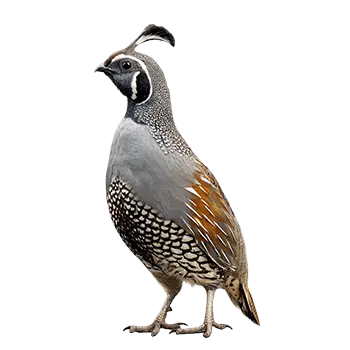

The California Quail (Callipepla californica) derives its common name from the U.S. state of California, where it is native, abundant, and serves as the official state bird - a designation it has held since 1931. The name instantly identifies both the species and its primary geographic association, making it universally recognized throughout its range and in aviculture. The species is occasionally called the California Valley Quail or Valley Quail to distinguish it from the related Mountain Quail, though "California Quail" remains the standard designation used by ornithologists, hunters, and aviculturists alike.
Alternate names occasionally encountered include Catalina Quail (historically used for island populations), Crested Quail (referencing the distinctive head plume), and various Spanish names including Codorniz de California used in Mexico and Spanish-speaking regions. However, California Quail predominates in English-language contexts worldwide.
Taxonomically, the California Quail belongs to the genus Callipepla within the family Odontophoridae (New World quails), a group of small to medium-sized ground-dwelling game birds endemic to the Americas. The family Odontophoridae contains approximately 32 species distributed from southern Canada through Central America, including familiar species like Northern Bobwhite, Gambel's Quail, and Scaled Quail. These New World quails are unrelated to Old World quails (family Phasianidae) despite superficial similarities and shared common names - the groups represent convergent evolution of similar lifestyles on different continents.
The genus Callipepla contains four species of crested quails found in western North America and northwestern Mexico, all displaying the characteristic forward-curving head plumes that distinguish them from other quail genera. These include the California Quail, Gambel's Quail (Callipepla gambelii, very similar in appearance but found in desert regions), Scaled Quail (Callipepla squamata), and Elegant Quail (Callipepla douglasii). The California Quail is the most commonly kept in aviculture and most recognizable due to its state bird status and widespread distribution.
The scientific name Callipepla californica combines Greek and geographic elements. "Callipepla" derives from Greek "kallos" (beautiful) and "peplos" (robe or cloak), referencing the beautiful, intricately patterned plumage that gives the birds their ornate appearance. "Californica" obviously indicates California as the type locality and primary range. The nomenclature thus emphasizes both the species' beauty and geographic association.
Geographic variation exists across the California Quail's range, with several subspecies recognized based on differences in plumage intensity, size, and coloration. These include Callipepla californica californica (the nominate coastal form), C. c. brunnescens (coastal southern California and Baja California, darker and browner), C. c. canfieldae (Owen's Valley, paler), C. c. catalinensis (Santa Catalina Island, larger and darker), and C. c. plumbea (arid interior regions, paler and greyer). In aviculture, subspecies distinctions are rarely maintained, with most captive birds representing the nominate coastal form or mixed ancestry.
In aviculture and among bird enthusiasts, California Quail are recognized as beautiful, interesting aviary birds suitable for experienced keepers with appropriate facilities. They have been kept in captivity for many decades with established breeding populations, though they are less commonly kept than chickens or domesticated quail species like Coturnix (Japanese Quail). Their combination of striking appearance, fascinating covey behaviors, and relatively hardy constitution makes them popular among game bird enthusiasts and mixed aviary keepers. They are particularly popular in outdoor aviaries where their ground-dwelling behaviors and social dynamics can be properly displayed.
The species holds cultural significance in California and the western United States, appearing on state symbols, artwork, literature, and representing the natural heritage of the region. Their distinctive appearance and characteristic calls make them iconic symbols of California's chaparral and oak woodland ecosystems.