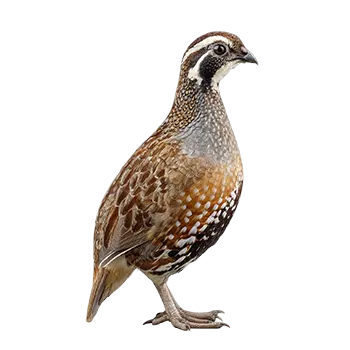

The Bobwhite Quail is scientifically classified as Colinus virginianus, belonging to the family Odontophoridae, which encompasses the New World quails—approximately 32 species of small to medium-sized ground-dwelling game birds endemic to the Americas. This family is distinct from Old World quails (family Phasianidae) found in Europe, Asia, and Africa, representing a separate evolutionary lineage despite superficial similarities and convergent adaptations to ground-dwelling lifestyles. The genus name Colinus is thought to derive from a Spanish or Mexican indigenous word for quail, while the specific epithet 'virginianus' refers to Virginia, reflecting the species' abundance in the colonial Virginia region where early European naturalists first described it scientifically.
The most widely used common name is Northern Bobwhite, emphasizing the species' primarily northern distribution within the New World quail range, as other Colinus species occur further south in Mexico and Central America. This name distinguishes it from related species and is the standard name in ornithological literature and field guides. However, in common usage particularly among hunters, game bird breeders, and aviculturists, the bird is almost universally called simply Bobwhite Quail or just Bobwhite, with the 'Northern' often dropped. The name derives from the male's distinctive, loud, clear whistled call that sounds remarkably like someone calling 'bob-WHITE,' one of the most recognizable and phonetically descriptive bird names in North America. This call has been transcribed as 'bob-white,' 'bob-bob-white,' or 'ah-bob-white' and represents one of the classic sounds of rural North American landscapes.
Alternate names are limited, though the species is occasionally called Virginian Partridge or Virginia Quail in older historical literature, reflecting both the scientific name and the bird's traditional classification with partridges before modern taxonomy clarified New World quails as a distinct family. In some Southern United States regions, they're called simply Partridge by hunters and locals, though this is technically incorrect as true partridges belong to different families. The shortened form Bob is used informally by hunters and game bird enthusiasts.
Regionally across the species' range, various informal local names exist including Virginia Quail in some Mid-Atlantic areas, Common Quail in parts of the South (though potentially confusing with the unrelated European Common Quail), and Partridge Quail in some historical texts. However, Bobwhite remains overwhelmingly dominant as the common name, recognized across the species' range and in avicultural contexts worldwide.
The Northern Bobwhite shows considerable geographic variation across its extensive range, with approximately 22 recognized subspecies distinguished by differences in size, plumage intensity, and coloration patterns. The exact number of subspecies varies depending on taxonomic authority, as some forms show clinal variation making boundaries unclear. Major subspecies include Colinus virginianus virginianus (nominate subspecies from the Eastern United States), C. v. floridanus (Florida, smaller and darker), C. v. texanus (Texas and surrounding areas, paler and grayer), C. v. mexicanus (Mexico), and numerous other forms. These subspecies show variations primarily in overall size with Florida birds being smallest and some Mexican forms largest, intensity of rufous coloration with eastern birds showing richer colors than pale western/southwestern forms, extent of white versus buff in facial markings, and overall darkness or paleness of plumage. Most captive populations represent mixed ancestry from multiple subspecies, as game bird breeders have historically mixed stocks for productivity traits rather than maintaining pure subspecies, though some specialized breeders maintain distinct regional forms.
The Northern Bobwhite is most closely related to other species in the genus Colinus including the Crested Bobwhite (C. cristatus) of Central and northern South America, showing similar ecology and behavior but with distinctive head crest, the Black-throated Bobwhite (C. nigrogularis) of southern Mexico and Central America, and the Yucatan Bobwhite (C. nigrogularis), sometimes considered a subspecies of Black-throated. These related species share similar ground-dwelling habits, social structure, and general ecology with Northern Bobwhite, though Northern Bobwhite is the most widespread, most northerly distributed, and most economically and culturally important species in the genus.
More broadly, the family Odontophoridae contains many familiar North American quail species including California Quail, Gambel's Quail, Mountain Quail, and Scaled Quail among others, all sharing similar ground-dwelling lifestyles, social covey formation, and seed-based diets. However, Northern Bobwhite is the most widespread and abundant quail in eastern North America and the species most commonly maintained in captivity for game bird production and aviculture.
The cultural and historical significance of Northern Bobwhite in North America is substantial. For centuries, these birds have been important game species supporting recreational hunting and contributing to rural economies. Their populations have been carefully managed through wildlife agencies, with hunting regulations designed to sustain populations. In the southeastern United States particularly, bobwhite quail hunting represents a cultural tradition with dedicated hunting plantations, specialized bird dogs, and elaborate hunting protocols. This hunting heritage has driven extensive captive propagation, with millions of bobwhites raised annually for release into hunting preserves and for restocking wild populations that have declined due to habitat loss.
In aviculture, bobwhites have been kept for over a century, initially primarily for game bird production but increasingly as ornamental birds and unique pets. They are among the most commonly kept quail species in captivity worldwide, valued for hardiness, prolific breeding, relative ease of care, and their charming appearance and behaviors. Domestication is limited compared to chickens—bobwhites remain essentially wild birds adapted to captivity rather than truly domesticated, though multiple generations of captive breeding have produced birds somewhat more tolerant of human presence and confinement than wild-caught birds.
Conservation concerns affect wild populations in many areas. Once abundant across their range, Northern Bobwhite populations have declined substantially since the mid-20th century, primarily due to habitat loss from modern agricultural practices, declining habitat quality, changing land use patterns, and other factors. This decline has prompted intensive management efforts, captive breeding programs for reintroduction, and habitat restoration projects. While the species remains widespread and is not globally threatened, regional declines have raised concerns among conservationists, wildlife managers, and hunting advocates, making bobwhite conservation a significant focus in game bird management across the southeastern United States particularly.