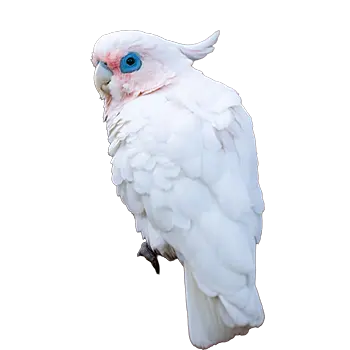
The Bare-Eyed Cockatoo possesses the characteristically intense, affectionate, demanding temperament typical of all cockatoo species, with personality traits that can be simultaneously endearing and extremely challenging. These birds are renowned for being extraordinarily cuddly, loving, and devoted companions that form profoundly deep emotional attachments to their owners. However, this intense bonding comes with extreme neediness, susceptibility to severe behavioral problems when their social needs aren't met, and demanding care requirements that make them suitable only for very experienced bird owners capable of providing near-constant attention and companionship. Prospective owners must understand that acquiring a Bare-Eyed Cockatoo means committing to decades with a bird that essentially functions as a permanently needy toddler requiring hours of daily attention.
When properly socialized, hand-raised, and bonded, Bare-Eyed Cockatoos can be extraordinarily affectionate, loving companions that actively seek and crave constant physical contact with their owners. They genuinely love being cuddled, held, petted all over their bodies, and carried around by their favorite people. Many individuals want to be touching their owners constantly, sitting on shoulders, snuggling against necks, or being cradled like babies. They respond to affection with soft vocalizations, relaxed body language, eye pinning indicating pleasure, and grinding their beaks contentedly. Some Bare-Eyed Cockatoos will literally throw tantrums including screaming and self-destructive behaviors if they don't receive adequate physical affection and attention throughout the day.
However, the bonding and affection characteristics of Bare-Eyed Cockatoos create some of the most significant challenges in parrot ownership. These birds very frequently develop extreme one-person bonds, showing intense, obsessive devotion to a single individual while being indifferent, fearful, or aggressively hostile toward everyone else including other family members. This one-person bonding can destroy household harmony when the bird attacks partners, children, or visitors perceived as threats or competition for their chosen person's attention. Jealousy is intense and common, with bonded birds often becoming aggressive guardians of their favorite person. Managing these possessive, obsessive behaviors requires extraordinary effort through extensive early socialization, ensuring the bird bonds with multiple people, and maintaining consistent interactions from various family members throughout the bird's entire life.
Social needs for Bare-Eyed Cockatoos are extreme and among the highest of any companion bird species. These birds require many hours—ideally most of their waking hours—of direct, quality interaction, companionship, physical contact, and inclusion in every aspect of family activities daily without exception. They are profoundly social flock animals that experience genuine psychological trauma when isolated, ignored, or separated from their bonded people. Common and often severe problems in under-socialized or neglected Bare-Eyed Cockatoos include persistent, ear-splitting screaming that can last for hours and becomes utterly unbearable, feather plucking and self-mutilation that can become life-threatening and essentially incurable once established, severe aggression toward owners and others often requiring rehoming, profound depression with associated health decline, and extraordinarily destructive behaviors. Prospective owners must brutally honestly assess whether they can provide the intensive, decades-long commitment these desperately needy parrots require before even considering acquisition.
Interaction style with humans is characteristically intense, playful, physically demanding, and highly engaged. Bare-Eyed Cockatoos are not birds that can entertain themselves or tolerate being left alone in cages for extended periods. They actively demand attention through vocalizations, displaying, and sometimes self-destructive behaviors when ignored. They love interactive games, wrestling gently with hands, exploring everything, and being constantly involved in their owner's activities. Training sessions are typically enthusiastic and productive, as they appreciate mental stimulation and showing off skills. However, Bare-Eyed Cockatoos can also be manipulative, learning quickly that screaming brings attention and potentially training their owners into undesirable response patterns if not handled with extreme consistency.
Noise levels in Bare-Eyed Cockatoos are extreme and represent one of the most significant challenges of ownership. These birds naturally vocalize extremely loudly at dawn and dusk, producing ear-piercing screams and contact calls that can easily exceed 120 decibels—comparable to jet engines or rock concerts at close range. Their vocalizations carry literally for miles, evolved for maintaining contact with flock members across vast Australian landscapes. This dawn and dusk calling is deeply instinctive and absolutely cannot be eliminated. Morning calling typically begins at first light, lasting 30-60 minutes or more as birds greet the day. Evening calling occurs before settling with similar intensity and duration.
Beyond natural calling, many Bare-Eyed Cockatoos develop habits of screaming persistently throughout the day when seeking attention, when their owners leave the room, when they want something, when excited, when bored, or seemingly at random. Some individuals scream essentially constantly when their social needs aren't being met. Their screaming is genuinely painful to nearby human ears, causes hearing damage with prolonged exposure, and can be heard by neighbors hundreds of yards away even through closed doors and windows. Prospective owners must understand these birds are completely and utterly inappropriate for apartments, condominiums, townhouses, or any living situation with shared walls or nearby neighbors. Even in rural properties, their volume can create serious conflicts.
Mood indicators in Bare-Eyed Cockatoos are relatively easy to read once owners learn their bird's signals. A relaxed, content bird displays sleek feathers, slow breathing, soft vocalizations or contented silence, and curious exploration. When seeking affection, they lower their heads, fluff their feathers slightly, and approach with soft chirps. Eye pinning indicates excitement or heightened emotion. Signs of stress, fear, or potential aggression include raised crest, feathers standing up on the body, wings held away from body creating a threatening appearance, lunging motions, hissing, and rapid eye pinning. These warning signs should prompt owners to give space rather than forcing interaction, though establishing boundaries with cockatoos is challenging given their neediness.
Common behavioral quirks include morning greeting routines involving enthusiastic vocalizations and displays, demanding to be included in absolutely everything their owners do including showering, eating, and watching television, throwing food when displeased or seeking attention, hanging upside-down while playing, nibbling and preening their owners' hair and skin as bonding behaviors, and following their favorite person from room to room unable to tolerate separation. Bare-Eyed Cockatoos experience pronounced hormonal periods, particularly during breeding season in spring, when even well-socialized birds may become unpredictably aggressive, possessive, territorial, and even more demanding than usual. During these periods, birds may attack previously accepted people, refuse handling, bite intensely, and become essentially unmanageable.
Talking ability in Bare-Eyed Cockatoos is moderate, with many individuals learning vocabularies of 20-50 words and phrases, though some develop more extensive vocabularies with dedicated training. Their voice quality is somewhat nasal and loud but generally understandable. They excel more at mimicking environmental sounds, whistles, and household noises than extensive speech. Some individuals become decent talkers while others focus primarily on their natural vocalizations. What they lack in talking ability they compensate for with extreme physical affection and entertaining, playful personalities. However, even their attempts at speech are delivered at high volume.
Activity patterns follow diurnal cycles with pronounced peaks at dawn and dusk when vocalizations and activity reach maximum intensity. Early morning hours see explosive energy and vocalization. Evening hours bring another surge before settling. Mid-day periods may be somewhat calmer with preening and quieter play, though many individuals remain demanding throughout the day. Maintaining consistent sleep schedules of 10-12 hours of darkness nightly is essential for preventing hormonal imbalances that exacerbate already extreme behavioral challenges. These parrots are highly sensitive to photoperiod, and irregular lighting can trigger breeding behaviors, increased aggression, and worsened neediness. The combination of extreme affection needs, high intelligence, susceptibility to severe behavioral problems, and deafening vocalizations makes the Bare-Eyed Cockatoo one of the most challenging yet rewarding companion parrots, suitable only for the most experienced, dedicated, and prepared bird owners.